
“Microorganism”: uncertainty in wording as a legislative strategy?
By Denis MESHAKA et Eric MEUNIER
Published on the 10/10/2025, modify the 09/03/2026


When reading legislation, one sometimes finds oneself thinking that it is a good thing that legislators are not responsible for editing the dictionaries in our libraries. The specific case of the term “microorganism” provides a striking example. Behind this term lie biological entities whose contours vary according to the regulatory texts. Bacteria, yeasts, algae, nematodes, even DNA or seeds: these are just some of the examples given by various regulatory texts, which show that the legislative definition of “microorganisms” has constantly varied according to economic interests. What do these texts have in common? They all can blur the traceability requirements imposed by GMO legislation.

While many communications claimed – and still claim – that the proposal to deregulate “new GMOs” only concerns plants, in March 2025 Inf’OGM showed that it also targets certain micro-organisms (unicellular algae)i. The reason is semantic. Regarding the scope of its deregulation proposal, the European Commission refers to two taxonomic groups that are widely considered to cover plants, but which in fact also cover single-cell algae, marine or aquatic plants, which are also considered microorganisms. Reading a law, a proposed law or even an international treaty therefore requires a prerequisite that is often overlooked, namely understanding the meaning of the words used and the definitions applied. Problems arise when several legislative texts provide varying legal definitions. An example of this is the different legislative definitions of the term ‘micro-organism‘.
“Organism“, a basic term
Focusing on the term “organism” is not a challenge here, as it determines the definition of the term “microorganism“. According to European Directive 90/220, adopted in 1990, which regulated the use of GMOs, an organism is “any biological entity capable of replication or of transferring genetic material“ii. European Directive 2001/18, which replaces 90/220, uses the same definitioniii.
The Cartagena Protocol, an international protocol adopted under the 1992 Rio Convention to prevent biotechnological risks, considers organisms in more detail. It defines living organisms as “any biological entity capable of transferring or replicating genetic material, including sterile organisms, viruses and viroids“iv. It should be noted here that the list of examples given is not exhaustive, as the term “including” is not restrictive.
Legally, therefore, “organisms” in Europe and internationally are biological entities capable of replicating/reproducing or transferring genetic material. This is an approach focused on the entity itself, which does not take into account the environment in which it can exist and evolve.
“Microorganism“, a term used to pave the way for patents
“Micro-organisms” should therefore, logically, be defined on the basis of these definitions of organisms. This is the case with European Directive 90/219, which regulated the use of genetically modified micro-organisms (GMMs). This text defined them as “any microbiological entity, cellular or non-cellular, capable of replication or of transferring genetic material“v .
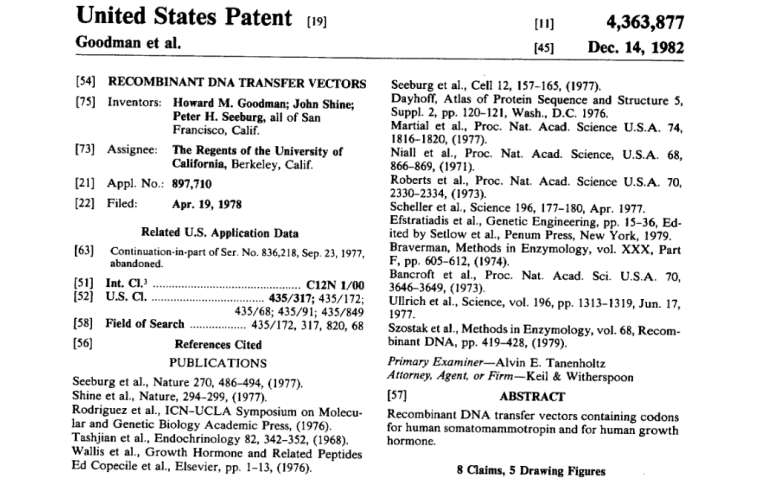
Legislation governing GMOs and GMMs is not the only legislation to address microorganisms. In the field of patents, it was in 1995 that the Board of Appeal of the European Patent Office (EPO) provided, in its decision T 356/93vi, a clarification that it considered necessary internally. It ruled that the interpretation of the term micro-organism “takes clearly into account the developments of modern industrial microbiology” and concluded from this interpretation that “processes carried out on vegetable cells may be defined as ‘microbiological processes’, and their products, namely genetically modified vegetable cells and their products […] may be defined as “the products thereof““. For the EPO, isolated plant cells are therefore micro-organisms. The Board thus clarified that processes using them, like the products obtained, were and still are patentable! Since this clarification, the EPO has noted in its Guidelines indicating the practices and procedures to be followed during the examination of (applications for) patents that “the term ‘micro-organism’ includes bacteria and other generally unicellular organisms with dimensions beneath the limits of vision which can be propagated and manipulated in a laboratory (see T 356/93), including plasmids and viruses and unicellular fungi (including yeasts), algae, protozoa and, moreover, human, animal and plant cells“vii. If the list of examples given here is broader than existing European legislation, then the aim is clearly to extend patentability to a larger number of micro-organisms, even if the entities cited are not micro-organisms in the common sense of the term.
Twenty years earlier, an international treaty with a very broad vision
The Budapest Treaty was adopted in 1977. As an international treaty signed by 91 countries around the worldviii, it regulates the deposit of microorganisms as samples within international depositary authorities (IDAs) in order to fulfil the requirement of sufficient description of an invention using these microorganisms. As a microorganism cannot be fully disclosed in writing in a patent text, such a sample deposit constitutes a description required for the granting of a patent.
While reading it, the Treaty provides a surprisingly broad viewix of what micro-organisms can be, while specifying on its website that it does not have a definition of this termx. Nevertheless, it provides an annex listing examples of “micro-organisms” that can be deposited with the IDAs, the content of which is surprising to say the leastxi. While the list includes microorganisms as they are generally understood (bacteria, viruses, protozoa, etc.), there are other examples that are unexpected to say the least: DNA, RNA, embryos, nematods (worms), plasmids and even seeds are included in the table entitled “List of kinds of microorganisms accepted by IDAs.”
Variable approaches depending on regulatory issues
The inclusion of isolated plant cells in the definition of “micro-organisms” in the EPO texts in 1995 paved the way for the inclusion of animal cells in other texts. Thus, in 2009, a European directive (2009/41) aimed at regulating the contained use of micro-organisms defined micro-organisms as “any microbiological entity, cellular or non-cellular, capable of replication or of transferring genetic material, including viruses, viroids, and animal and plant cells in culture“xii.
Broadening the definition of a “microorganism“
From 2009 onwards, other pieces of legislation will in turn broaden the examples of “microorganisms” given. This was the case in 2012 with the adoption in Europe of Regulation 528/2012 on the use of biocidal products. This time, a micro-organism is defined as “any microbiological entity, cellular or non-cellular, capable of replication or of transferring genetic material, including lower fungi, viruses, bacteria, yeasts, moulds, algae, protozoa and microscopic parasitic helminths“xiii. The presence of algae in this list is particularly noteworthy, since some algae are among the taxonomic groups of living organisms that the European Commission proposes to deregulate when genetically modified, as we saw in March 2025xiv.
When European legislators talk about micro-organisms, as in the case of the European Parliament asking the Commission for a proposal to deregulate them when they are GMOs, what are they talking about? According to non-binding texts, such as the European Commission’s glossary, these may be organisms invisible to the naked eyexv. However, as we have just seen, European legislation and international treaties take a very broad view of what constitutes a micro-organism, which obviously serves the interests of businesses. For example, companies have patent rights applying to a number of isolated molecules or cells and, with the proposed deregulation of GMOs, could have a large number of non-plant organisms deregulated because they are considered “micro-organisms“.
These companies are not afraid of paradoxes, because within the Cartagena Protocol, some want “to exclude from the scope (of the Cartagena Protocol) certain products derived from modern biotechnologies, such as RNAi pesticides, vaccines, viruses… because they are not themselves living organisms, even though they are disseminated with the aim of modifying the genome or epi-genome of living organisms,” as reported by Guy Kastler in an analysis published by Inf’OGMxvi. Here, their position makes strategic sense, since the Cartagena Protocol regulates the transboundary movement of GMOs. In such a text, arguing that these molecules or organisms – although considered microorganisms under European patent law or certain European Union legislation – do not constitute organisms would allow them to be excluded from the obligations imposed by the Protocol. Molecules and organisms that would remain patentable under EPO directives!
i Eric Meunier, “The European Commission’s proposal to deregulate GMOs does cover GMO microorganisms” Inf’OGM, 11 March 2025.
ii “Council Directive 90/220/EEC of 23 April 1990 on the deliberate release into the environment of genetically modified organisms,“ Official Journal No. L 117, pp. 0015–0027, 8 May 1990.
iii “Directive 2001/18/EC of the European Parliament and of the Council of 12 March 2001 on the deliberate release into the environment of genetically modified organisms and repealing Council Directive 90/220/EEC – Commission statement”, Article 2, Official Journal No. L 106, pp. 0001–0039, 17 April 2001.
iv Secretariat of the Convention on Biological Diversity, “Cartagena Protocol on Biosafety to the Convention on Biological Diversity: text and annexes”, Article 3, 2000.
v « Council Directive 90/219/EEC of 23 April 1990 on the contained use of genetically modified micro-organisms », article 2, Official Journal n° L 117, p. 0001 – 0014, 8 may 1990.
vi EPO, “Decision of the Technical Board of Appeal 3.3.4, dated 21 February 1995 – T 356/93 – 3.3.4”, EPO OJ, pp. 545-585, 31 August 1995.
vii EPO Guidelines, Part G, Chapter II, 5.5.1.
viii WIPO, “Budapest Treaty”.
ix WIPO, “Summary of the Budapest Treaty on the International Recognition of the Deposit of Microorganisms for the Purposes of Patent Procedure”, 1977.
x WIPO, “Budapest System FAQs”.
xi WIPO, “Lists of Types of Microorganisms Accepted for Deposit by ADIs”.
xii “DIRECTIVE 2009/41/EC OF THE EUROPEAN PARLIAMENT AND OF THE COUNCIL of 6 May 2009 on the contained use of genetically modified micro-organisms”, Official Journal of the European Union, L 125/75, 21 May 2009.
xiii “Regulation (EU) No 528/2012 of the European Parliament and of the Council of 22 May 2012 concerning the making available on the market and use of biocidal products Text with EEA relevance”, Article 3, OJ L 167, pp. 1–123, 22 May 2012.
xiv Eric Meunier, “The European Commission’s proposal to deregulate GMOs does cover GMO microorganisms” Inf’OGM, 11 March 2025.
xv Scientific Committees, “Micro-organism”.
xvi Guy Kastler, “Interconnections between new biotechnologies and DSI or GSD”, Inf’OGM, 11 July 2024.