
News
What “discussion” procedures are imposed on European legislators?
By Eric MEUNIER
Published on the 11/02/2026, modify the 14/03/2026


Since July 2023, EU institutions have been engaged in discussions on the proposal to deregulate many GMOs. These discussions follow an established procedure of negotiations between the Council of the European Union, the European Parliament and the European Commission. Complex but logical, this procedure can sometimes confuse those who follow it. Inf’OGM helps you see things more clearly.

There are numerous legislative projects that have been initiated by the European Commission over the past two years, as well as those that have already been announced. In areas related to biotechnology, these projects tackle existing legislation aimed at protecting the environment, health and citizens’ rights, as Inf’OGM recently pointed out in an opinion piecei. It is essential to understand how European legislators discuss, exchange views and put forward their own points of view, or at least those of their voters.
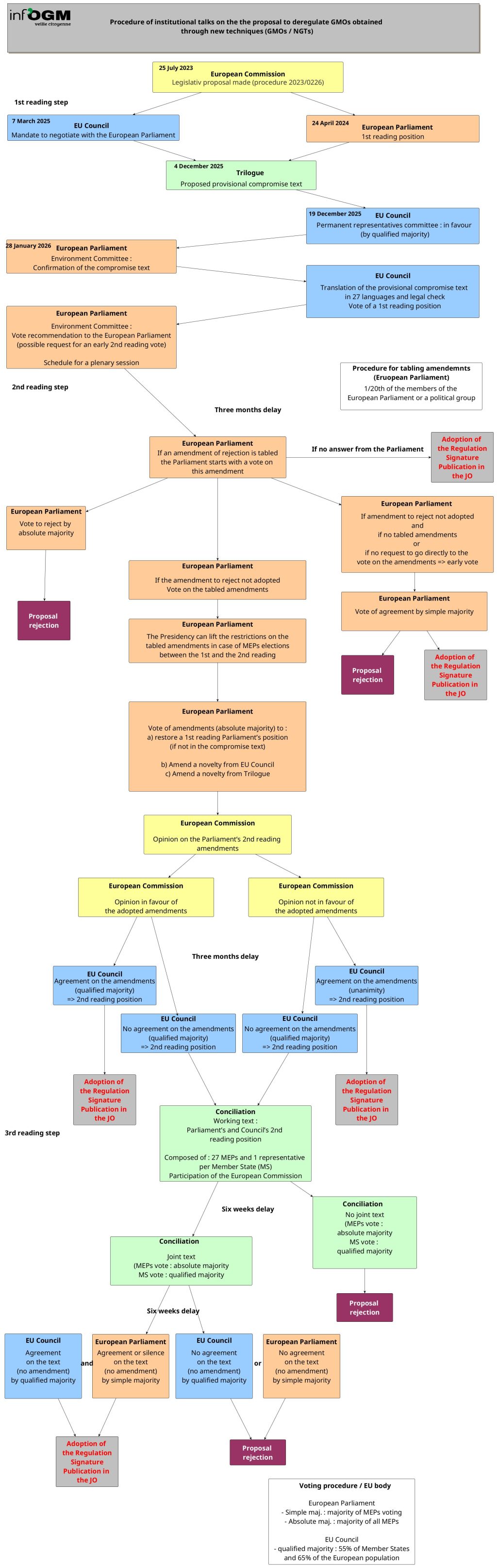
Focusing on the work currently underway on the possible deregulation of many GMOs (with key dates already set for the stages that have been completed), Inf’OGM has outlined below the step-by-step procedure for the adoption or rejection of European legislation.
The work of the European Commission (in yellow), the Council of the European Union (in blue), the European Parliament (in salmon pink) and the trilogue or conciliation meetings (in green) are shown in chronological order.
i « GMOs, seeds, pesticides, transparency… European law under attack! », Inf’OGM, 22 January 2026.
We need your help!
For over 25 years, Inf’OGM has been producing information, made freely available to everyone, on the artificialisation and appropriation of life (GMOs, NTGs, biotech, patents, etc.).
The monopolisation of a large share of public press subsidies by a few media groups reinforces the concentration of media ownership in the hands of a handful of businessmen. This concentration undermines the quality of information and democratic debate, which require a plurality of viewpoints.
In this context, alternative media outlets such as Inf’OGM, which receive no advertising revenue and provide information free of charge, need you – our readers – to continue to exist! Because, even when freely accessible, information comes at a cost.
Supporting Inf’OGM means working towards reliable, independent information on GMOs, biotechnology and seeds that is accessible to everyone.