
News
Deregulation of GMOs: 93 organisations call to “protect farmers’, breeders’ and citizens’rights”
By Antoine VEPIERRE
Published on the 02/06/2026


Following the European Council’s approval on 21 April of the text aimed at deregulating GMOs produced using new genetic modification techniques (GMOs/NGTs), it is now up to the European Parliament to vote on this text. Ahead of this vote, scheduled for mid-June, 93 European organisations have sent a joint letter to the members of the Parliament’s Environment Committee asking them to “protect farmers’, breeders’ and citizens’ rights”.
On 29 April, 93 civil society organisations, farmers, livestock breeders and businesses from 18 European countries sent a letteri to MEPs sitting on the European Parliament’s Environment Committee. The aim of this letter is to raise awareness ahead of the committee’s vote on the proposal concerning new genomic techniques (NGTs), initially scheduled for 5 May (see box), but ultimately postponed until 17 June. Indeed, following the EU Council’s approval on 21 April of the compromise text resulting from the ‘trilogue’ negotiations, it is now up to the Parliament to give its opinion on this new versionii. The signatories of the letter condemn the proposed deregulation, focusing on two key points: patents, and the traceability and labelling of these GMOs, calling on MEPs to be particularly vigilant on these issues.
“Safeguard traceability and labelling”
As consumer organisations had already highlighted in October 2025iii, the authors of the letter point out that “freedom of choice is a fundamental principle enshrined in the Charter of Fundamental Rights of the European Union”. In this regard, farmers, breeders and food producers must be able to produce and/or use seeds and feed guaranteed to be GMO-free, whilst citizens must be able to know what they are eating.
The organisations are therefore once again calling for the introduction of “full supply chain traceability measures and on-package labelling for all NGT products”, “followed by effective coexistence measures and the supply of detection methods”, as set out in the European Parliament’s initial proposal in February 2024iv. To lend weight to their demands, the authors also point out that such measures have already been requested on several occasions by agri-food companies, in September 2024v and May 2026vi.
“Ensure protection from patents”
As Inf’OGM reported on numerous occasionsvii, patents represent a major sticking point in the current version of the compromise text. The signatories note, as other stakeholders have done previouslyviii, that the patent system would “place a heavy burden on farmers and breeders by exposing them to infringement cases”. This would have the effect of hampering “the development of new varieties by hindering access to genetic resources, thus accelerating further biodiversity loss”. And, ultimately, they highlight the inconsistencies between this text and the EU’s stated ambitions, as patents would result in increasing “our dependency from the major US and Chinese patent holder companies at a time where the European food and agriculture sector is aiming for more autonomy”. This analysis was reinforced in late March 2026 by a note from the French Embassy in the United States addressed to the French government, but ignored by the latterix.
On the subject of patents, the organisations are calling on MEPs to reinstate the restrictive provisions they had voted for at first reading in February 2024, “so that patent protection would not extend to genetic material that could also be obtained by conventional breeding”. According to them, this is the only effective way to ensure “the protection of European farmers and breeders”, with a recent study published by the European Commission itself showing that “patents have an important negative impact on small and medium-sized plant breeders”x.
Will their message be heard by MEPs? We will find out on 17 June at the earliest.
Is the European Commission failing to stand by its policy choices?
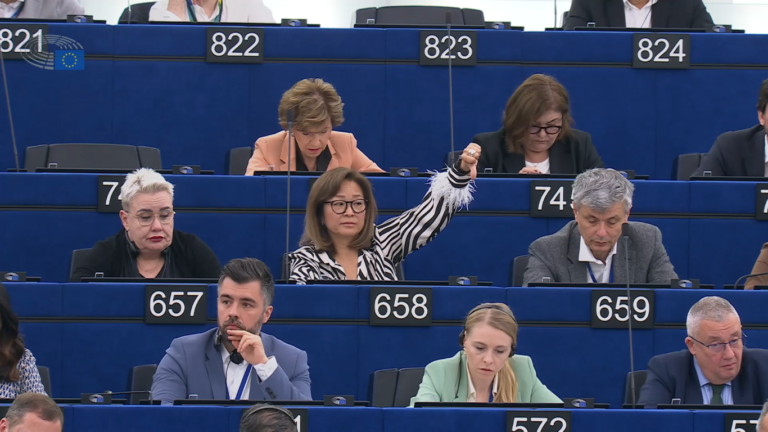
The formal vote by the European Parliament’s ENVI Committee did not ultimately take place during the meeting on 4 and 5 May. Members of this committee were nevertheless able to hold an “exchange of views” with Oliver Várhelyi, European Commissioner for Animal Health and Welfarexi. During this exchange, the Commissioner stated that “additional traceability rules” had been added to the text on the deregulation of GMOs/NGTs negotiated in the trilogue, before contradicting himself by stating: “we have not changed any of the regulation to the traceability of GMOs and GMMs in food and feed”. Christophe Clergeau, one of the three authors of the 37 amendments tabledxii, was quick to point out these falsehoods, as no traceability is envisaged for GMOs obtained through Category 1 NGTs. He also questioned the fact that the European Commission is not taking responsibility for its policy choices, leading to “less transparency, less oversight, and fewer citizens’ rights to information”xiii.
The European Parliament challenged by supporters of GMO/NGT deregulation
On 4 May, some thirty trade organisations describing themselves as “agri-food value chain partners” (including Copa-Cogeca, Euroseeds, EuropaBio and CropLife) also sent a letter to MEPs urging them “to support the adoption of the trilogue compromise text“xiv. Unsurprisingly, they reiterate the talking points they have used throughout their pro-deregulation lobbying in recent years: “to strengthen the competitiveness and resilience of the European agricultural and food supply systems” with a view to “of sustainability and climate change” and alignment “with the legislative developments and ongoing practice of the ever-increasing number of third countries […] to assure the continued flow of agri-food products from and to the European Union”.
The signatories believe that, in their view and as supported by the European Commission and the Council of the EU, “Category 1 NGT plants feature modifications that are indistinguishable from those bred with conventional method” and would therefore be subject to the same regulatory provisions as the latter regarding marketing authorisations. They also welcome the supposed traceability provided by seed labelling.
On the issue of patents, the organisations use convoluted wording regarding an agreement “on provisions that balance the need for appropriate protection of intellectual property rights while safeguarding broadest possible access to such innovations for all, at fair, reasonable and non-discriminatory conditions”.
Finally, satisfied with the agreement reached in the trilogue, the “European agri-food chain organisations […] reject any amendments to this carefully-balanced compromise as this would halt the practical implementation and prevent Europe from finally catching-up and aligning with the rest of the world in his important area”.
This final justification is consistent with the way in which the European Commission is urgently undertaking a number of legislative projects, without allowing time for analysis and reflection, let alone consultation.
i Joint letter, « New Genomic Techniques – Upcoming ENVI Vote – Protect farmers’, breeders’ and citizens’ rights », 29 April 2026.
ii Eric Meunier, « EU Council approves deregulation of GMOs/NTGs », Inf’OGM, 21 April 2026.
iii Antoine Vépierre, « Consumer associations call for continued labelling and traceability of GMOs », Inf’OGM, 14 November 2025.
iv Eric Meunier, « Les États membres bloquent la déréglementation des OGM », Inf’OGM, 8 February 2024.
v Verband Lebensmittel ohne Gentechnik e.V. (VLOG), « Regulation of New Genetic Engineering: Food Industry for Freedom of Choice », 3 septembre 2024.
vi Joint letter, « New Genomic Techniques – Upcoming ENVI Vote – Defend the European retail and food
industry sector », 4 May 2026.
vii Corporate Europe Observatory et GMWatch, « Biotech lobby groups are set to trap farmers and breeders in patent minefield », 12 April 2026.
Denis Meshaka, « GMO/NGT Regulation: civil society organisations concerned about the outcome of the trilogue », Inf’OGM, 5 November 2025.
Eric Meunier, « Patents and GMOs: different stakeholders, different solutions », Inf’OGM, 26 February 2025.
Denis Meshaka, « GMO patents: is it possible to break the deadlock? », Inf’OGM, 10 February 2025.
viii Joint statment, « JOINT STATEMENT ON THE DEREGULATION OF NEW GMOS – Protect the business of small and medium size breeders, farmers, and the organic and non GMO sectors in the EU », 11 February 2025.
ix Eric Meunier, « GMO/NGT: A memo from the French Embassy in the United States ignored by the government », Inf’OGM, 1st June 2026.
x European Commission, « Protection of biotechnological inventions ».
xi European Commission, ENVI Committee, « Ordinary meeting 20260504-1500-COMMITTEE-ENVI », 4 May 2026.
xii European Commission, ENVI Committee, « 2023/0226(COD) – AMENDMENTS 1 – 37 – Draft recommendation for second reading », 22 May 2026.
xiii Christophe Clergeau, « Pourquoi le Commissaire Oliver Várhelyi n’assume-t-il pas ses choix politiques ? », May 2026.
xiv Joint letter, « Re: EU Regulation for Plants derived from New Genomic Techniques », 4 May 2026.
We need your help!
For over 25 years, Inf’OGM has been producing information, made freely available to everyone, on the artificialisation and appropriation of life (GMOs, NTGs, biotech, patents, etc.).
The monopolisation of a large share of public press subsidies by a few media groups reinforces the concentration of media ownership in the hands of a handful of businessmen. This concentration undermines the quality of information and democratic debate, which require a plurality of viewpoints.
In this context, alternative media outlets such as Inf’OGM, which receive no advertising revenue and provide information free of charge, need you – our readers – to continue to exist! Because, even when freely accessible, information comes at a cost.
Supporting Inf’OGM means working towards reliable, independent information on GMOs, biotechnology and seeds that is accessible to everyone.