
SLAPP: a transposition lacking ambition and parliamentary debate
By Sherpa, la Maison des Lanceurs d’Alerte, Greenpeace France, Anticor, Transparency International France, le Syndicat National des Journalistes (SNJ), le SNJ-CGT, la CFDT-Journalistes, Reporters Sans Frontières, le Fonds pour une Presse Libre, Un Bout des Médias.
Published on the 01/06/2026, modify the 15/06/2026


ollowing the transposition into French law, at the end of April 2026, of the 2024 European Directive aimed at combating SLAPP (“strategic litigation against public participation”), Inf’OGM publishes here the press release dated 6 May 2026 issued by eleven organisations campaigning on this issue. Deploring “the lack of ambition in this text, drafted without consultation with civil society or parliamentary debate”, these eleven organisations had already published the opinion piece “SLAPP: just 35 days left to act” in the newspaper Le Monde on 31 March 2026, an opinion piece to which Inf’OGM and the Syndicat de la Presse pas pareille were signatories.
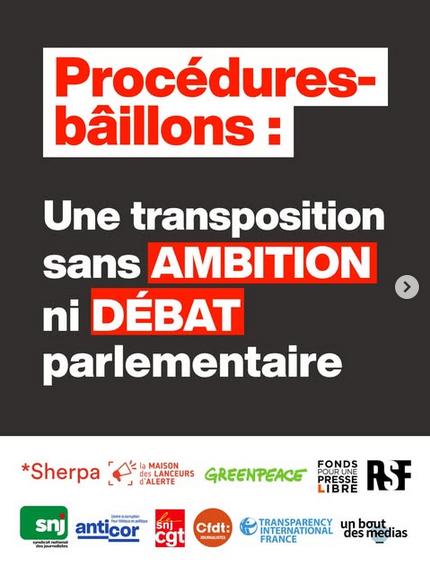
The French government had until 7 May to transpose a 2024 European directive aimed at combating gagging lawsuits. This has now been done with the decree of 30 April 2026, published on 5 May. The signatory organisations deplore the lack of ambition in this text, drafted without consultation with civil society or parliamentary debate, despite the major stakes involved in protecting freedom of expression.
SLAPP are legal proceedings brought by companies, institutions or public figures against critical voices (generally the media, journalists, whistleblowers, NGOs, etc.) with the aim not of securing a legal victory but of achieving censorship. This constitutes a misuse of the judicial system that undermines public debate and thus poses a serious threat to democracy.
To combat this phenomenon, on 11 April 2024 the European Union adopted a directive providing for several procedural tools. Like the other Member States, France was required to transpose it by 7 May 2026.
Civil society had repeatedly urged the government and parliamentarians to approach the forthcoming transposition with ambition. The most recent example: last March, Le Monde published an open letter to this effect, signed by 138 organisations, media outlets and journalists’ associations.
A missed opportunity
Decree No. 2026-337 of 30 April 2026, published on 5 May, implements this transposition, but falls short of the challenges at stake.
The directive establishes minimum protections, whilst allowing Member States to go further to protect freedom of expression. Rather than seizing this opportunity, France has opted for a minimalist transposition. Thus, the decree published on 5 May concerns only civil proceedings. Criminal defamation proceedings are not covered by the new protections, even though this is a classic means of silencing dissent. In other words, a very large proportion of gagging lawsuits remain beyond the scope of the new tools provided for in the text. Nor does this decree contain any strengthening of penalties, which is the only measure likely to deter those who bring such lawsuits.
Yet other options were available. Our organisations went so far as to set out in concrete terms how this transposition could have been carried out to provide better protection against SLAPP.
A lack of democratic debate
Finally, this reform should have been implemented through a bill. A decree drafted behind closed doors by the Ministry of Justice does not address the issues raised by SLAPP. Freedom of expression, access to the courts and equality of arms before the law are all aspects that would have warranted a parliamentary debate. In this regard, our proposals remain available to parliamentarians who wish to make up for this missed opportunity to combat SLAPP effectively.
At stake is the preservation of public debate, and thus the very foundations of our democracy.
We need your help!
For over 25 years, Inf’OGM has been producing information, made freely available to everyone, on the artificialisation and appropriation of life (GMOs, NTGs, biotech, patents, etc.).
The monopolisation of a large share of public press subsidies by a few media groups reinforces the concentration of media ownership in the hands of a handful of businessmen. This concentration undermines the quality of information and democratic debate, which require a plurality of viewpoints.
In this context, alternative media outlets such as Inf’OGM, which receive no advertising revenue and provide information free of charge, need you – our readers – to continue to exist! Because, even when freely accessible, information comes at a cost.
Supporting Inf’OGM means working towards reliable, independent information on GMOs, biotechnology and seeds that is accessible to everyone.