
News
71 MPs urge the French government to reject the deregulation of GMOs derived from new genomic techniques
By Antoine VEPIERRE
Published on the 18/03/2026


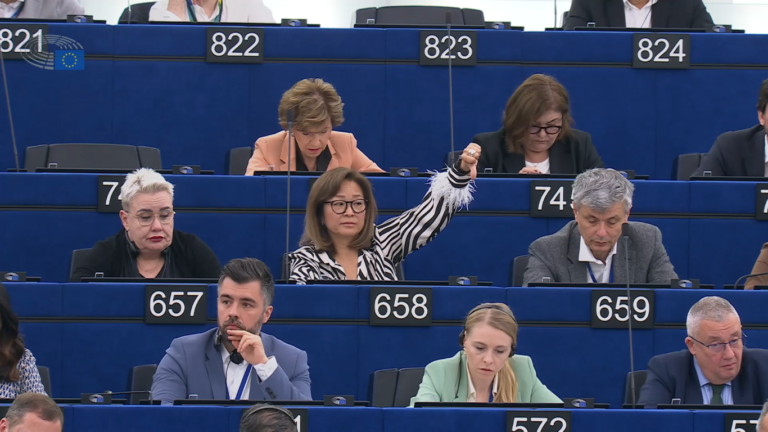
Following the approval by European Union member states, including France, of the draft text on the deregulation of GMOs derived from new genomic techniques (GMOs/NGTs), French MPs tabled a motion for a resolution on 21 January 2026. This motion for a resolution calls on the government to oppose the European text.
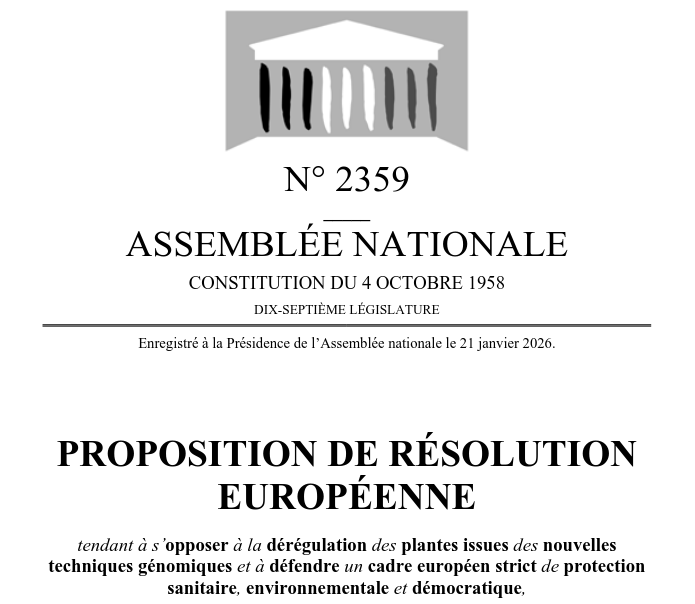
On 19 December 2025, contrary to its initial position, the French government representative came out in favour of the deregulation of GMOs/NGTs. This French U-turn, mirroring those of Poland and Greece, enabled a qualified majority of Member States to be reached on this text1. It was following this new stance, motivated by non-binding commitments from the European Commission, that 71 MPs (12% of the Assembly) from La France insoumise decided to table a European motion for a resolution “aimed at opposing the deregulation of plants derived from new genomic techniques and defending a strict European framework for health, environmental and democratic protection”2.
A resolution based on legal grounds
In this resolution, the MPs outline chronologically the various stages leading up to this compromise text. Starting with the origins of the European Commission’s proposal for deregulation, they recall that the public consultation conducted in 2022 had clearly demonstrated European citizens’ commitment “to upholding the precautionary principle, maintaining mandatory labelling, ensuring full traceability, and the need for an in-depth democratic debate prior to any amendment of the existing regulatory framework”. Ignoring these results, however, the Commission had pursued its objective of proposing the deregulation of GMOs/NGTs plants, culminating in a compromise text between representatives of the European Parliament, the Council of the EU and the European Commission on 4 December last year3. MPs then denounced its “contradiction with the European legal framework as interpreted by the Court of Justice of the European Union” (2018)4, which had been confirmed by the French Council of State in 20205.
The initiators of this resolution then warn of the risks that the deregulation of GMOs/NGTs would entail, pointing in particular to a “serious infringement of citizens’ right to information, guaranteed by Directive 2001/18/EC, by consumer law, and by the case law of the CJEU”, failure to respect the precautionary principle and a “practical inability to ensure the compliance of their production” for the organic sector, Protected Designation of Origin (PDO), Protected Geographical Indication (PGI), as well as smallholder farming and GMO-free sectors. Like many stakeholders, whether opposed to this text or not, they also raise the issue of patents, which would reinforce “the concentration of intellectual property in the hands of a few multinational seed companies, through the extension of patentability to living organisms”.
Finally, the MPs who signed this resolution condemn the techno-solutionism and scientific reductionism embodied by GMOs/NGTs, arguing that they are promoted on the basis of false promises (resistance to climate hazards and pathogens). In their view, these genetically modified plants would merely “encourage the continuation of intensive agricultural models that are heavy users of inputs, homogenising landscapes and exacerbating the erosion of cultivated biodiversity”.
Resolutions already rejected in early 2024
This initiative by French parliamentarians echoes two resolutions tabled in early 20246, whilst the European Parliament was deliberating on the position to adopt regarding the proposal to deregulate GMOs.
On 8 January 2024, Lisa Belucco, Sébastien Peytavie, Nicolas Thierry and Marie Pochon, all four MPs from the Ecologist – Nupes group, tabled a draft resolution opposing the deregulation of GMOs/NGTs7. On 24 January, 51 MPs from seven different parliamentary groups did the same8. However, these two texts were merged by their authors on 20 February, enabling the tabling of a single “Proposal for a European resolution to prevent the deregulation of new genetically modified organisms”, this time backed by 82 MPs9. However, on 27 February, the National Assembly’s Committee on European Affairs decided to reject the proposal, followed by the Committee on Sustainable Development and Spatial Planning on 29 March 2024.
In April 2026, the French government will have to formally vote on a text proposing the deregulation of GMOs/NGTs resulting from the trilogue negotiations at the end of 2025 (between representatives of the Parliament, the Commission and the Council of the European Union). Although it has arrived late in the process, this motion for a resolution against the deregulation of GMOs/NGTs could nevertheless, if dealt with in time, lead to a strong stance from the National Assembly towards the government ahead of the vote next April. The government might then find it more difficult to secure France’s support for the proposed text.
What procedure does a motion for a resolution follow?
A European motion for a resolution forms part of the “political dialogue” procedure between the European Commission and national parliaments. As such, the Commission is required to forward all its draft texts to the parliaments of the Member States. National assemblies may then adopt European resolutions addressed to their government and the Commission. However, in France, European resolutions must first be examined by the National Assembly’s Committee on European Affairs, comprising 48 MPs, which may adopt, reject or amend them. A committee responsible for the substance of the resolution will then give its opinion (in the case of GMOs/NGTs, the Committee on Sustainable Development and Spatial Planning). If the resolution is adopted in committee, it is then put to a vote in the Assembly’s plenary session. If it is also adopted there, it is then forwarded to the Government and the European Commission, which is required to respond within three months. Although they have no legal implications, these resolutions nevertheless carry political weight, as they represent the majority of MPs. The Government also regularly reports on how it has taken these resolutions into account in European negotiations.
- Eric Meunier, “The French government in favour of deregulating numerous GMOs”, Inf’OGM, 28 January 2026. ↩︎
- Assemblée nationale, “Proposition de résolution, n° 2359, tendant à s’opposer à la dérégulation des plantes issues des nouvelles techniques génomiques et à défendre un cadre européen strict de protection sanitaire, environnementale et démocratique”, 21 January 2026. ↩︎
- Eric Meunier, “Qualified majority in the Council of the European Union to deregulate numerous GMOs”, Inf’OGM, 24 December 2025. ↩︎
- CJEU, PRESS RELEASE No. 111/18, “Organisms obtained by mutagenesis are GMOs and are, in principle, subject to the obligations laid down by the GMO Directive”, 25 July 2018. ↩︎
- Zoé Jacquinot, “OGM : le Conseil d’État suit les organisations contre le gouvernement”, Inf’OGM, 10 February 2020. ↩︎
- Eric Meunier, “Des députés français contre la déréglementation des OGM/NTG”, Inf’OGM, 13 February 2024. ↩︎
- Assemblée nationale, “Proposition de résolution, n° 2049, visant à préserver l’interdiction des plantes issues des nouvelles techniques génomiques, et garantir une souveraineté des paysans sur leurs propres semence”, 8 January 2023. ↩︎
- Assemblée nationale, “Proposition de résolution, n° 2105, relative à la proposition de règlement présentée par la Commission européenne sur les nouvelles techniques génomiques“, 24 January 2024. ↩︎
- Assemblée nationale, “Proposition de résolution, n° 2232, pour éviter la dérégulation
des nouveaux organismes génétiquement modifiés”, 20 February 2024. ↩︎
We need your help!
For over 25 years, Inf’OGM has been producing information, made freely available to everyone, on the artificialisation and appropriation of life (GMOs, NTGs, biotech, patents, etc.).
The monopolisation of a large share of public press subsidies by a few media groups reinforces the concentration of media ownership in the hands of a handful of businessmen. This concentration undermines the quality of information and democratic debate, which require a plurality of viewpoints.
In this context, alternative media outlets such as Inf’OGM, which receive no advertising revenue and provide information free of charge, need you – our readers – to continue to exist! Because, even when freely accessible, information comes at a cost.
Supporting Inf’OGM means working towards reliable, independent information on GMOs, biotechnology and seeds that is accessible to everyone.