
Actualités
GMO food safety – Seralini and Zhu: Double standards!
Par Eric MEUNIER
Publié le 27/01/2014, modifié le 09/03/2026


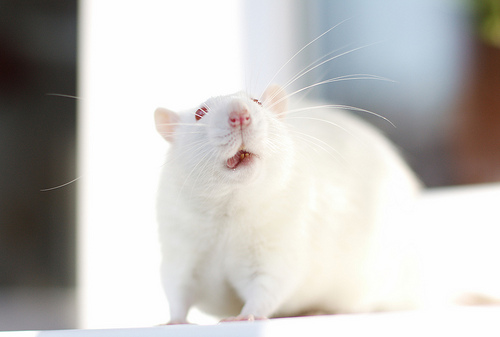
In January 2013, the journal Food and Chemical Toxicology published an article by Zhu et al. [1] stating that « transgenic corn modified to resist glyphosate herbicides is as healthy and nutritional as conventional corn « . To support this conclusion, the Chinese team conducted a toxicological analysis in rats for thirteen weeks. The researchers conducted various analyses of weight and of biochemical and electron microscopy parameters to « detect potential impacts of this GM maize on rats ».
The previous issue of the same journal published a study conducted by the team of Professor Gilles-Eric Séralini, which concluded that GM maize NK603 posed toxicological risks. G-E Séralini had used the same strain of rat, the Sprague-Dawley, but fed them for two years, over their lifetime. This study was subjected to sharp criticism, and a year later, in December 2013, the journal Food and Chemical Toxicology decided to retract the publication. The argument put forward was that the data presented did not enable well-founded conclusions to be reached. [2]
The International Transdisciplinary Studies Group (GIET), chaired by Dr Frédéric Jacquemart (also President of Inf’OGM), in a letter of 13 December 2013 to the journal Food and Chemical Toxicology, reported « serious doubts » about the study of Zhu. GIET told the editor of the journal, Dr Hayes, that the findings of this study were not justified by the analyses conducted. Indeed, GIET highlighted the lack of information on the statistical power of the study in the scientific article itself. Clearly, it is impossible to know whether the study was designed in a manner that would enable any effects to been seen or not! The assertion of the safety of the GM corn is thus scientifically unfounded. GIET also emphasized that the conclusion of the article establishes an equivalence between GM corn and conventional corn, although no analysis of equivalence, which is indispensable to justify such a conclusion, was performed.
Thus, for GIET and even according to[?] the protocol established by scientists, if the study of G-E Séralini must be retracted because the data does not support the conclusion presented, then exactly the same applies to the study of Zhu and colleagues.
On january 2014, the 22nd, Frédéric Jacquemart received Food and Chemical toxicology’s reply to his request. The journal writes him that no action will be taken regarding Zhu’s article. It is therfore to be understood that the journal considers that the conclusions reached by Zhu and his team in their article can be claimed from the data they present. Those conclusions were that a transgenic maize is as healthy and nutritious as a conventional maize and that both are equivalent. Such a conclusion from the journal comes even though it is impossible, when reading the article, to know whether the study was designed in a manner that would enable any effects to been seen or not. And with no equivalence test being carried ! With such a reply from the journal, one might possibly consider that a double standard do exist…
[1] « A 90-day feeding study of glyphosate-tolerant maize with the G2-aroA gene in Sprague-Dawley rats », Zhu et al., Food and Chemical Toxicology 51 (2013) 280–287
Nous avons besoin de vous !
Depuis plus de 25 ans, Inf’OGM produit une information mise gratuitement à la disposition de toutes et tous sur l’artificialisation et l’appropriation du vivant (OGM, NTG, biotech, brevet...).
L’accaparement d’une grande part des aides publiques à la presse par quelques groupes de presse renforce la concentration des médias dans les mains de quelques hommes d’affaires. Cette concentration nuit à la qualité de l’information et au débat démocratique, qui exigent une pluralité de point de vue.
Dans ce contexte, les médias de la presse pas pareille comme Inf’OGM, qui ne reçoivent aucun revenu publicitaire et diffusent l’information gratuitement, ont besoin de vous - lecteurs et lectrices - pour continuer d’exister ! Car, même en accès libre, l’information a un coût.
Soutenir Inf’OGM, c’est œuvrer pour une information fiable, indépendante et accessible à toutes et tous sur les OGM, les biotechnologies et les semences.