
News
The deregulation of GMOs is drawing criticism from all corners of Europe
By Antoine VEPIERRE
Published on the 15/06/2026


On 17 June, between 12.30 and 1.30 pm, MEPs, meeting in plenary session, will vote, without debate, on the proposal to deregulate GMOs derived from new genetic modification techniques (GMOs/NGTs). Inf’OGM summarises here some of the positions, campaigns and other calls for action by civil society organisations, elected representatives, businesses and trade unions regarding the risks that its adoption would entail.
On the eve of the European Parliament vote1, it is an understatement to say that anger is mounting over the proposal to deregulate GMOs/NGTs. A demonstration is also planned for 16 June in Strasbourg2. Coming from a variety of stakeholders3 and from EU member states (and non-member states)4, criticism is mounting and calls to MEPs have multiplied in recent years. We offer you a non-exhaustive compilation of these, supplemented by three initiatives in Italy, Greece and France.
An overview of European positions
Having been involved since 2014 in legal proceedings before the Council of State and subsequently the Court of Justice of the European Union (CJEU), the French organisations involved5 in the appeal saw the European courts rule in their favour in 2018: GMOs obtained through genetic modification techniques developed mainly after 2001 cannot be exempted from regulation.
As early as 2022, these French organisations were already warning of a potential loophole in the legislation, pointing out “the intention of the legislator [in 1990 and 2001], who never intended to exempt from GMO regulations plants obtained using new genetic modification techniques that emerged and were developed in the 1990s alongside transgenic plants, which are indisputably regulated GMOs”6. This 2018 court ruling, upheld on appeal in 2023 and binding on the European Commission, forms the basis of the deregulation proposal that has attracted considerable criticism.
In November 2022, just as the European Commission had announced that it would present, in the second quarter of 2023, a legislative proposal “concerning new genomic techniques, such as targeted mutagenesis or cisgenesis”, the German Federation of Consumer Organisations (VZBV) spoke out in turn, quickly followed by some of its European counterparts7. Anticipating that the proposal could result in reduced regulation of GMOs/NGTs, it called on the European Commission to apply the precautionary principle. It was already calling for new GMOs/NGTs to be subject to a risk assessment and a pre-market authorisation procedure. It also demanded that they be labelled as such, so that consumers could decide whether they wished to buy and eat these products. In France, this was also the position taken by 16 consumer associations a year later8. In June 2023, again in France, it was the Federation of Trade and Distribution (FCD) which, using similar arguments, called for “the precautionary principle to be applied and for there to be complete transparency regarding the placing on the market of these products so that our customers can make an informed choice”9.
However, the turning point in the scale of the mobilisation came following the publication of the text proposing the deregulation of GMOs/NGTs by the European Commission in July 2023. From then on, an agricultural union10, processors11 and organic producers12 asserted that GMOs/NGTs are incompatible with small-scale and even conventional farming, as well as the principles of organic farming, whilst the GMO-free sector called for their labelling13.
For their part, small and medium-sized seed companies were beginning to realise the risks that patents would pose to their business and were alarmed by this14. Even recently, some of them have spoken out publicly to express their opposition to the text that could be voted on 17 June due to the risks associated with patents15.
It is also worth noting the opposition expressed since then by certain researchers16, politicians17, chefs18 and, more recently, law professors19. Recent months have also seen a proliferation of joint open letters co-signed by coalitions of civil society organisations. These are notably aimed at calling on MEPs to protect the organic and GMO-free sectors, as well as small and medium-sized seed producers, and to ensure that citizens’ right to know what they are consuming is respected20.
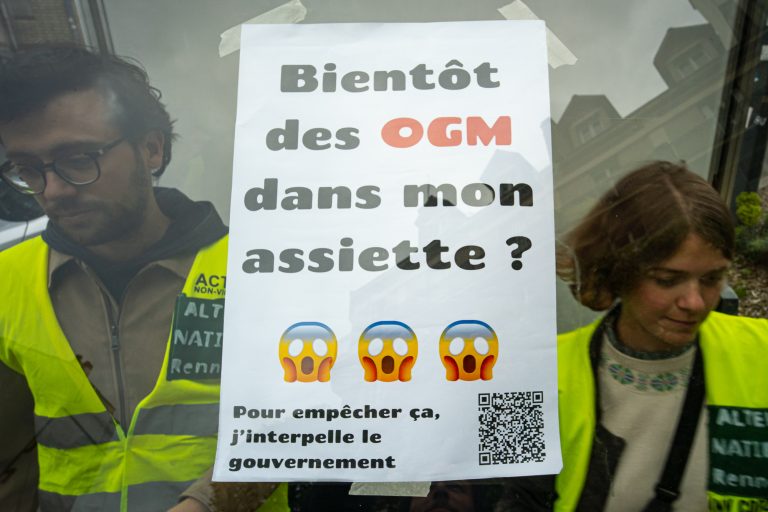
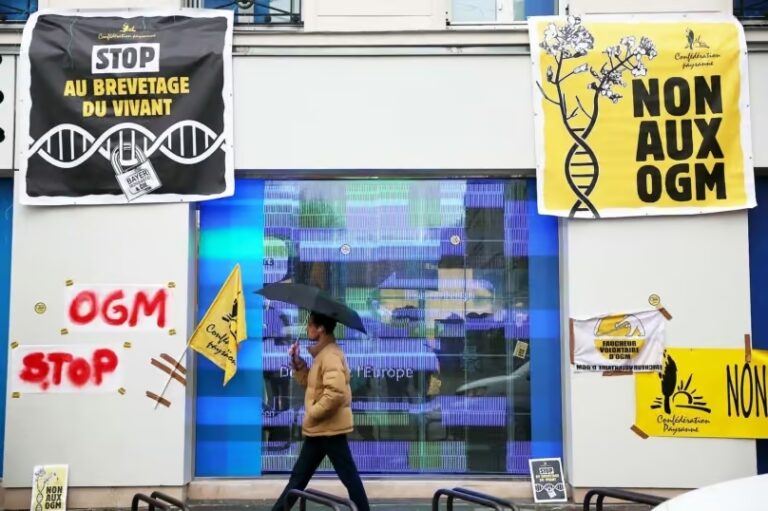
Finally, as part of public campaigns, in November 2022 Greenpeace raised awareness among consumers in 23 French cities about the issue of “new GMOs” and called on supermarket chains to demand that French and European authorities label all GMOs21. On 13 December 2023, around sixty members of the Confédération paysanne, the Faucheurs volontaires, Greenpeace, the Fédération Nationale de l’Agriculture Biologique (FNAB), Agir pour l’environnement and the European Coordination of La Via Campesina (ECVC) occupied Europa Expérience, a showcase venue for European institutions located in Paris22. There, they denounced the European Commission’s attempt to deregulate GMOs. On 5 May 2025, in Rennes, the local Alternatiba collective carried out “an act of civil disobedience by taking over billboards in the city centre to warn the general public about the possible forthcoming deregulation of GMO crops”23.
In Italy, municipalities are declaring themselves GMO-free
Since 2024, ARI and Crocevia have been running a campaign encouraging municipalities and regions to declare themselves “municipalities free of old and new GMOs”24. Whilst the declaration signed by the municipalities stipulates a ban on growing plants or rearing animals produced using genetic modification techniques, whether for experimental or commercial purposes, it goes even further. Indeed, the resolution also requires school canteens to include a ban on foods containing GMOs in their specifications. Finally, this resolution requires the display of a sign stating “municipality free from old and new GMOs”.
In 2024, we mentioned the town of Poppi, the first municipality to join this movement25. By 2026, 8 municipalities had joined the movement, including the municipality of Pesaro, which has over 100,000 inhabitants, bringing the number of signatory municipalities to 17 and now representing over 160,000 Italian citizens.
In Greece, a symposium to denounce the deregulation of GMOs/NGTs
On 7 May, Greenpeace Greece and the seed and biodiversity networks Sito and AEGILOPS organised a public event in Athens26. Like France, Greece had historically opposed the deregulation of GMOs/NGTs, before changing its stance in 2025 and lending its support to the text proposed by the European Commission.
During this event, and as the Panhellenic Federation of Agronomists’ Associations (POSG) also did in a press release27, the speakers reiterated the criticisms levelled at the deregulation text and at GMOs more generally:
- no analysis/detection protocols and a lack of labelling, rendering the traceability of these GMOs non-existent and leaving farmers, seed producers, processors and consumers in the dark;
- challenge to the argument of equivalence between mutations occurring naturally in fields and those induced by NGTs, which are not as precise as their deregulation advocates claim, as they produce off-target effects whose impacts are difficult to assess;
- the risks posed by patents to farmers, who will find themselves under threat for having selected plants whose genomes contain sequences on which multinational seed companies may have taken out patents.
They are therefore asking to “Greek MEPs not to support the EU’s new proposal on genetically modified organisms, because it abolishes rights such as safety and transparency rules that were secured 25 years ago” and want “labelling requirements for GMOs to remain in place”.
A demonstration on the eve of the European Parliament vote
Numerous organisations have therefore stepped up their efforts to raise awareness and mobilise over the last three years to express their opposition to the deregulation of GMOs/NGTs. With the European Parliament vote fast approaching, they do not intend to stop there. A broad coalition of farmers, breeders, environmental organisations, beekeepers and citizens is therefore calling for a demonstration on 16 June in Strasbourg, on the eve of the vote, to “to stop the deregulation of GMOs and defend transparent, democratic, and precautionary GMO rules in Europe”28. It remains to be seen whether MEPs will listen to them and take care to defend the founding principles of Directive 2001/18.
- European Parliament, “Final agenda for 17 June 2026“. ↩︎
- ECVC, “16 June – Farmers mobilise in Strasbourg: Say NO to GMOs!”, 1st June 2026. ↩︎
- Antoine Vépierre, “A wide range of stakeholders opposed to the deregulation of GMOs/NGTs”, Inf’OGM, 20 April 2026. ↩︎
- Antoine Vépierre, “Deregulation of GMOs: 93 organisations call to “protect farmers’, breeders’ and citizens’rights“”, Inf’OGM, 2 June 2026.
Denis Meshaka, “Des organisations de consommateurs et de transformateurs se mobilisent”, Inf’OGM, le journal, no. 175, April/June 2024. ↩︎ - Stakeholder organisations: Confédération Paysanne, Réseau Semences Paysannes, Friends of the Earth, Vigilance OGM et pesticides 16, Vigilance OG2M, CSFV49, OGM Dangers, Vigilance OGM 33, Fédération Nature & Progrès. ↩︎
- Confédération paysanne, “L’avocat général de la CJUE tente d’ouvrir une brèche permettant de contourner la réglementation OGM”, 27 October 2022. ↩︎
- Charlotte Krinke, “Nouveaux OGM : précaution exigée par les consommateurs allemands”, Inf’OGM, 29 November 2022.
Hervé Le Meur and Eric Meunier, “Une large gamme d’acteurs opposés à la dérèglementation des OGM”, Inf’OGM, le journal, no. 173, October/December 2023. ↩︎ - Christophe Noisette, “OGM/NTG, les consommateurs veulent pouvoir choisir”, Inf’OGM, 15 November 2023. ↩︎
- Eric Meunier, “French retailers want GMO/NGT to be regulated”, Inf’OGM, 3 April 2024. ↩︎
- Confédération paysanne, “Nouveaux OGM : la Commission européenne ouvre les vannes !”, 5 July 2023. ↩︎
- Denis Meshaka, “Le « non aux OGM/NTG » des transformateurs de produits biologiques européens”, Inf’OGM, 19 October 2023. ↩︎
- Denis Meshaka, “L’Ifoam ne veut pas d’OGM/NTG dans l’agriculture biologique”, Inf’OGM, 14 November 2023. ↩︎
- Hervé Le Meur and Eric Meunier, “Une large gamme d’acteurs opposés à la dérèglementation des OGM”, Inf’OGM, le journal, no. 173, October/December 2023.
Antoine Vépierre, “Des associations de consommateurs demandent la réglementation des OGM/NTG”, Inf’OGM, 21 May 2024. ↩︎ - Hervé Le Meur and Eric Meunier, “Une large gamme d’acteurs opposés à la dérèglementation des OGM”, Inf’OGM, le journal, no. 173, October/December 2023.
Denis Meshaka, “GMO/NGT Regulation: civil society organisations concerned about the outcome of the trilogue”, Inf’OGM, 5 November 2025.
Antoine Vépierre, “A wide range of stakeholders opposed to the deregulation of GMOs/NGTs”, Inf’OGM, 20 April 2026. ↩︎ - Magali Reinert, “« Nous risquons de tout perdre » : les dangers du vote européen sur les OGM”, Reporterre, 4 June 2026. ↩︎
- Eric Meunier, “Lettre ouverte de chercheurs contre la dérèglementation des OGM”, Inf’OGM, 21 December 2023.
Antoine Vépierre, “A wide range of stakeholders opposed to the deregulation of GMOs/NGTs”, Inf’OGM, 20 April 2026. ↩︎ - “Des députés français contre la déréglementation des OGM/NTG”, Inf’OGM, 13 February 2024. ↩︎
- Antoine Vépierre, “A wide range of stakeholders opposed to the deregulation of GMOs/NGTs”, Inf’OGM, 20 April 2026. ↩︎
- Joint opinion, “« La France, en privilégiant les intérêts de certains groupes semenciers, sacrifie un droit essentiel : produire et consommer avec ou sans OGM »”, Le Monde, 8 June 2026. ↩︎
- “Deregulation of GMOs: 13 organisations call for it to be rejected”, Inf’OGM, 25 January 2024.
Antoine Vépierre, “In 2025, more and more organisations are opposed to the deregulation of GMOs”, Inf’OGM, 12 March 2025.
Antoine Vépierre, “French organisations call on MEPs to reject GMO deregulation”, Inf’OGM, 9 March 2026.
Antoine Vépierre, “A wide range of stakeholders opposed to the deregulation of GMOs/NGTs”, Inf’OGM, 20 April 2026. ↩︎ - Christophe Noisette, “New GMOs – Greenpeace raises awareness among consumers”, Inf’OGM, 27 December 2022. ↩︎
- Christophe Noisette, “Paris – Mobilisation contre la dérèglementation des OGM”, Inf’OGM, 14 December 2023. ↩︎
- Antoine Vépierre, “French organisations concerned about GMO deregulation”, Inf’OGM, 4 June 2025. ↩︎
- Centro Internazionale Crocevia, “Comuni e regioni liberi da nuovi OGM/TEA”, 31 October 2024. ↩︎
- Christophe Noisette, “ITALIE – La Commune de Poppi refuse les « nouveaux OGM » sur son territoire”, Inf’OGM, 10 December 2024. ↩︎
- GMWatch, “Public event in Athens, Greece: Experts warn on EU plans on new GMOs”, 15 May 2026. ↩︎
- GMWatch, “Greek agronomists’ association slams EU GMO deregulation plans”, 18 May 2026. ↩︎
- ECVC, “16 June – Farmers mobilise in Strasbourg: Say NO to GMOs!”,1st June 2026. ↩︎
We need your help!
For over 25 years, Inf’OGM has been producing information, made freely available to everyone, on the artificialisation and appropriation of life (GMOs, NTGs, biotech, patents, etc.).
The monopolisation of a large share of public press subsidies by a few media groups reinforces the concentration of media ownership in the hands of a handful of businessmen. This concentration undermines the quality of information and democratic debate, which require a plurality of viewpoints.
In this context, alternative media outlets such as Inf’OGM, which receive no advertising revenue and provide information free of charge, need you – our readers – to continue to exist! Because, even when freely accessible, information comes at a cost.
Supporting Inf’OGM means working towards reliable, independent information on GMOs, biotechnology and seeds that is accessible to everyone.