
News
Patents, living organisms and GMOs/NGTs
By Denis MESHAKA
Published on the 25/03/2026


A patent confers the right to prevent third parties from exploiting an invention. Whilst historically it applied to specific technical objects and/or the processes for obtaining them, its extension to living organisms – and subsequently to genetic information – has transformed its scope. Between the broadening of claims, mechanisms for extending protection and growing legal uncertainties, patents now represent a threat from the biotechnology industry to fundamental economic and societal issues, particularly food sovereignty.
Against a backdrop marked by debates surrounding GMOs produced using new genetic techniques (GMOs/NGTs) and, more broadly, by growing questions regarding the appropriation of living organisms, the issue of patents lies at the heart of major economic, legal and ethical challenges. Initially covering mechanical objects, chemical substances, etc., patenting expanded in the 1980s to include material biological products1. More recently, they have come to cover intangible, legally undefined objects based on genetic information identified in organisms or biological products: “digital sequence information” or “genetic sequence data” (DSI/GSD)2. In the context of the ongoing European legislative debate on the possible deregulation of numerous GMOs, many of which could result from the use of DSI by “artificial intelligence” (AI) systems, and in light of the tensions arising from these developments, it seems necessary to return to the fundamentals of patent law. This involves recalling its principles, conditions and limitations.
The patent: a legal instrument
A patent is an industrial property title issued by an official institution, the INPI (Institut National de la Propriété Industrielle)3 for France and the European Patent Office (EPO)4 for countries5 bound by the European Patent Convention (EPC)6. A patent granted by the INPI applies only within French territory. When issued by the EPO, a patent may subsequently be validated in some or all of the signatory countries to the EPC, such as France. Opposition proceedings against a granted patent may also be brought by third parties before the EPO or, in the case of a French patent, before the INPI.
The EPO and the INPI merely grant patents; they are in no way responsible for what happens thereafter, particularly matters of infringement, which are dealt with by the respective national courts. Nevertheless, since June 2023, a European court may be seised of actions for infringement and invalidity of the “European patent with unitary effect” obtained following a patentability examination conducted by the EPO. This is the Unified Patent Court (UPC), which currently covers 17 EU countries7 and whose list evolves as the Agreement on a Unified Patent Court is ratified8.
A granted patent confers on its holder a monopoly on the commercial, and in some jurisdictions also non-commercial, exploitation of an invention, as well as the right to prevent a third party from exploiting it without their consent9. Infringement is exploitation without authorisation. It is assessed at national level, meaning that each European country has its own legislative system (except in the case of a European unitary patent – see above) to enable a patent holder to defend their rights. However, the patent holder may himself require a licence to exploit the invention if it constitutes an improvement on a broader invention that has already been patented. For example, one might have patented a process improving the accuracy of Crispr/Cas9, but require a licence from the holders of the fundamental rights to this technique in order to commercially exploit this improvement.
To obtain a patent, one must first apply for it. This is known as a “patent application“. This patent application is a document, filed for example with the INPI or the EPO, which describes the invention in detail in a section called the “description” and, in a section called the “claims“, defines the essential features of the claimed invention. Taking the example of a hammer, one would need to define the handle and the striking head. For a genetic sequence, or a protein – for example, an antibody or a hormone – its sequence and function must be defined. Genetic sequences are patentable because, in France and at the EPO, their isolation, description and associated function(s) are considered to constitute “an invention“. The scope of such a patent is not limited to the use of the isolated sequence alone. It extends to the use of any organism containing that sequence, which is therefore no longer isolated and expresses its function. The processes of isolating these sequences and determining their function are now increasingly carried out virtually using “AI” algorithms.
A patent application also contains administrative information, such as the name of the applicant, the inventors, an abstract of the invention… and, where applicable, a list of genetic sequences. The description must – according to the EPC and the French Intellectual Property Code (CPI) – set out the invention “in a sufficiently clear and complete manner so that a person skilled in the art [Editor’s note: a toolmaker or a biotechnology engineer]can carry it out” without having to exert an inventive effort beyond their ordinary skills. This “reproducibility” of the invention can be understood as the ability to obtain identical results in the same way, ensuring that the invention produces sufficiently stable and predictable effects. However, it poses particular problems in the biotechnology sector, where one is dealing precisely with living organisms, their complexity and often their inability to be reproduced identically10. Other legal and administrative factors not mentioned here contribute to the granting, maintenance and defence of patents.
The hammer, the natural gene and NGTs
Neither the CPI nor the EPC provides a positive definition of an invention, but it is conventionally agreed that it is “a technical solution to a technical problem“. If one seeks to drive a nail into a piece of wood more easily – the technical problem – the hammer certainly constitutes a technical solution. However, the term “invention” takes on a particular meaning when it comes to living organisms.
To be considered patentable, an invention must meet certain legal requirements11. It must be new (according to the law, “not form part of the state of the art“, i.e. what is already known) and involve an inventive step (according to the law, “not obvious from the state of the art“). “Obviousness” to a person skilled in the art is a relatively subjective concept, which is often at the heart of the debate in disputes over the validity of a patent. An invention must also be capable of industrial application; that is to say, according to the law, its subject matter can be made or used in any kind of industry, including agriculture.
What these same conditions make clear is that a discovery is not patentable. Indeed, a discovery is not an invention in the sense of a “creation of the mind” capable of being protected by intellectual property law. But what, then, of inventions based on living matter? In what way are a protein, or a gene encoding a protein, new when they do indeed exist in nature? In what way are they an invention and not a discovery under patent law?
The answer provided by European legislation (transposed into French law) is set out in Directive 98/4412: “Biological material which is isolated from its natural environment or produced by means of a technical process may be the subject of an invention even if it previously occurred in nature“. The EPO, which has incorporated this provision into its legislation, clarifies this point with regard, for example, to the patentability of plants: “obtained by technical processes, it may be considered patentable if the trait in question (e.g. colour, resistance to pests, yield, vigour etc.) was previously found in nature”. The aim, according to the EPO, is “to encourage and recognise the discovery of incorporating the characteristic in a plant using a technical method and making the associated technical invention available to the general public, the development of which is usually faster and more systematic than a natural process and thus offers numerous benefits for plant breeding”. It is worth noting that the EPO does not specify in what way, or to what extent, the technical process is faster or more targeted, or indeed whether it goes beyond what a natural process does or can do, and appears here to be echoing arguments put forward by industry.
The key point seems clear: if a human intervenes technically on natural biological material – “isolates” it, as the law puts it – the biological material or genetic information thus isolated becomes new and potentially patentable. The United States has taken a stricter stance, with the 2013 Myriad Genetics ruling by the Supreme Court, which decided that the isolation step is not sufficient, as the isolated DNA remains, after all, DNA found in nature. Since then, only complementary DNA (or cDNA)13, an artificially synthesised copy of the DNA of a gene existing in nature, can be patented in the United States.
Another fundamental concept in our subject area is the EPO’s definition of the various technical processes of mutagenesis. In its guidelines for the examination of patent applications, the EPO defines “targeted” mutagenesis and “random” mutagenesis as techniques, and the resulting plants as patentable provided that the general conditions for patentability are met14. A so-called “random” mutagenesis process is therefore patentable provided it is reproducible by a person skilled in the art, meaning it is no longer random within the meaning of patent law. New genetic modification techniques (NGTs) and the products derived from them are also patentable. Furthermore, the issue of essentially biological processes (EBPs) – which are not patentable – has fuelled the debate on patentability for years. Products derived from such processes were in fact patentable until July 2017. Media coverage of failed legal challenges to such patents and several decisions by the European Parliament were necessary to put an end to this situation15.
In its application to living organisms, the patent has gradually moved away from its original purpose. The isolation of biological materials, the identification of genes and, more recently, the use of DSI have contributed to shifting the patent from the material realm to that of information. But the extension of the scope of patents is not solely due to these technical developments. It also stems from the way in which patent applications are drafted and from certain legal mechanisms that extend protection beyond the original subject matter of the“invention“. It is this extension through language and the law that needs to be examined, which will be the subject of the next article in Inf’OGM.
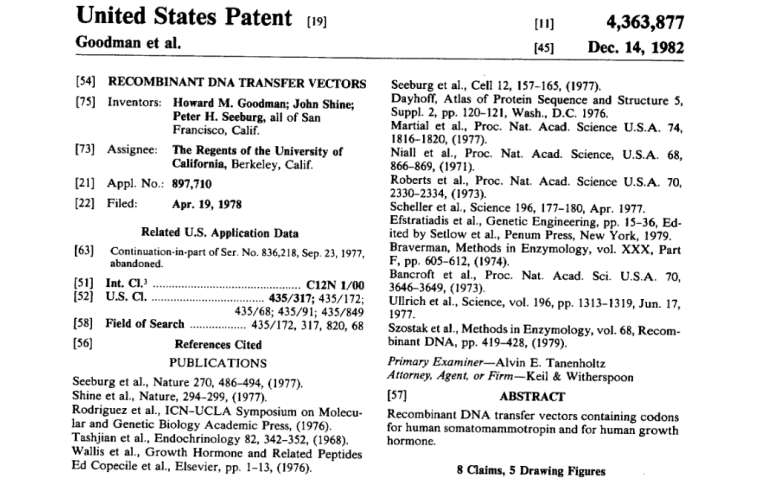
- US Patent 4,363,877 on growth hormone (University of California) in 1982. ↩︎
- To make the text easier to read, the rest of this article will use only the abbreviation DSI to refer to these three undefined concepts. ↩︎
- Website of the Institut National de la Propriété Industrielle. ↩︎
- Website of the European Patent Office. ↩︎
- European Patent Office, ‘Member States of the European Patent Organisation’. ↩︎
- European Patent Office, ‘European Patent Convention’,17thedition, November 2020. ↩︎
- Website of the Unified Patent Court. ↩︎
- Unified Patent Court, ‘Legal Documentation’. ↩︎
- French Intellectual Property Code, Article L615-1. ↩︎
- Denis Meshaka, “Reproducibility of biotechnological inventions”, Inf’OGM, 11 April 2025. ↩︎
- French Intellectual Property Code, Article L611-10. European Patent Convention, Article 52. ↩︎
- European Directive 98/44 on biotechnological inventions, Article 3.2. ↩︎
- Complementary DNA (or cDNA) is a single-stranded DNA artificially synthesised from messenger RNA (mRNA), thus representing the coding region (for a protein) of the genome region that has been transcribed into this mRNA. ↩︎
- EPO, Guidelines for Examination at the EPO, Part G, Chapter II, ‘5.4 Plant and animal varieties, essentially biological processes for the production of plants or animals’. ↩︎
- Denis Meshaka, “’Essentially biological process’, a definition shaken up”, Inf’OGM, 22 April 2024. ↩︎
We need your help!
For over 25 years, Inf’OGM has been producing information, made freely available to everyone, on the artificialisation and appropriation of life (GMOs, NTGs, biotech, patents, etc.).
The monopolisation of a large share of public press subsidies by a few media groups reinforces the concentration of media ownership in the hands of a handful of businessmen. This concentration undermines the quality of information and democratic debate, which require a plurality of viewpoints.
In this context, alternative media outlets such as Inf’OGM, which receive no advertising revenue and provide information free of charge, need you – our readers – to continue to exist! Because, even when freely accessible, information comes at a cost.
Supporting Inf’OGM means working towards reliable, independent information on GMOs, biotechnology and seeds that is accessible to everyone.