
News
Patents on life: extension through language and law
By Denis MESHAKA
Published on the 27/03/2026


In the field of life sciences, the scope of a patent depends not only on the invention described, but also on the way it is claimed and the legal framework governing its protection. Drafting strategy, functional claims, homology percentages… these are all tools that can considerably broaden the scope of the initial “invention“. In the context of genetic sequences and digital data associated with living organisms, these mechanisms are now of particular importance.

In the previous article1, we outlined how patent law has gradually been applied to living organisms and genetic information. But the actual scope of a patent also depends on how it is drafted and interpreted. In the field of living organisms and biotechnology, certain drafting strategies and legal provisions do indeed allow for a substantial broadening of the protection claimed. It is this dynamic of extension that we examine here.
A scope extending beyond the initial “invention“
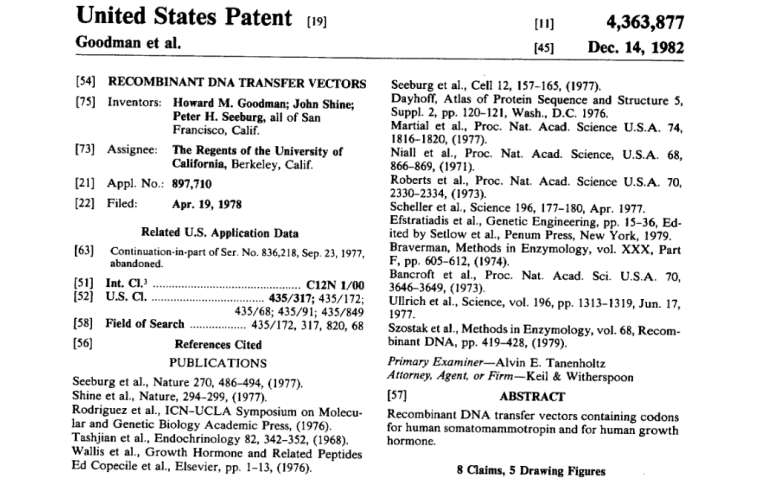
The “life sciences” industry employs various drafting strategies to obtain very broad patents, describing in particular genetic sequences and their function – sometimes presumed – often at the risk of legal fragility. Since the first patent on a biological subject matter (a recombinant human growth hormone) was granted in 19822, applicants have sought to cover not only a precisely identified sequence, but also all its possible variants. To do so, they use speculative claims based on percentages of “identity“, “similarity” or “homology” between the claimed sequence, originally identified, and a whole set of sequences that the patent intends to cover via this system of percentages. These formulations, which are flexible to say the least, thus make it possible to encompass a very large number of sequences not explicitly described in the text of the patent, and whose functionality is not demonstrated. This raises the question of compliance with patentability criteria, in particular the industrial application required by the European Patent Office (EPO). The EPO does not set a specific threshold for these percentages, examines patent applications on a case-by-case basis, and case law varies. For example, in decision T 2437/13 (Coronavirus/Amsterdam Institute), the EPO Board of Appeal held that a sequence claimed as having “at least 95% homology” must be understood as having 95% nucleotide identity in an alignment3. In decision T 2101/09, concerning sequence identity, the Board stated that the required level of identity depends on the circumstances of the specific case and the requirements of the European Patent Convention (EPC) (inventive step, sufficiency of description, etc.)
According to another approach, an invention can be defined by the function of a biological material rather than by a specific sequence4. This broadens the scope of patents, but also increases their vulnerability in the event of litigation. This is the case, for example, with antibodies, regarding which several European and US decisions have emphasised that a vague or hypothetical function is not sufficient to satisfy the requirements of industrial applicability (or its US equivalent: the utility criterion). Whilst a few antibody sequences may be given as examples in a patent application, this is generally insufficient to justify a claim which, because it is drafted in functional terms (“antibody A capable of binding to receptor R“), could cover tens of thousands of discovered antibodies or inventions.
European law also provides for the “scope of protection” conferred by a patent, notably in Articles 8 et seq. of Directive 98/44. According to these provisions, “the protection conferred by a patent on a biological material possessing specific characteristics as a result of the invention shall extend to any biological material derived from that biological material through propagation or multiplication in an identical or divergent form and possessing those same characteristics“. Furthermore, “the protection conferred by a patent on a product containing or consisting of genetic information shall extend to all material, save as provided in Article 5(1), in which the product in incorporated and in which the genetic information is contained and performs its function“. It is therefore not necessary for the product to be derived from the patented invention or its reproduction, as is the case with a patent relating to biological material.
When a sequence or genetic information is patented, this extension therefore implies that the rights attached to the patent apply to any product in which that sequence is incorporated and performs its function (a plant is a biological material). Thus, the drafting strategy aimed at broadening the claims upstream is combined with a legal mechanism for extending protection downstream, which further increases the potential scope of the rights conferred. Moreover, this exacerbates legal tensions surrounding their validity and effects, particularly in the fields of plant science, biodiversity and agriculture. This aspect of patents acting as a barrier can stifle innovation, but also prohibit the use of biological materials containing patented genetic information that does not originate from the patented invention. This is what is referred to as “patents on native genes“.
A shift from the tangible to the virtual
In the early 1980s, patents mainly covered cells, microorganisms, proteins, genes, reagents…5. Although defined directly or indirectly in patents by sequences, these tangible elements could be found in fermenters, laboratory refrigerators or freezers… However, in recent years, the description of a growing proportion of such “inventions” has become intangible. We have moved from the era of biological material isolated from living matter to the era of virtual material, with putative functions, defined by information derived from genetic sequencing – “genetic information” in European law or “digital sequence information” (DSI) in international law – stored in digital databases.
As confirmed to Inf’OGM by the EPO, patent applications based on DSI are treated as if they were inventions embodied in living matter. Yet the issue at stake is the patenting of digital information to which industry attributes a biological function via bioinformatics processes. As we shall see in a subsequent article, the EPO consistently considers that the concept of DSI, which is still not legally defined, does not constitute a specific category under European patent law. Indeed, it appears neither in the EPC nor in the EPO guidelines. As such, the EPO considers that it does not therefore constitute “an independent basis for assessing patentability“, which does not prevent the granting of patents relating to “genetic information“.
Inf’OGM has already extensively documented the impact of patents on living organisms. Today, this impact has taken on a concrete form and potential scale, particularly through patents on genetic resources, which are plunging a whole sector of the agricultural and food economy – as well as other uses of living organisms – into legal uncertainty. In particular, this affects the most vulnerable players – though they are the most fundamental – such as farmers, small and medium-sized seed producers, and other users and processors of organic products. Let us imagine that a person identifies a genetic sequence present in a plant and converts it into a digital sequence of the DSI type in a database. They then file a patent application claiming it as genetic information associated with a function. Although the patent formally covers digital data, its scope may extend to any organism containing this sequence and expressing the function described in the patent. Thus, any use of wild plants, local varieties or micro-organisms in which the DSI-type sequence exists naturally could be affected. A farmer re-sowing a traditional variety containing this sequence could then face opposition on the grounds of the patent, not because he has reproduced or copied the patented invention, but because he is using an organism in which the sequence covered by the patent is present.
Under the law, a patent on living organisms thus does not confer a right to exploit them, but a right to prohibit their use by third parties. This is harmful in many respects, particularly when the living organisms in question are cultivated or wild biodiversity, or the seeds of farmers. Shouldn’t knowledge about living organisms, on the contrary, benefit society as a whole, rather than being reserved for certain actors – notably industrialists and research institutes – in return for payment?
- Denis Meshaka, “Patents, living organisms and GMOs/NGTs”, Inf’OGM, 25 March 2026. ↩︎
- US Patent No. 4,363,877 granted on 4 December 1982 to the University of California. ↩︎
- European Patent Office, Boards of Appeal, decision T2437/13 of 19 June 2019. ↩︎
- Denis Meshaka, “Brevets sur les séquences génétiques : démesure et fragilité”, Inf’OGM, 7 July 2023. ↩︎
- Denis Meshaka, “Patents on life: a US ‘invention’”, Inf’OGM, le journal, no. 168, July/September 2022. ↩︎