

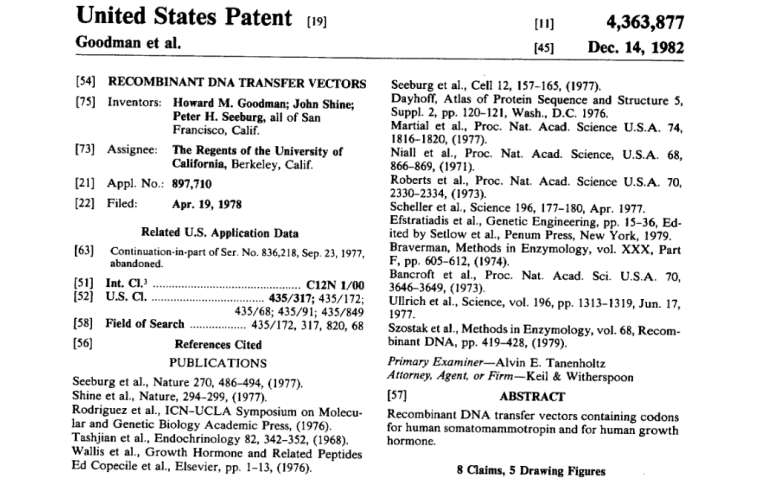
Patents, living organisms and GMOs/NGTs
A patent confers the right to prevent third parties from exploiting an invention. Whilst historically it applied to specific technical objects and/or the processes for obtaining them, its extension to living organisms – and subsequently to genetic information – has transformed its scope. Between the broadening of claims, mechanisms for extending protection and growing legal uncertainties, patents now represent a threat from the biotechnology industry to fundamental economic and societal issues, particularly food sovereignty.
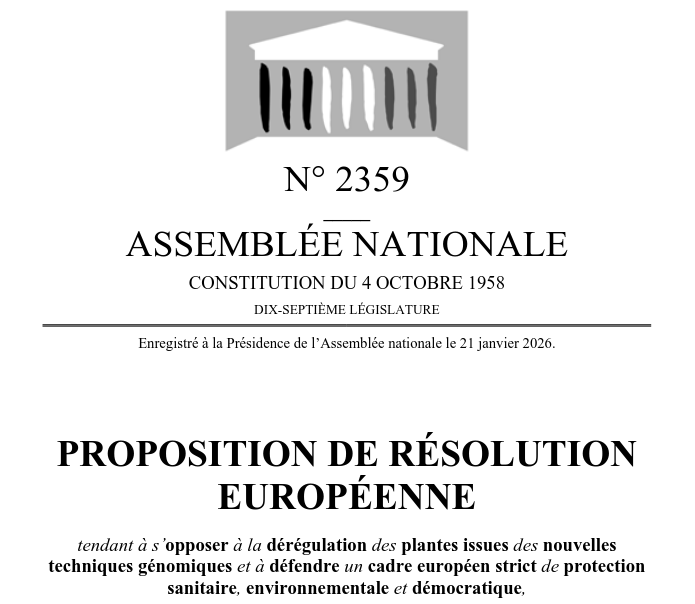
71 MPs urge the French government to reject the deregulation of GMOs derived from new genomic techniques
Following the approval by European Union member states, including France, of the draft text on the deregulation of GMOs derived from new genomic techniques (GMOs/NGTs), French MPs tabled a motion for a resolution on 21 January 2026. This motion for a resolution calls on the government to oppose the European text.

Crispr/Cas9 : from patent disputes to the widespread use of GMOs
A dispute over patent rights to Crispr/Cas9 has been ongoing for several years between its main discoverers, universities and research institutes. To date, the outcome of this dispute and its impact on the Crispr/Cas9 economy remain unpredictable. Added to this is an ongoing dispute over Crispr applications between the parties to the main dispute and companies. Despite this, the widespread use of this tool for modifying living organisms, and the associated health, environmental and socio-economic consequences, seem inevitable.
French organisations call on MEPs to reject GMO deregulation
On 19 December 2025, EU Member States declared themselves in favour of deregulating GMOs derived from new genomic techniques (GMOs/NGTs). After a brief passage through the European Parliament’s Environment Committee, this text must now be formally adopted by the Council of the European Union. If this is the case, it will be up to the European Parliament to vote on the text. 18 French organisations are taking this opportunity to send an open letter to MEPs calling on them to “defend the founding values, principles and treaties of the European Union, as well as the position adopted by the European Parliament in February 2024”. Other European organisations are encouraging European citizens to contact MEPs directly.

What “discussion” procedures are imposed on European legislators?
Since July 2023, EU institutions have been engaged in discussions on the proposal to deregulate many GMOs. These discussions follow an established procedure of negotiations between the Council of the European Union, the European Parliament and the European Commission. Complex but logical, this procedure can sometimes confuse those who follow it. Inf’OGM helps you see things more clearly.

Patents and NGTs: the singular position of Germany’s main agricultural union
While the deregulation of GMOs obtained through new genetic modification techniques (GMOs/NGTs) is currently under review, the issue of patents continues to provoke contrasting positions within European agricultural organisations. In this context, the position of the Deutscher Bauernverband (DBV), Germany’s main agricultural union, is particularly noteworthy. While in favour of the use of these NGTs, it nevertheless warns of the risks associated with patents. This is an original position among European agricultural organisations.

MEPs approached by industry to deregulate GMOs/NGTs
Since the European Commission submitted its proposal to deregulate almost all GMOs in 2023, multinational seed companies and lobbyists have been busy lobbying European institutions to support this proposal. Companies and civil society organizations can request meetings with MEPs. These meetings are listed, at least in part, on the Parliament’s website. In this article, Inf’OGM shows that supporters of GMO deregulation had 59 meetings, compared to 23 for opponents.

The European Commission as absolute ruler over GMO and pesticide legislation?
The legislative texts concerning GMOs proposed by the European Commission aim to almost entirely remove the regulatory framework for GM plants and microorganisms. In addition to this deregulation, two new measures have been discreetly slipped in. The first, which is common to the pesticides dossier, would consist of authorising these products without any time limit. The second would give the European Commission full powers over future legislative changes.

French government in favour of deregulating many GMOs
On 19 December 2025, the French government came out in favour of deregulating GMOs obtained using new techniques of genetic modification (NGT). Having previously abstained, it has, according to our information, changed its position following a commitment made by the European Commission. This commitment, which has not yet been made public but which Inf’OGM has been able to read, does not, however, add anything to the provisional text proposed to deregulate GMOs. France’s position has enabled a qualified majority of Member States to be reached on a text that, furthermore, does not provide for any risk assessment of GMOs obtained using new techniques and classified in category 1, any labelling or traceability of these GMOs, or any environmental monitoring.

The deregulation of GMO microorganisms is underway
A proposal for a directive made by the European Commission on 16 December 2025 calls on Member States and the European Parliament to deregulate the marketing of genetically modified bacteria, yeasts, viruses and other micro-organisms, including transgenics. According to the Commission, the aim would be to allow companies to market these GMO microorganisms (GMMs) under lighter or even no rules. This would involve an “adapted” health and environmental risk assessment, an end to traceability, an end to environmental monitoring… Following the plants, the deregulation of GMOs is therefore continuing, this time with microorganisms, with perhaps the animals next in line in 2026.

Qualified majority in the Council of the European Union to deregulate numerous GMOs
On Friday 19 December, the Member States meeting within the Council of the European Union reached a qualified majority agreement on a text to deregulate many GMOs. This text, negotiated two weeks earlier between representatives of the European Commission, the European Parliament and the Council, proposing broad deregulation of GMOs obtained through new techniques of genetic modification, has finally convinced a sufficient majority of States. The European Parliament is now due to consider it in January 2026.

GMO/non-GMO equivalence: the Commission turns “certain cases” into a general rule
The proposal to deregulate some of the GMO plants made by the European Commission in July 2023 is based in particular on the assumption that new techniques of genetic modification can produce organisms with modifications that could also be obtained using so-called “conventional” methods. To make this claim, the European Commission uses a subtle but decisive semantic abuse in its proposal…