

The Commission says it is acting as a matter of urgency to deregulate GMO micro-organisms…
The European Commission wants to deregulate genetically modified bacteria, yeasts and viruses in order to reduce the time it takes for them to be placed on the market, the risk assessments carried out on them, and the information provided to operators and the public… This is the package of measures proposed from December 2025! Under the guise of a so-called urgent need for action, the Commission has cut corners by failing to consult the public on this issue and by withholding certain documents, including a key “impact assessment”.
In France, a campaign against the deregulation of genetically modified micro-organisms
In an opinion piece published on 22 July 2026 on a French media’s website Mediapart, sixteen representatives of French organisations have expressed alarm at the potential deregulation of genetically modified micro-organisms. This deregulation, proposed by the European Commission in December 2025, has already received initial approval from the Council of the European Union, including that of the French government. In their opinion piece, the signatories specifically call on the French government “to make a genuine change in stance and to take a firm stand against this deregulation of GMOs”.

Organic farming and biocontrol: two concepts that do not overlap
According to the European Commission, biocontrol products are intended to be a sustainable alternative to chemical pesticides. However, as we saw in a previous article, the Commission plans to group products that are genuinely low-risk together with products derived from biotechnologies – whose risks have not been assessed – under the single term “biocontrol”. Yet, the term “biocontrol” creates confusion by fostering the illusion that it is a technique akin to organic farming. What is the reality?

Biocontrol: European Commission seeks lighter regulation
Presented as an alternative to chemical pesticides, biocontrol operates on a logic of substitution that allows the pesticide industry to “green” its operations. Worse still, biocontrol products could overshadow beneficial approaches such as peasant agroecology or biological pest control. To facilitate the marketing of biocontrol substances, the European Commission proposed a definition and simplified regulations in the draft Omnibus X regulation in December 2025.
The European Commission is proposing legislation on biocontrol
In December 2025, the European Commission proposed a set of measures to amend the regulations governing food and animal consumption, compiled in a document entitled “Omnibus X”. This document notably proposed the creation of a new legal category: “biocontrol substances”, described as an alternative to chemical pesticides, whose development and marketing the European Commission aims to promote. However, on June 12, the Council of the EU noted the lack of a qualified majority for this text.

Cornerstone of French and European law, the precautionary principle under attack by the FNSEA
The FNSEA (French National Federation of Farmers’ Unions) recently called for the “precautionary principle” to be replaced by an “innovation principle”. Behind this political and semantic offensive lies a challenge to the risk management framework enshrined in the French constitution. Whilst the European Commission says it intends to propose an “innovation regulation” before the end of the year, this demand from the FNSEA echoes the ongoing process of deregulating GMOs derived from new genetic modification techniques (NGTs). By seeking to abolish their assessment, traceability and mandatory labelling, Europe too is disregarding the precautionary principle, which it nevertheless enshrined in the Maastricht Treaty.

Europe set to approve a new mRNA vaccine for human use
In late February, the European Medicines Agency (EMA) recommended granting marketing authorisation for a vaccine marketed under the name mCombriax. This is an mRNA “vaccine” against COVID-19 and seasonal flu, developed by Moderna, intended for people aged 50 and over. This opinion will be forwarded to the European Commission, which could adopt the marketing authorisation decision. Given that mRNA technology is still in its infancy and has not yet really proven itself in the medical field, this favourable opinion is somewhat surprising.
In 2020, France believed it was possible to distinguish GMOs/NGTs
If the European Commission manages to convince the European Council and Parliament to accept its legislative proposal, many GMOs could be deregulated in Europe. Since the 2010s, it has been argued that these GMOs produced using new techniques (GMOs/NGTs) cannot be distinguished from organisms that have arisen naturally or through conventional breeding. Yet, in 2020, France explained in detail how to make this differentiation technically possible. A fact that the French government seems to have forgotten since…

Since 2018, the EU has been able to regulate GMOs/NGTs
Prior to 2018, some Member States had decided not to submit certain applications for trials authorisation of GMOs obtained through new techniques (GMOs/NGTs) to the GMO legislation. However, in 2018, a ruling by the Court of Justice of the European Union (CJEU) clarified that these GMOs must indeed be treated as regulated GMOs. According to a 2021 report by the European Commission, these cases of wrongfully deregulated GMOs have been rectified, and the trials in question have been cancelled or brought into compliance with regulations. These cases suggest that regulating such GMOs is indeed feasible.
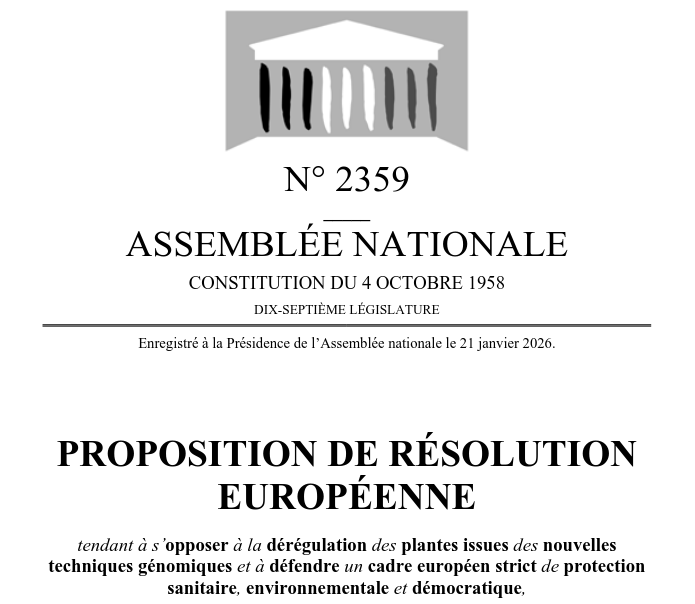
71 MPs urge the French government to reject the deregulation of GMOs derived from new genomic techniques
Following the approval by European Union member states, including France, of the draft text on the deregulation of GMOs derived from new genomic techniques (GMOs/NGTs), French MPs tabled a motion for a resolution on 21 January 2026. This motion for a resolution calls on the government to oppose the European text.

Biotech Act : precaution sacrificed in the name of innovation?
In a recent proposal for regulations claiming to “strengthen the biotechnology and biomanufacturing sectors”, the European Commission wants to see these sectors governed by a policy that “balance innovation with safety, equity and environmental protection”. However, the text mainly aims to promote industrial competitiveness and attractiveness to investors. It provides for faster authorisation procedures for “biotechnology products”, a lighter regulatory framework and prioritisation of so-called “strategic” projects in order to reduce time to market.

What “discussion” procedures are imposed on European legislators?
Since July 2023, EU institutions have been engaged in discussions on the proposal to deregulate many GMOs. These discussions follow an established procedure of negotiations between the Council of the European Union, the European Parliament and the European Commission. Complex but logical, this procedure can sometimes confuse those who follow it. Inf’OGM helps you see things more clearly.