
News
DSI’s databases do not respect certain fundamental rights
By Nithin Ramakrishnan (Third World Network et IT for Change)
Published on the 17/11/2026


In a report published on 29 June 2026, Third World Network and IT for Change examine how digital sequencing information (DSI) databases operate. The organisations conclude that “current DSI-sharing practices affect the enjoyment of human rights and the implementation of the Convention on Biological Diversity (CBD), the Nagoya Protocol, and emerging international frameworks on DSI governance”. This finding was published three months ahead of COP17 on biodiversity, where these DSI are on the agenda.
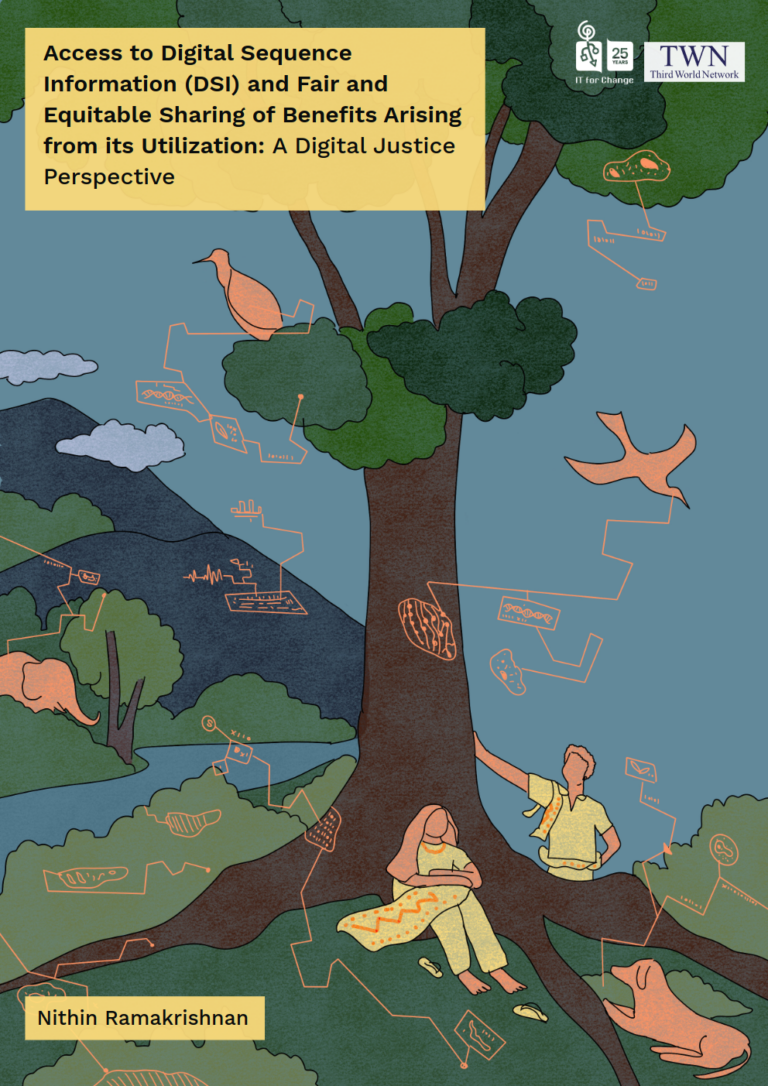
Since 19 October 2026, the States that have ratified the Convention on Biological Diversity (CBD) have been meeting in Yerevan (Armenia). Digital Sequencing Information (DSI)1 is on the agenda. DSI is one of the tools that could enable legalised biopiracy2 by multinationals in the pharmaceutical, biotechnology and cosmetics sectors, amongst others. In June 2026, the organisations Third World Network3and IT for Change4 published a report5 which, although it only indirectly addresses the issue of farmers’ rights, establishes that the main databases centralising this DSI have adopted operating practices that infringe upon “several internationally recognised human rights”. Inf’OGM publishes here the summary of this report.
This study examines the governance practices of selected Digital Sequence Information (DSI) databases from the perspective of biodiversity justice, sovereignty, human rights, and fair and equitable benefit-sharing under international law. It analyses how current DSI-sharing practices affect the enjoyment of human rights and the implementation of the Convention on Biological Diversity (CBD), the Nagoya Protocol, and emerging international frameworks on DSI governance.
Advances in sequencing technologies, bioinformatics, synthetic biology, and artificial intelligence have transformed the use of genetic resources. Increasingly, research and development are conducted through access to digital genetic sequence data rather than physical biological materials. This shift has enabled researchers and commercial actors to utilize genetic resources while bypassing access and benefit sharing (ABS) obligations traditionally associated with access to physical materials. The study argues that this has created conditions for “digital biopiracy”, where sequence data derived from biodiversity-rich countries and Indigenous Peoples and local communities (IPLCs) are utilized using digital technologies without fair and equitable sharing of benefits.
The report undertakes a comparative analysis of selected databases and platforms frequently referenced in international ABS discussions, namely the Genbank (based on International Nucleotide Sequence Database Collaboration policy), Global Initiative on Sharing All Influenza Data (GISAID), and the Global Biodiversity Information Facility (GBIF). It evaluates their practices across fourteen elements from the DSI data life-cycle, including data submission requirements, due diligence, user identification, data access conditions, benefit-sharing obligations, jurisdiction, audit rights, access guarantees, and consistency with the UNESCO Recommendation on Open Science 2021.
The study finds that despite differences in institutional design, the examined databases follow broadly similar governance approaches that externalize responsibility for legality and benefit-sharing to data providers and national authorities, while the databases themselves assume little responsibility for ensuring accountability or equitable use. In particular, the study identifies several systemic governance concerns:
- absence of meaningful checks on whether data uploaders possess lawful authority or consent from rights holders;
- anonymous access to DSI;
- lack of enforceable benefit-sharing obligations on users;
- absence of effective mechanisms linking DSI to the country of origin and original biological materials;
- limited transparency and accountability of database operators;
- inadequate safeguards against digital biopiracy;
- absence of data audit rights for competent authorities;
- discriminatory or unequal access conditions;
- biosecurity and cyber-biosecurity risks associated with unrestricted sharing of sensitive sequence information; and
- concentration of digital infrastructure and governance power in a small number of developed countries and institutions.
The report argues that prevailing claims equating anonymous access with “open access” are inconsistent with the UNESCO Recommendation on Open Science 2021. Open Science, properly understood, requires accountability, transparency, responsible governance, and equitable sharing of benefits. Open access to DSI could be subjected to all these requirements. The study contends that current DSI-sharing systems often promote the extraction of data from developing countries without reciprocal scientific, technological, or economic gains, thereby reinforcing structural inequalities in the bioeconomy. The paper further demonstrates that unregulated DSI-sharing practices undermine several internationally recognized human rights, including:
1. the right to sovereignty over natural resources;
2. the right to self-determination;
3. the right to development;
4. the right to enjoy the benefits of scientific progress;
5. the right to enjoy natural resources;
6. and the rights of Indigenous Peoples and local communities.
Drawing on international environmental law, such as the Convention on Biological Diversity, the Nagoya Protocol, international human rights law, the CBD COP Decision 16/2, and emerging global debates on data governance, the study argues that States possess clear legal authority to regulate the generation, storage, sharing, and utilization of DSI. It further argues that States hosting or supporting DSI databases have international responsibilities to ensure that such infrastructures do not undermine the sovereign rights and legal interests of provider countries and communities.
The report concludes that current DSI governance models are inadequate to address the legal, ethical, developmental, and security implications associated with the growing digital bioeconomy. It therefore calls for the development of a DSI-sharing environment that is accountable, transparent, respectful of provider rights, and consistent with international law.
To this end, the study proposes the development of a multilaterally accountable database infrastructure and recommends minimum requirements for DSI databases, including:
i. verified user registration and prohibition of anonymous access;
ii. legally binding data access and use agreements;
iii. compliance with national ABS laws;
iv. due diligence and traceability measures;
v. recognition of provider rights and country-of-origin information;
vi. no perpetual retention rights for databases;
vii. maintenance of user logs and audit rights;
viii. non-discriminatory access guarantees;
ix. safeguards against biosecurity risks;
x. interoperability between accountable databases;
xi. obligations to support fair and equitable sharing of both monetary and non-monetary benefits;
xii. legal clarity on policies, such as on intellectual property claims and termination; and
xiii. cooperation with competent legal authorities.
Ultimately, the study argues that accountable governance of DSI is not incompatible with scientific progress or open science. Rather, accountable governance is necessary to ensure that scientific advancement contributes to equity, human rights, biodiversity conservation, public trust, and global justice.
- Denis Meshaka, « DSI: The Cali Fund still a work in progress ahead of COP17 », Inf’OGM, 23 October 2026. ↩︎
- Guy Kastler, « Interconnexions entre les nouvelles biotechnologies et les DSI ou GSD », Inf’OGM, le journal, n°178, January/March 2025. ↩︎
- Third World Network website. ↩︎
- IT for Change website. ↩︎
- Nithin Ramakrishnan, « Access to Digital Sequence Information (DSI) and Fair and Equitable Sharing of Benefits Arising from its Utilization: A Digital Justice Perspective », juin 2026. ↩︎
We need your help!
For over 25 years, Inf’OGM has been producing information, made freely available to everyone, on the artificialisation and appropriation of life (GMOs, NTGs, biotech, patents, etc.).
The monopolisation of a large share of public press subsidies by a few media groups reinforces the concentration of media ownership in the hands of a handful of businessmen. This concentration undermines the quality of information and democratic debate, which require a plurality of viewpoints.
In this context, alternative media outlets such as Inf’OGM, which receive no advertising revenue and provide information free of charge, need you – our readers – to continue to exist! Because, even when freely accessible, information comes at a cost.
Supporting Inf’OGM means working towards reliable, independent information on GMOs, biotechnology and seeds that is accessible to everyone.