
News
The Commission says it is acting as a matter of urgency to deregulate GMO micro-organisms…
By Eric MEUNIER
Published on the 30/09/2026


The European Commission wants to deregulate genetically modified bacteria, yeasts and viruses in order to reduce the time it takes for them to be placed on the market, the risk assessments carried out on them, and the information provided to operators and the public… This is the package of measures proposed from December 2025! Under the guise of a so-called urgent need for action, the Commission has cut corners by failing to consult the public on this issue and by withholding certain documents, including a key “impact assessment“.
In December 2025, as the end-of-year holidays approached, the European Union was in the midst of a legislative debate over whether plants genetically modified using new techniques of genetic modification (NGT) should be deregulated or not. It was during this same period that the European Commission chose to launch a similar legislative push on genetically modified micro-organisms (GMMs). This drive was initiated by Denmark, home to one of the leading multinational companies in the field of microorganisms, Novonesis, which was then holding the presidency of the Council of the European Union (EU).
If the European Commission has shown, as we shall see, great haste in this matter, it is because it has taken considerable liberties with several procedural stages. However, according to the Commission, there is an “urgent” need to act in the interests of the EU’s competitiveness. Yet, to date, very few countries have deregulated GMOs produced using NGTs (GMO/NGT), as shown in an OECD report published in late 2025i.
No public consultation and an accelerated timetable
The proposal was formally published on 16 December 2025ii. Like any legislative proposal put forward by the European Commission, the proposal to deregulate GMMs is the result of preparatory work by the Commission, which, in order to comply with “good practices“, must take various steps. These typically include gathering external input and organising a public consultation to assess the expectations of citizens, businesses, trade unions, associations and so on.
A distinctive feature of this proposal to deregulate GMMs is that no call for contributions or public consultation took place. The proposed text nevertheless refers to two such initiatives, with the Commission stating in the introductory remarks accompanying the proposal that “stakeholders’ views on GMMs expressed in the calls for evidence related to the Biotech Act 10 and the Food and Feed Safety Simplification Omnibus 11 stressing the recent innovations regarding GMMs and underlining the necessity to adapt the GMO framework to these developments have been taken into account“. The Commission’s wording is accurate, since the consultations to which it refers did not concern the deregulation of GMMs that can be released into the environment. The first concerned the “Biotech Act“, which deals primarily with biotechnology in general, but whose call for contributions made no mention of micro-organismsiii. The second focused on the safety of food and feed and refers to GMMs solely in the context of their cultivation in fermentersiv. Given that this proposal “is part of the Biotech Act“v, the Commission presumably considered that a dedicated consultation was unnecessary, disregarding citizens and placing them in the incongruous position of being unable to comment on a draft piece of legislation of which they had not been informed.
In the absence of a call for contributions and prior public consultation, on what basis did the European Commission therefore base its decision? Still in its introductory remarks, the Commission refers to “an external study commissioned by the European Commission […] (“Analysis of the Regulatory Framework for Biotechnology and Biomanufacturing in the EU”)“, which it states was “being carried out” and “in English only“, as stated in the French version, at the time the proposal was formally tabled. The Commission also states that it gathered information “through 25 interviews (by November 2025)“. Who did it interview? This information is not provided…
A mandatory impact assessment… but one that does not exist
Among the documents that the European Commission is required to provide when putting forward a legislative proposal is an “impact assessment“. Carrying out such an assessment seems logical, as it involves evaluating the positive and negative impacts that the new measures proposed by the Commission would have. However, in the case of GMMs, the Commission does not know what the impacts of its proposal would be if it were to be adopted. Indeed, no impact assessment was attached on 16 December 2025, nor has one been provided even todayvi.
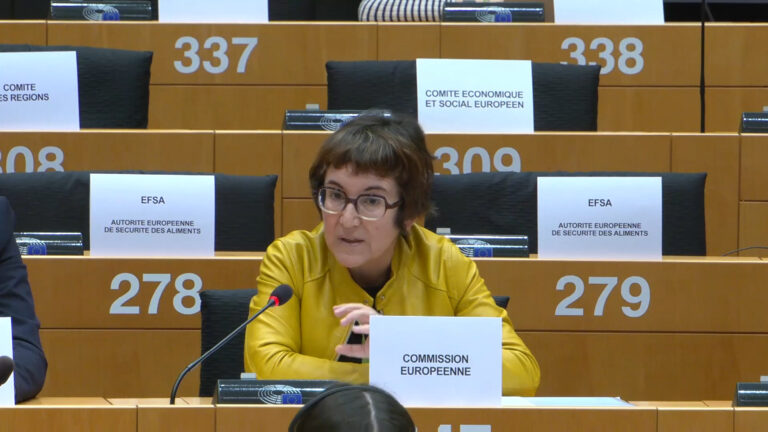
Irene Sacristán Sánchez, Director of the European Commission’s Biotech Unit, on 24 March 2026 before MEPs“Because of the urgency to act on biotech, the Commission decided not to do an impact assessment before making the proposal but to present a staff working document substantiating the evidences collected, consultations, etc…”
The European Commission justified this lack of an impact assessment “considering the political urgent need to address the policy challenges identified in the European Biotech Act“. It stated that an “an impact assessment could not have been delivered in the timeframe available before the proposal’s adoption“. This position was confirmed by the Director of the European Commission’s Biotech Unit, Irene Sacristán Sánchez, on 24 March 2026vii. On that day, addressing MEPs sitting on the European Parliament’s ENVI–Public Health Joint Committee, she stated that “because of the urgency to act on biotech, the Commission decided not to do an impact assessment before making the proposal but to present a staff working document substantiating the evidences collected, consultations, etc…“.
This explanation is surprising, as work on this legislative proposal did not begin in autumn 2025. As early as 2022, the Commission commissioned the European Food Safety Authority (EFSA), which brings together European experts, to provide a report on the risk assessment of GMMs released into the environment. In 2023, it commissioned its other expert group, the European Network of GMO Laboratories (ENGL), to produce a report on the detection and identification of GMMs. And, in February 2024, whilst the Commission had begun to gather the necessary scientific documentation, the European Parliament asked it to review the available information on “micro-organisms, fungi and animals” with a view to deregulating GMMs derived from NGTs (GMM/NGT). The urgency to act claimed by the European Commission to justify not having had time to carry out an impact assessment of its proposal is therefore not justified, given that four years have passed since it began its work.
However, on 16 December 2025, the Commission gave an assurance that “an analytical Staff Working Document (SWD) will be prepared. The analytical SWD will explain the proposal and will present the underlying evidence and impact analysis, including a cost–benefit assessment“. At the time of publication of this article, almost a year later, these documents supporting the proposed directive on the release of GMMs have still not been published on the European Legislative Observatory’s website. Only the working documents supporting the Biotech Act have been made public.
A proposal that over-interprets expert opinions
Among the other measures taken by the Commission, it may be worth recalling the case of the two expert opinions mentioned above, which were compiled in 2022 and 2023.
Regarding the detection and identification of GMMs and NGTs in the agrifood sector, the ENGL submitted its report in 2025. As Inf’OGM reported at the timeviii, this report concluded that “the vast majority of these micro-organisms are detectable and identifiable. However, “in some cases“, with the processes currently available, very small genetic modifications can be more complicated, or even impossible, to detect and differentiate from those that can occur without technical intervention on the genome”. The European Commission’s interpretation of this report is along these lines, but the proposal it has chosen to put forward is not limited to “certain cases“. Indeed, in its introductory remarks, it notes the existence of “certain challenges due to technical difficulties and to the fact that in some instances similar modifications to those obtained with NGTs may also occur naturally“ix. The proposed legislation therefore covers cases in which “it is not feasible to provide a method that detects, identifies and quantifies are also adapted in the proposal” the GMM. This generalisation is reflected in the proposed legislative measure, as it provides that “where this is duly justified by the notifier, the modalities to comply with analytical method performance requirements shall be adapted as specified in the implementing act adopted“. It is therefore up to businesses to declare whether their GMMs are traceable or not…
As regards the issue of risk assessment for GMMs and NGTs, the Commission’s U-turn is more nuanced. In October 2025, EFSA published its reportx on the matter, which Inf’OGM will discuss in detail in a forthcoming article. The experts concluded, in particular, that “on a case-by-case basis for specific NGT-Ms, fewer requirements may be needed” to carry out a valid risk assessment. They specified that, given “possible hazards relate to genotypic and phenotypic changes introduced and not to the method used for the modification, it is recommended that any new guidance should take a consistent risk assessment approach for strains/products derived from or produced with microorganisms” genetically modified, regardless of the technique used.
On this basis, the European Commission proposes that the current legislation on GMOs be amended to “establish specific requirements for GMMs with an inherently low risk profile to ensure that the risk assessment and procedures are proportionate to the risks the GMMs raise [and thus] lead to a reduction of time to market for low-risk GMMs“.
The very concept of “low-risk” GMMs does not exist in the EFSA opinion. Whilst it mentions risks that may be “less frequent” for certain GMMs, nowhere does it refer to the existence of “low-risk” GMMs. However, for the Commission, this change in terminology is sufficient to propose that it alone should be responsible for amending Directive 2001/18 so as to provide “procedural requirements for the risk assessment of low-risk GMMs adapted to their characteristics“. This “low-risk GMM” status would be based on the notion that the GMM has a “Status of Qualified Presumption of Safety“, which would be established by European experts via “the safety status assigned by the [EFSA] to selected groups of micro-organisms on the basis of an assessment showing no safety concerns” and on condition that the GMM does not contain “genes of concern which are not naturally present in the parental organism, in particular acquired antimicrobial resistance genes“. It is therefore to be expected that, should the Council of the EU and the European Parliament grant it this power, the Commission will amend Directive 2001/18 so that no specific risk assessments are carried out for these GMMs…
The Commission is using a single text to introduce two deregulations
Proposed Directive 2025/0405, aimed at facilitating the commercial release of GMMs in Europe, contains another issue that has nothing to do with GMMs: that of organ production and transplantation in human medicine. A single piece of legislation to amend two directives dealing with different areas… a choice that raises questions. As noted by the French Senate in a report by its Committee on European Affairs dated 13 May 2026, this merging of the two subjects was carried out by the Commission “on the grounds that it introduces changes announced in the context of the new legislation on biotechnology [Editor’s note: the Biotech Act], which can only be implemented by means of a directive and therefore cannot be included in the proposed regulation [Editor’s note: the Biotech Act]”xi.
However, this explanation does not account for why the European Commission did not put forward two proposals for directives, one to deal with GMMs and the other with organ transplantation. Once again, on 24 March 2026, during the meeting of the European Parliament’s Joint Committee on the Environment and Public Healthxii, Irene Sacristán Sánchez explained that the Biotech Act is like a puzzle and “the biotech act cuts across many sectors of legislations […] and these two elements are part of that“. An explanation which, in fact, is not really an explanation at all… Moreover, concerning the proposal on organ transplantation, the French Senate ruled in May 2026 that “such a proposal for revision should have been separated from the revision of the GMO Directive“.
The urgency to act claimed by the European Commission enables it to initiate procedures to amend European legislation within very tight deadlines. Whilst discussions on the deregulation of GMO/NGT plants took three years, the Commission wishes to move more quickly on GMMs. The French Senate also notes that “in recent years, the European Commission has been putting forward an increasing number of legislative proposals aimed at simplification, notably in the form of “omnibus” bills, which are most often examined within very tight deadlines” and is alarmed that such a legislative proposal “is being examined within such a short time-frame, given that it concerns the regulation of genetically modified organisms, [a subject] that is particularly critical in view of the environmental, health and ethical issues” it raises. In addition to the numerous environmental and health impacts and infringements of farmers’ rights highlighted by a coalition of French organisationsxiii, the proposal is also set to be dealt with as a matter of urgency. Despite the seriousness of the issue, the European legislator is not resisting this pressure to act. The Council of the EU has, in fact, already adopted a favourable position six months after work beganxiv, whilst the Parliament could adopt its own position in less than a year’s time, next November…
i Eric Meunier, « The OECD highlights disparities in regulations on GMOs obtained by NGTs », Inf’OGM, 24 September 2026.
ii European Commission, « Document 52025PC1031 – Proposal for a DIRECTIVE OF THE EUROPEAN PARLIAMENT AND OF THE COUNCIL amending Directives 2001/18/EC and 2010/53/EU as regards the placing on the market of genetically modified micro-organisms and the processing of organs », 16 December 2025.
iii European Commission, « Biotech Act ».
iv European Commission, « Food and feed safety simplification omnibus ».
v Remarks made by the European Commission at a meeting of the European Parliament’s Joint Committee Environment and Public Health on 24 March 2026.
European Parliament, « Joint Committee Procedure ENVI-SANT CJ64 », 10:15:00, 24 March 2026.
vi The documents to be attached by the Commission to its legislative proposal are available on the page dedicated to the proposal on the European Legislative Observatory website, under the heading “Documentation Portal/European Commission”. The documentation portal still does not contain any European Commission documents other than the proposal made in December 2025.
European Parliament, « Placing on the market of genetically modified micro-organisms and the processing of organs », visited on 28 September 2026
vii European Parliament, « Joint Committee Procedure ENVI-SANT CJ64 », 10:15:00, 24 March 2026.
viii Eric Meunier, « The majority of micro-organisms modified by NGTs are detectable », Inf’OGM, 23 December 2025.
ix See point 3 of the Commission’s explanatory memorandum to its legislative proposal:
European Commission, « Document 52025PC1031 – Proposal for a DIRECTIVE OF THE EUROPEAN PARLIAMENT AND OF THE COUNCIL amending Directives 2001/18/EC and 2010/53/EU as regards the placing on the market of genetically modified micro-organisms and the processing of organs », 16 December 2025
x EFSA GMO Panel (EFSA Panel on Genetically Modified Organisms), Mullins, E. et al., « New developments in biotechnology applied to microorganisms », EFSA Journal, Vol. 22, Issue 7, e8895, 22 July 2024.
xi French Republic, Senate, Commission of european affairs, « Political opinion on the Proposal for a Directive of the European Parliament and of the Council amending Directives 2001/18/EC and 2010/53/EU as regards the placing on the market of genetically modified micro-organisms and the processing of organs », 13 May 2026.
xii European Parliament, « Placing on the market of genetically modified micro-organisms and the processing of organs », visited on 28 September 2026.
xiii Eric Meunier, « In France, a campaign against the deregulation of genetically modified micro-organisms », Inf’OGM, 9 September 2026.
xiv Eric Meunier, « The Council of the EU wants to speed up the release of GMM into the environment », Inf’OGM, 6 July 2026.
We need your help!
For over 25 years, Inf’OGM has been producing information, made freely available to everyone, on the artificialisation and appropriation of life (GMOs, NTGs, biotech, patents, etc.).
The monopolisation of a large share of public press subsidies by a few media groups reinforces the concentration of media ownership in the hands of a handful of businessmen. This concentration undermines the quality of information and democratic debate, which require a plurality of viewpoints.
In this context, alternative media outlets such as Inf’OGM, which receive no advertising revenue and provide information free of charge, need you – our readers – to continue to exist! Because, even when freely accessible, information comes at a cost.
Supporting Inf’OGM means working towards reliable, independent information on GMOs, biotechnology and seeds that is accessible to everyone.