
News
Off-target effects of NGTs: CRISPR/Cas “fatigues chromatin”
By Annick BOSSU
Published on the 29/06/2026, modify the 15/09/2026


Touted as precise, simple and inexpensive, CRISPR/Cas is the flagship tool underpinning the promises made by GMOs derived from new genetic modification techniques (NGTs). Already at the centre of several controversies, CRISPR/Cas is once again making headlines. This time, it concerns the discovery of a new type of harmful effect.
The unforeseen effects of using CRISPR/Cas – its unintended effects on DNA, both off-target and on-target – have been documented for around a decadei. Yet they are overlooked in the legislative text adopted by the European Parliament on 17 June 2026ii, concerning NGTs. As for epigenetic and phenotypic effects, which often have a feedback effect on the genome, these are not mentioned either.
Here we discuss a scientific publication from November 2025iii which specifically details the consequences of using CRISPR/Cas at the epigenetic level and, more precisely, at the chromatin level. What is chromatin? In what way might its modification be significant and call into question the use of the CRISPR/Cas tool?
An overview of current knowledge on chromatin
Identified by Flemmingiv during the era of the optical microscope (around 1880) whilst observing eukaryotic cells, this substance, located within the cell nucleus, forms granules that stain when exposed to certain dyes. The scientist named it “chromatin” (from the Greek χρῶμα = chrôma = colour). Flemming also noted that chromatin transforms into filaments during cell division. These filaments would later be named chromosomes (coloured bodies).
It was not until much later that it was discovered that the carrier of genetic information is a molecule called DNA, and that chromatin is a structure comprising DNA, proteins (called histones) and a few strands of RNA. This organisation forms a single unit and ensures the compaction of DNA within the nucleus (through successive coiling). Thus, the 2 metres of DNA in a human cell are confined in the form of chromatin within a compartment – the nucleus – measuring just a few micrometres (1 micrometre = 0.001 mm) whilst the cell is not dividing (interphase), and in the form of chromosomes when it is dividing. A chromosome represents the maximum compaction of a DNA molecule within the cell.
Chromatin, which is highly decompacted compared to chromosomes, resembles a string of pearls, and its structure has been revealed by electron microscopy in very few locations within the nucleus of an interphase cell.
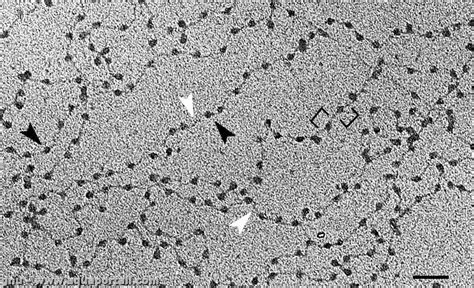
White arrows: “strand” = DNA molecule
Black arrows: “beads” = nucleosome (8 histone protein molecules clustered together)
It is during this decompaction phase that DNA can be active, i.e. transcribed into messenger RNA and replicated, but also repaired following a break. Outside this phase, the DNA is inaccessible, as it is highly condensed.
This chromatin structure is not fixed. Indeed, “the protein components of the nucleosome, or histones, exist in the form of variants and can be modified; the nucleosome represents a variable module, providing an expanded repertoire of information in addition to that provided by the genetic code“v. This is sometimes referred to as the “histone code“.
These variants influence gene expression, which highlights the importance of maintaining chromatin integrityvi. Genotoxic stresses (on DNA) are among the factors influencing chromatin histones.
CRISPR/Cas: a genotoxic stress that alters chromatin?
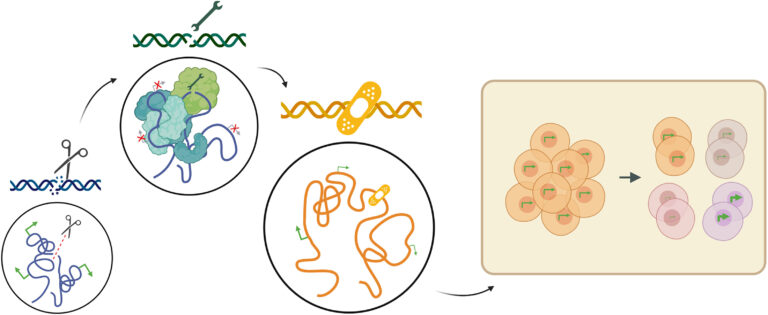
It is worth recalling that the CRISPR/Cas9 complex is capable of cutting both strands of the DNA molecule, which disrupts DNA integrity (on-target and off-target effects), but also, and this is precisely what the study published in Sciencevii has just demonstrated: it affects the entire chromatin, that is, the structure that determines DNA expression in relation to histones. Using CRISPR/Cas9, the researchers introduced targeted double-strand breaks in the DNA (as biotechnologists do when producing GMOs), and then monitored changes in chromatin organisation and gene activity.
The study was carried out on human cells as part of an experimental human gene therapy trial.
The researchers found that, even after DNA repair (the rejoining of the two ends of each strand), the chromatin in the region targeted by CRISPR underwent substantial changes in its spatial organisation: the chromatin remained misfolded and showed reduced expression of several genes, a phenomenon known as transcriptional alterations. The authors, Susanne Bantele et al., refer to this phenomenon as “chromatin fatigue“. They note that this is a previously unknown effect of cellular responses to DNA breakage and repair, with the potential to permanently alter the composition and function of cells genetically modified using the CRISPR/Cas9 tool. Double-strand breaks in DNA are particularly damaging to chromatinviii.
This “chromatin fatigue” occurs whether CRISPR/Cas is used to silence a gene, to modify a gene via mutagenesis, or to carry out transgenesis.
“Chromatin fatigue“, a long-lasting alteration
The authors of the study have shown that these chromatin alterations are long-lasting. These post-repair effects are inherited by daughter cells and alter gene expression across several cellular generations. The potential cellular and physiological consequences of these long-lasting modifications remain to be investigated, bearing in mind, amongst other things, that patients have already been treated with gene therapy using CRISPR/Casix.
Furthermore, the organisation of DNA itself and within chromatin, together with histones and RNA, is a very ancient feature in the evolution of life and is shared by all eukaryotesx. We are gradually discovering that there is spatial and temporal variability in chromatin. However, even within this dynamic landscape, entire chromatin domains can be maintained in a stable manner, and the overall pattern remains the same across eukaryotesxi.
The consequences of this chromatin fatigue, which alters gene expression in plants genetically modified using CRISPR/Cas, could include biochemical changes – such as the production of new toxins and allergens – or an altered nutritional valuexii.
In animals genetically modified using CRISPR/Cas, including humans, disruptions to gene expression resulting from chromatin fatigue could trigger serious physiological consequences: “Chromatin architecture is a central determinant of genomic stability. Effective DNA repair requires dynamic chromatin remodeling to grant repair factors timely access to lesions and to orchestrate repair pathway choice. Disruption of chromatin-regulatory mechanisms or DNA damage response pathways undermines repair fidelity and contributes to a wide spectrum of human disorders, including developmental syndromes, premature aging, and multiple cancers”xiii.
This new study paves the way for further researchxiv. For example, could “chromatin fatigue” affect the germ cells and offspring of organisms? In plants, studies into the phenotypic consequences of this chromatin fatigue should be carried out, at a time when the flagship tool of gene editing technologies, CRISPR/Cas, appears to be a significant cause of it.
“Chromatin fatigue” should be regarded as an epigenetic trace, a scar that could potentially pose a danger to the organism, but also as a marker of genome modification by CRISPR/Cas or other genetic modification processes, and therefore an obvious means of detecting and identifying these genetic modifications, whether intentional or not. However, in their drive to deregulate GMOs produced by NGT, the European Commission and the Council of the European Union have failed to take this into account.
It is an irony of the story – and a curious fact to say the least – that some of the authors of the Science articlexv are employees of a company well known to biotech firms… or rather, a family of Danish companies: the Novo family! This group is, in fact, actively lobbying to deregulate genetically modified micro-organisms! Have the lobbyists at the Novo companies read the findings on chromatin produced by their own scientists? xvi
i A few examples:
Annick Bossu, “Médecine : les technologies Crispr/Cas se cherchent encore”, Inf’OGM, 20 February 2024.
Annick Bossu, “OGM : quand la biologie met Crispr au pas”, Inf’OGM, 10 November 2022.
Eric Meunier, “OGM – Crispr/Cas peut « éclater » les génomes”, Inf’OGM, 28 October 2021.
ii Eric Meunier, “The deregulation of the GMO/NGT adopted in Strasbourg”, Inf’OGM, 26 June 2026.
iii S. Bantele et al., “Repair of DNA double-strand breaks leaves heritable impairment to genome function”, Science, Vol. 390, Issue 6773, 6 November 2025.
iv A pioneer in cytology (or cell biology), he described mitosis, chromatin…
v Geneviève Almouzni, « La chromatine, un véhicule d’informations au-delà de la séquence d’ADN : sa
dynamique et sa stabilité », 25 November 2014.
vi Ibid.
vii S. Bantele et al., “Repair of DNA double-strand breaks leaves heritable impairment to genome function”, Science, Vol. 390, Issue 6773, 6 November 2025.
viii There are two main pathways for DNA repair, one of which is more faithful than the other. The less faithful pathway is thought to have a mutagenic effect, with a risk of causing malignant tumours. Numerous regulatory mechanisms influence the choice of one or the other of these pathways for the repair of double-strand breaks. One such mechanism relates specifically to the effects of chromatin.
Joonyoung Her, Samuel F. Bunting, “How cells ensure correct repair of DNA double-strand breaks”, Journal of Biological Chemistry, Volume 293, Issue 27, 6 July 2018.
ix Annick Bossu, “Médecine : les technologies Crispr/Cas se cherchent encore”, Inf’OGM, 20 February 2024.
x Histones are not even unique to eukaryotic cells:
Janet Iwasa, “Molecule of the Month: histones across the tree of life”, 26 February 2026.
xi Jannon Fuchs et al., “Chromosomal histone modification patterns – from conservation to diversity”, Trends in Plant Science, Vol. 11, May 2026.
xii GMWatch, “Gene editing disrupts multiple gene functions through large-scale epigenetic changes in a way that persists through successive cell generations”, 17 December 2025.
xiii Joonyoung Her, Samuel F. Bunting, “How cells ensure correct repair of DNA double-strand breaks”, Journal of Biological Chemistry, Volume 293, Issue 27, 6 July 2018.
Adriana Chiaramida et al., “Chromatin Remodelling, DNA Double-Strand Break Repair, and Human Disease: How a Breakup Changes You”, Biomolecules, 15 April 2026.
xiv Lingjiang Chen, Zhiyong Mao, Yu Chen, “Chromatin fatigue: An epigenetic legacy of DNA repair”, Ageing Cancer Res Treat, 2026.
xv S. Bantele et al., “Repair of DNA double-strand breaks leaves heritable impairment to genome function”, Science, Vol. 390, Issue 6773, 6 November 2025.
xvi GMWatch, “Gene editing disrupts multiple gene functions through large-scale epigenetic changes in a way that persists through successive cell generations”, 17 December 2025.
Christophe Noisette, “Novonesis, a new Danish industrial giant promoting “biosolutions”?”, Inf’OGM, 15 May 2024.
We need your help!
For over 25 years, Inf’OGM has been producing information, made freely available to everyone, on the artificialisation and appropriation of life (GMOs, NTGs, biotech, patents, etc.).
The monopolisation of a large share of public press subsidies by a few media groups reinforces the concentration of media ownership in the hands of a handful of businessmen. This concentration undermines the quality of information and democratic debate, which require a plurality of viewpoints.
In this context, alternative media outlets such as Inf’OGM, which receive no advertising revenue and provide information free of charge, need you – our readers – to continue to exist! Because, even when freely accessible, information comes at a cost.
Supporting Inf’OGM means working towards reliable, independent information on GMOs, biotechnology and seeds that is accessible to everyone.