

News
A robot to pollinate genetically modified tomatoes
By Christophe NOISETTE
Published on the 13/04/2026, modify the 27/08/2026


Agritech is the convergence of genetics, robotics and digital technology. The tomato we’re about to discuss could serve as a symbol of this: it has been genetically modified to be more easily pollinated by a robot, which is itself controlled by a network of connected computers, commonly referred to as “artificial intelligence” (“AI”). This “innovation” is, above all, an illustration of the current headlong rush toward technology.
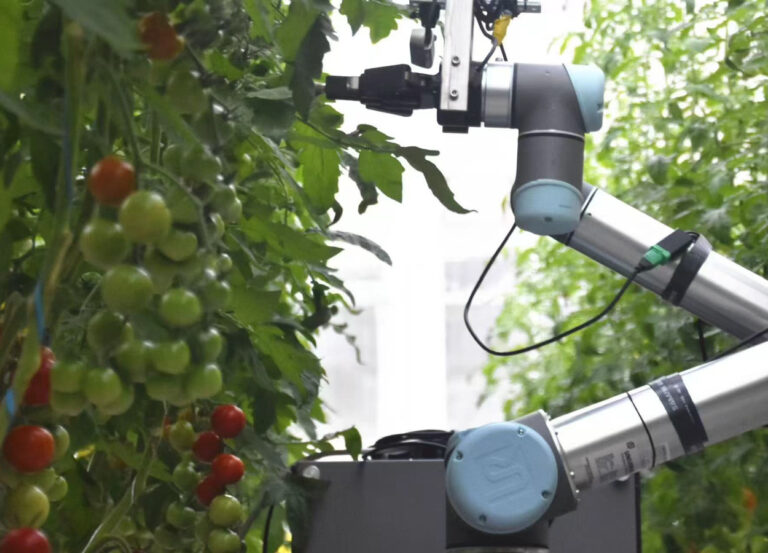
In China, researchers from several public research centers, including the Institute of Genetics and Developmental Biology of the Chinese Academy of Sciences, have genetically modified a tomato to produce “male-sterile lines bearing flowers with exserted stigmas”i. Let’s break this down. In tomatoes, the stigmas (the part of the flower that receives pollen) are enclosed or hidden inside the stamen tube formed by the five fused stamens. The tomato is primarily self-pollinating: it self-fertilizes. In the open air, the wind or insects, through the air movement created by their wing beats, allow pollen to fall onto the stigmas and fertilize them. Self-pollination is a natural barrier to the production of F1 hybrid lines (the controlled crossbreeding of two different plants). To produce these F1 hybrids, tomatoes must therefore be manually castrated (removal of the anthers that produce pollen, i.e., the male gamete) so that they can be fertilized by pollen from another tomato line. This operation alone accounts for 70% of the production cost of F1 hybrids, according to the previously cited article published in Cell.
A Tomato with Two GMO Parents
The research team selected two types of genetically modified tomato parental lines. The first is described as “male-sterile” because it will not produce pollen. Consequently, it will receive pollen from the other line. It is based on the Ailsa Craig variety. Using the CRISPR complex, the researchers induced a genetic modification in the GLO2ii gene (which belongs to the MADS-box gene family, which plays a key role in floral development). The result is a tomato with an exserted stigma and male-sterility.
The second line, which could be qualified as “male”, is based on a wild tomato (Solanum pimpinellifolium) used by researchers for its resistance to certain diseases, its taste, etc. But it has two drawbacks for breeders: its size and its photoperiod – the reaction of living organisms to variations in the length of day and night – which are unsuitable for greenhouse conditions. The researchers again used CRISPR to genetically modify the sequences responsible for flowering (SP and SP5G). The result: a more compact cherry tomato that can flower continuously under artificial lighting.
Next comes the robot. Equipped with two connected cameras, it is designed to analyze images of flowers from the two parental lines in real time. To do this, the algorithm first had to be “trained” using thousands of photos of tomato flowers. According to the robot’s developers, the algorithm improves with each attempt. But this requires a team of people sitting behind screens to “label” this data, as reported in an article by Basta!. All this information is stored in enormous data centers that consume vast amounts of energy and water. In practice, the robot vibrates the pollen-donor line, causing the pollen to fall into a box. It collects the pollen and deposits it on the tip of the pistil of the male-sterile line, which receives the pollen.
In summary, the researchers created a male-sterile tomato by genetically modifying it and then used a robot to fertilize it with pollen collected from another line, which was also genetically modified. This enables the continuous greenhouse production of F1 hybrid tomatoes, 24/7. According to the researchers, this strategy has also been implemented for soybeans. Soybeans, due to their tightly closed flowers, are in fact one of the most self-pollinating plants and are among the most resistant to industrial F1 hybrid productioniii.
Hybrids: A Booming Market
The production of F1 hybrids is nothing new. For a century, it has been the first step in the process of plant privatization. Indeed, a farmer who uses F1 hybrids cannot use his harvest to produce his own seeds without risking the degeneration of his future crops. This control over “reproduction”, through technological and legal barriers, is justified in the name of “hybrid vigor” (heterosis) – a yield increase that varies greatly depending on the species and which, moreover, is accompanied by a significant decline in the nutritional quality of the crops.
According to Global Market Insights, the global market for F1 hybrid seeds was valued at 56 billion U.S. dollars in 2023 and could reach 110 billion dollars by 2032iv. Another consulting firm estimates the market at $33 billion in 2025 and projects that it will reach $85 billion by 2034v.
In China, hybrids accounted for 77.6% of the seed market in 2022, while open-pollinated varieties accounted for 22.4%vi. The Chinese market for F1 hybrid tomato seeds is particularly significant: it is valued at 8.5 billion yuan (approximately 1.1 billion euros) in 2024 and could exceed 15 billion yuan by 2030 (approximately 1.90 billion euros)vii.
Thus, a company that adopts the technology package described in this article could see its revenue skyrocket. For now, this is not a commercial product but a scientific project. However, the authors state that they have filed patents, without providing further details on the claims of these patents. Nevertheless, for commercial use, any company wishing to bring this tomato to market will need to obtain licenses for certain technologies used, such as CRISPR/Cas9.
China: from “rustic” tomatoes to smart greenhouses
China is the world’s leading tomato producer, with 68 million tons projected for 2025, and could reach 108 million tons by 2030viii, the vast majority of which is destined solely for the Chinese market. Currently, tomatoes are primarily produced by small-scale farmers, often under contract with large companies. But greenhouse tomato production is skyrocketing, and significant investments are being made in this sector. These are often “high-tech” greenhouses.
Runtai Agricultural Technology Development Co., Ltd. has established an agricultural complex covering nearly 17 hectares in the city of Kokdala, in the Xinjiang Uyghur Autonomous Region (northwest China), dedicated to the intensive production of tomatoes. According to the Chinese media outlet People Dailyix, in these greenhouses, tomatoes are grown year-round, without soil, surrounded by numerous sensors to “optimize” production, just like in the Netherlands… In this article, the company’s executive director, Tang Yue, emphasizes that “compared to traditional open-field planting, the park-based planting method offers significant advantages, increasing annual yield by a factor of 5 to 6 and using only 1/20th of the amount of water required for traditional irrigation, making the crop more environmentally friendly”. However, this equation overlooks the energy and water costs associated with digital technology, which is used extensively in this park. And beyond the environmental issue, what about small-scale farmers? They will never be able to withstand such competition and will therefore have to abandon their land.
Another example is Beiing Hongfu Agriculture, one of China’s largest tomato greenhouses, spanning 50,000 square meters. The company has invested 320 million yuan to develop a semi-automated, controlled system. The facility incorporates numerous sensors to “monitor, control, and optimize the environment”, as described in an article promoting these greenhousesx. The sensors collect data on air temperature and humidity, light, CO2 concentration, and soil moisture, among many other parameters. This data is then analyzed and compared to desired optimal standards, before commands are automatically sent to a network of equipment to control the greenhouse. “Hongfu” tomatoes can be found in supermarkets across China, including Carrefour stores in Beijing and Metro stores in Shanghai. The article, which reads more like an advert than a real article, notes, however, that “amid the bevy of technological tools in use at the facility, pollination is still done in the most traditional way possible – with the help of bumblebees”. This detail is intriguing.
Robots and GMOs for pollination
Indeed, given these significant investments in tomato greenhouses, can’t we imagine another use for this GMO tomato and its pollinating robot? Couldn’t this combo also be sold to address the decline of bumblebees? Pollinating insects are indeed in decline worldwidexi, primarily due to the inputs used in industrial agriculturexii.
As we have seen, tomatoes are primarily self-pollinating. Naturally, they do not need pollinating insects to reproduce. However, in greenhouses, without “natural” wind, self-pollination is less effective: pollen can get stuck in the anthers. This is where bumblebees come in. By landing on the flowers and vibrating them with their thoracic muscles (or flight muscles), they allow the pollen to detach and fall onto the stigma. This is known as sonication pollination. Their presence is often associated with yield increases of between 20 and 30%. Their decline forces growers to import costly colonies, which are often sensitive to stress, transport and heatxiii. Will pollinator robots one day be competitive with these farmed bumblebees? Will they enable better pollination than bumblebees?
This technological project is nothing more than a headlong rush: we are attempting to repair the damage caused by overdeveloped industrial agriculture and its technologies with even more technology, thereby creating new damage and new dependencies, even though it is not an effective long-term solution. On the contrary, it amounts to digging ourselves deeper into a system that has been criticized by numerous studies. This is the analysis offered by Frédéric Jacquemart in an article published by Inf’OGM: “The field of GMOs is no exception to this brilliant strategy. Notably, decision-makers, having observed that genetically homogeneous crops inevitably lead to the emergence of pathogens requiring even more pesticides, are implementing programs aimed at restoring cultivated biodiversity. How? By generating this biodiversity using the tools of what they call ‘genome editing,’ which, in current practice, means CRISPR/Cas”. Frédéric Jacquemart and his co-signatories state that it is “urgent to establish a comprehensive (systemic) assessment that takes into account the organization of the complex natural systems on which we depend in order to guide public decision-making”… And it is sometimes wise to accept that traditional farming and agroecological practices are more effective for feeding the world while preserving health and the environment.
i Yue Xie, Tinghao Zhang, Minghao Yang, Hongchang Lyu, Yupan Zou, Yangchang Sun, Jun Xiao, Wenzhao Lian, Jianhua Tao, Hua Han, Cao Xu, « Engineering crop flower morphology facilitates robotization of cross-pollination and speed breeding », Cell, Volume 188, Issue 21, pp. 5809-5830, 16 October 2025.
ii The genetic mutation is known as “glo2-inver” and consists of an inversion of 2,795 nucleotide pairs and a translocation of 420 nucleotide pairs.
iii Jean-Pierre Berlan, La Planète des clones, Editions la Lenteur, 14 June 2019, 240 p.
iv Global Market Insights, « Hybrid Seeds Market Size & Share 2024 – 2032 », August 2024.
v Fortune Business Insights, « Hybrid Seeds Market Size, Share And Analysis by Crop Type(Cereals (Rice, Corn, Barley, and Sorghum), Oilseeds (Canola, Soybean, Cotton, and Sunflower), Fruits & Vegetables (Tomato, Cabbage, Chilli & Bell pepper, Okra, Cucumber, and Melons)), And Regional Forecast, 2026-2034 », 16 March 2026.
vi Mordor Intelligence, « China Seed Market Size & Share Analysis – Growth Trends and Forecast (2026 – 2031) ».
vii Institute of Genetics and Developmental Biology, Chinese Academy of Sciences, « Crop Matchmakers: AI-powered Robotic Breeder GEAIR Takes Over Hybrid Crop Breeding », 11 August 2025.
viii Fortune Business Insights, « Asia Tomato Market Size, Share & Industry Analysis, By Product Type (Fresh and Processed), By Nature (Conventional and Organic), By Form (Whole/Fresh, Canned, Diced, Frozen, Pulp, Paste, Puree, and Powder), By End-Use (Household/Retail [Supermarkets/Hypermarkets, Convenience Stores, and Others], Foodservice, and Industrial [Sauces & Condiments, Ready Meals, Snacks, Beverages, and Others]), and By Country, Forecast Period 2026–2034 », 16 March 2026.
ix « Xinjiang : à Kokdala, la technologie permet de récolter plus de tomates avec moins d’eau », Le Quotidien du Peuple en ligne, 21 June 2024.
x Wang Yulian, « Explore one of China’s largest intelligent tomato greenhouses », CGTN, 26 June 2020.
xi Fred Lewsey, « Pollinators – The first global risk index for species declines and effects on humanity ».
xii Muséum national d’Histoire naturelle, « Le déclin des insectes met en péril le vivant », 9 May 2023.
xiii Xavier Van achter, « Variation de la taille des bourdons en conditions contrôlées et naturelles », Mémoire en Biologie des Organismes et Écologie, Université de Mons, 2019.
We need your help!
For over 25 years, Inf’OGM has been producing information, made freely available to everyone, on the artificialisation and appropriation of life (GMOs, NTGs, biotech, patents, etc.).
The monopolisation of a large share of public press subsidies by a few media groups reinforces the concentration of media ownership in the hands of a handful of businessmen. This concentration undermines the quality of information and democratic debate, which require a plurality of viewpoints.
In this context, alternative media outlets such as Inf’OGM, which receive no advertising revenue and provide information free of charge, need you – our readers – to continue to exist! Because, even when freely accessible, information comes at a cost.
Supporting Inf’OGM means working towards reliable, independent information on GMOs, biotechnology and seeds that is accessible to everyone.