
News
MEXICO – Stacked GM corn: what are the risks?
By Annick BOSSU
Published on the 03/04/2026


Although it went largely unnoticed by the media, a victory was secured in Mexico on 17 March 2025 by indigenous peoples and certain scientists: a ban on the cultivation of GM maize was enshrined in the national Constitution. More recently, on 21 January 2026, another milestone victory was achieved by those campaigning against the risks posed by GM maize imported from the United States. But what is this maize, and what risks does it pose?
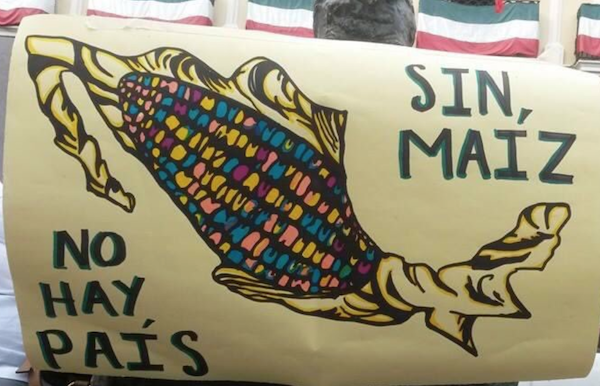
Even before the constitutional reform of March 2025, it had become illegal to grow genetically modified maize in Mexico. However, according to experts, this still occurs, particularly for scientific purposesi. For this country, the major problem is that cross-pollination with native maize varieties has been taking place since the introduction of GM maize in the early 1990s. Contamination had in fact been observed by scientists as early as 1998ii! Nowadays, transgenic maize in Mexico, mainly imported from the United States, is used to feed livestock. Nevertheless, contamination is still being detectediii.
Due to their genetic modifications, these imported maize varieties are tolerant to herbicides and capable of producing Bt insecticidal proteins.
However, in response to insect resistance to Bt toxins produced by genetically modified plants and weed resistance to herbicides, the biotechnology and seed industry has stacked transgenes within a single plant. Maize is the prime example of this accumulation of modified genes.
A recent publication by Mickaël Antoniou, a researcher at King’s College London (United Kingdom), commissioned by the Mexican authorities, examines the risks of stacked genes and the consequences of this stackingiv.
The greatest danger: cross-pollination
It is estimated that the history of maize began around 9,000 years ago in Mexico, where a local plant, teosinte, was cultivated by the earliest Native American civilisations at an altitude of 1,500 metres. Teosinte is a plant adapted to the tropical climate and humid summers; it bears numerous ears, each containing only a few grains. It is believed that the evolution of teosinte, the ancestor of maize, occurred both naturally through spontaneous genetic mutations and, above all, through farmer-led selection. This selection process led to the development of a vast number of maize varieties adapted to different climates and altitudes, providing a food source with a yield far superior to that of teosinte.
Following cross-pollination between North American GM maize and indigenous maize, contamination is jeopardising the integrity of these numerous indigenous maize populations, as it reduces the genetic diversity of maize – a diversity also threatened by patents. The adaptive capacities of indigenous maize are thus reduced, thereby limiting the possibilities for a varied diet across different regions. The nutritional quality of the maize is also significantly affectedv.
Thus, contamination poses the greatest danger from these GM crops, which harm all small farmers and the entire Mexican population, particularly as maize, in all its diversity, represents a strong cultural value linked to Mexican identity. This encroachment on indigenous maize by industrial GM maize has become a driving force behind a remarkable citizens’ strugglevi. It is against this backdrop that, in 2026, the “Colectividad en Defensa del maíz” has just won a final legal victory in Mexico, with the court ruling that “the country’s Ministry of Economy had violated the constitutional right to petition“vii. Indeed, the Ministry had failed to respond to a petition from the collective calling for a counter-action against the United States for depriving them of the benefits of the Mexico-US treaty “in the field of agricultural biotechnology”. Since 2013, when the moratorium on GMO maize sowing came into force, this struggle by local collectives has been successful, despite all the legal challenges brought by multinational companies such as Monsanto, Syngenta and Dow-Dupont (now Corteva).
Gene stacking in maize and the assessment of its risks
Gene stacking, the industry’s mechanistic response to the emergence of resistance, is not a recent phenomenon.
As early as 2012, Inf’OGM noted the presence, in a single maize variety – maize 3122 (imported into Europe) – of four genetic modifications involving the insertion of transgenes designed to express the Cry1Ab, mCry3A, Cry34/35Ab1 and Cry1F to kill the European corn borer and the corn rootworm, and two genetic modifications to tolerate two herbicides, one based on glyphosate and the other on glufosinate, making a total of six stacked transgenesviii. Sub-combinations are possible, either in the laboratory or following the sexual reproduction of the maize in question. However, no risk assessment has been carried out on these.
As for the risk assessment of maize with all stacked transgenes, Mickaël Antoniou, in his report for the Mexican governmentix, emphasises that “a direct assessment of the toxicity of these stacked varieties of GM maize has simply not been carried out”. In the September 2025 press articlex, he adds: “What’s happened over the years is that, as insects have become resistant to the early Bt toxins that were engineered into the corn, companies have added more variants of Bt toxins into the crop – up to six now, in some varieties. In addition, you’ve got not just glyphosate-tolerant genes, but up to three different herbicide-tolerant genes added on top of that”. He goes on to add: “What regulators have done – no doubt, what industry has convinced them to do – is that if a GMO crop was passed as safe with one or two Bt toxins in it, it was assumed that when you combine more traits into one crop, there is no additional risk”.
Similarly, he challenges the principle of substantial equivalencexi and criticises the limited use of proteomics (the science of all proteins in a cell, an organism, etc.) and other so-called ‘omics’ techniquesxii to assess the toxicity of stacked-gene GMOsxiii.
In Europe, gaps in the risk assessment of the first transgenic maize varieties had already been highlighted by Inf’OGM. This assessment is based either on erroneous assumptions (such as the claim that the Bt insecticidal proteins produced by these maize varieties are identical to those produced by the original bacterium), or on invalid tests, as in the case of maize Mon810xiv.
Health risks associated with gene stacking
Mickaël Antoniou explains that the health risks of GM maize and its associated pesticides stem from three main sources: the Bt insecticidal proteins produced by genetically modified plants, DNA damage caused by the genetic modification processes themselves, and the associated herbicides used on genetically modified crops.
The issue is of particular significance in Mexico, where maize, a symbol of national identity, forms the basis of the population’s diet.
Regarding Bt toxins, he points out that they “have never been an integral part of the human diet, especially in the special form they have been engineered into the crop” and, further, “evidence suggests Bt toxins may survive digestion, enter the bloodstream”.
He concludes that there is therefore a risk of toxic or allergic reactionsxv.
Regarding what we call unintended effects on DNA, he states that “the GM transformation process – the process by which a GMO is generated in the laboratory – is highly mutagenic. What do I mean by that? Inadvertently, you create unintended damage to the DNA of the crop. Much of this DNA damage remains in the final marketed product. What is the danger from this? DNA damage can change the function of multiple genes – not just one, but many genes. And by changing the pattern of gene function in the organism, you will change its biochemistry and its composition, including the unexpected production of new toxins and allergens”.
The risks associated with herbicides are already well documented in the scientific literaturexvi. For his part, Mickaël Antoniou explains: “we conducted a rat feeding study exposing animals to a mixture of glyphosate, 2,4-D and dicamba”xvii. The studies showed that “exposure to glyphosate resulted in glomerular and tubular dysfunction, and increased thyroid hormone levels in a dose-dependent manner in dams. The additive effects were evident from treatment with the glyphosate, dicamba, 2,4-D mixture on kidney and thyroid function of dams”.
The researcher concludes that “regulators are failing to consider combinatorial toxicity”, that is to say, the combined deleterious effects – genetic, molecular and cellular disruptions – resulting from gene stacking. These effects are, however, revealed by proteomics as well as by metabolic studiesxviii.
Mexico is indeed facing a major health problem for its inhabitants due to contamination, but also for farm animals fed with this maize containing stacked genetic modifications. The report written by Mickaël Antoniou highlights the numerous health risks associated with such maize, to which must be added the environmental risks posed by the pesticides used on it. This reinforces the country’s arguments for exercising caution regarding these GMOs. The fight to preserve indigenous maize is therefore more than justified, a fact understood by the current Mexican Presidentxix.
i Kate Linthicum, ‘Don’t mess with Mexico’s maíz: Constitutional amendment to ban GMO corn seeds’, Los Angeles Times, 13 March 2025.
Marie-Pierre Smets, member of the Board of Directors of FIAN Belgium, “Le maïs mexicain, au cœur des luttes paysannes”, 28 October 2022.
ii Lilian and Bernard Eddé, “Contamination du maïs mexicain : la controverse scientifique”, Inf’OGM,1st November 2003.
iii The latest in 2023.
United Mexican States, “Mexico – Measures Concerning Genetically Engineered Corn (MEX-USA-2023-31-01)”, p. 39, 15 January 2024.
iv Stacy Malkan, “Are GMOs safe? A molecular geneticist speaks out”, U.S. Right to Know, 10 September 2025.
Professor Michael Antoniou, King’s College London, UK, “EXPERT REPORT ON THE TOXICITY OF AGENTS CONTAINED IN GENETICALLY ENGINEERED CORN AND THE HEALTH RISKS ASSOCIATED
TO ITS CONSUMPTION”, 28 May 2024.
Dr Michael Antoniou is a professor of molecular genetics in the Department of Medical and Molecular Genetics at King’s College London (United Kingdom).
v Government of Mexico, “Mexico – Measures Concerning Genetically Engineered Corn (MEX-USA-2023-31-01)”, p.39, 15 January 2024.
vi Led primarily by the coalition “La Colectividad en Defensa del maíz”.
vii Demanda Colectiva Maíz, “Demanda Colectiva Maíz gana sentencia a Economía por desatender petición de contrademandar a EEUU”, 21 January 2026.
viii Eric Meunier, “ETATS-UNIS – Deux « super maïs » OGM tuant six ravageurs et résistant à deux herbicides”, Inf’OGM, 29 May 2012.
ix Government of Mexico, “Mexico – Measures Concerning Genetically Engineered Corn (MEX-USA-2023-31-01)”, p.39, 15 January 2024.
x Stacy Malkan, “Are GMOs safe? A molecular geneticist speaks out”, U.S. Right to Know, 10 September 2025.
xi The principle of substantial equivalence essentially involves comparing the components of a transgenic plant (proteins, nutrients, minerals, etc.) with those of conventional plants. If the differences observed correspond to known differences between varieties of the same species, the transgenic plant is considered to be substantially equivalent.
xii These are various disciplines of biology whose names end with the suffix “-omics“, such as genomics, proteomics, transcriptomics, metabolomics (metabolic studies)…
xiii Stacy Malkan, “New scientific methods challenge claims that GMOs and glyphosate are safe”, U.S. Right to Know, 16 September 2025.
xiv Eric Meunier, “Risques OGM dans l’UE : de moins en moins bien évalués”, Inf’OGM, le journal, no. 168, July/September 2022.
Frédéric Jacquemart, “Expertise des OGM : l’évaluation tourne le dos à la science”, Inf’OGM, 2012.
xv Stacy Malkan, “Are GMOs safe? A molecular geneticist speaks out”, U.S. Right to Know, 10 September 2025.
xvi For example:
Mesnage, Robin et al., “Major pesticides are more toxic to human cells than their declared active ingredients”, BioMed Research International, vol. 2014, 2014.
Defarge N, Takács E, Lozano VL, Mesnage R, Spiroux de Vendômois J, Séralini GE, Székács A., “Co-Formulants in Glyphosate-Based Herbicides Disrupt Aromatase Activity in Human Cells below Toxic Levels”, Int J Environ Res Public Health, 26 February 2016.
xvii Anca Oana Docea, Andrei Eugen Cirstea, Liliana Cercelaru et al., “Effect of perinatal exposure to glyphosate and its mixture with 2,4-D and dicamba on rat dam kidney and thyroid function and offspring’s health”, Environmental Research, vol. 237, part 1, 15 November 2023.
xviii United Mexican States, “Mexico – Measures Concerning Genetically Engineered Corn (MEX-USA-2023-31-01)”, p. 39, 15 January 2024.
Mesnage, R., Teixeira, M., Mandrioli, D. et al., “Multi-omics phenotyping of the gut-liver axis reveals metabolic perturbations from a low-dose pesticide mixture in rats”, Commun Biol 4, 471, 14 April 2021.
xix Government of Mexico, « Plan Nacional de Maíz Nativo beneficiará 1.5 millones de campesinos: presidenta Sheinbaum”, 13 November 2025.