
News
In the United States, companies produce few GMOs from NGTs
By Eric MEUNIER
Published on the 27/11/2026


Over the past 16 years, the U.S. Department of Agriculture has issued 230 authorisations for GMOs plant developed using new techniques of genetic modification. These represent 35 plant species, 21 traits, and come from 55 different private entities. In reality, however, companies have been relatively inactive, filing an average of 1.2 applications per month for fewer than ten varieties that have actually been brought to market. Their focus appears to lie elsewhere, since, over the same period, more than 1,000 patents for products or processes were granted.
For the past 16 years, the U.S. government has been processing requests from various entities seeking to determine whether a GMO can be authorised (for laboratory research, cultivation, or commercialisation) without undergoing risk assessment, labelling, and other procedures. These requests benefit from a certain degree of transparency, as the government makes the letters it receives and its responses public. But this transparency is limited, as the raw data posted online, with much information deemed “confidential business information”, seems more intended to fulfil a formal transparency requirement than to provide a clear understanding of what is actually at stake. Similarly, it is difficult to keep track of the thousands of related patent applications, which will allow companies to appropriate biodiversity.
230 applications from 55 private entities
Fewer than ten GMO plants developed using new techniques of genetic modification (GMOs / NGTs) are reported to have been commercialised in the United Statesi. However, this figure does not correspond to the number of applications filed with the administration during the same period. Between 2011 and 2026, 230 applications were processed. Based on these 230 applications from 55 organisations and the responses issued, one initial observation stands out : the multinationals that have shaped the history of transgenic GMOs are almost absent from the GMO/NGT market. We observe that Corteva filed five applications, Bayer three, Syngenta and DuPont two each one, and Dow AgroSciences one. These five multinationals, which exerted significant influence in Europe to secure the deregulation of GMO plants, thus account for less than 5% of the applications processed by the U.S. administration over sixteen years. BASF and Limagrain, for their part, are absent from the landscape.
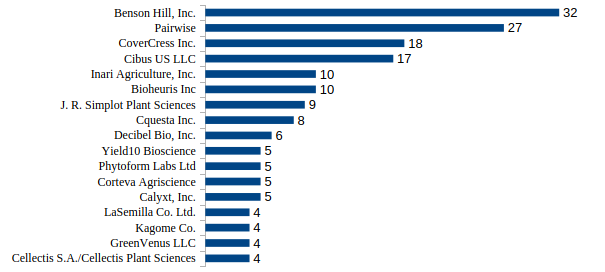
Number of applications (minimum of 4) submitted by each company as of November 3, 2026ii
As for the other 50 companies, Benson Hill tops the list with 32 applications filed, the vast majority of which are for soybeans (29 applications) and three for peanuts. Pairwise also appears on the list with 27 applications, mostly for blackberries, but also for mustard, black raspberries, cucumbers, potatoes, and an unspecified plant from the Brassica family. Pairwise, co-founded in 2017 by a former Monsanto employee, is a company that has already made headlines, particularly this year with the numerous non-exclusive licensing agreements it has granted to several other organisations to allow them to use a CRISPR/Cas tool. This company had obtained an exclusive license from Massachusetts General Hospitaliii.
Next come a few companies with about ten applications each. Among them is Covercress, a company in the U.S. Midwest that genetically modifies the plant known as field pennycress (Thlaspi) to turn it into “a new oilseed crop”. Covercress appears to be focusing on the biofuel sector, with pennycress marketed as a winter cover crop that can then be processed into oil for biofuelsiv. Next is the better-known company Cibus, with 17 applications, almost exclusively for canola modified to resist fungi or tolerate herbicides. Behind them is Inari with 10 applications covering a wider variety of plants. The company has filed applications for corn, soybeans, tomatoes, and wheat—most of which have been modified to achieve higher expected yields or other characteristics that remain undisclosed, as they are classified as confidential.
Who really dominates the market thanks to patents?
In order to conduct their genetic modification work on plants using new techniques, these 55 private entities had to obtain the rights associated with patents through licensing agreementsv. These patents – more than 1,000 granted in the United States between 2011 and 2025vi – may have been granted to cover a technique or a genetic sequence, for example. However, gaps in information regarding these licensing agreements (which grants which licensing rights to whom?) make it impossible, within the scope of this article, to determine which companies are actually behind the 55 that have filed applications or granted the latter the rights related to their patents on CRISPR/Cas, meganucleases, TALENs, etc.
This situation of possible domination by such or such multinational due to the patents it owns and the licensing agreements it has granted seems all the more difficult to assess given that certain information from the list of authorised GMO plants may seem surprising. For example, a licensing agreement signed in 2017 between the Broad Institute and Syngenta for “CRISPR/Cas technology in agriculture” led the multinational to file only two applications in the United States for a genetically modified corn and a genetically modified ricevii. For its part, the multinational BASF signed a “global” licensing agreement in 2017, also with the Broad Institute, but ultimately filed no applications in the United Statesviii.
A Greater Variety of Plants Than with Transgenesis
When we include the applications filed by the 49 companies not yet mentioned and having filed fewer than ten applications (accounting for half of all applications filed), it becomes clear that genetically modified plants created using new techniques are more diverse than those in the transgenic plant GMO portfolio. While the latter have historically been dominated largely by corn, cotton, and soybeansix with herbicide tolerance and/or resistance to insects classified as “pests” being the overwhelmingly predominant traits, this is not the case for GMO / NGT.
In the case of GMO / NGT, the distribution is more even. Admittedly, soybeans still dominate, accounting for 49 of the 230 applications filed. However, the remaining applications are spread across a wider range of plants, since, in addition to soybeans, 34 other plant species are covered by the filed applications. The second most modified plant is pennycress (Thlaspi). There are also 20 tomato varieties, whose composition or structure has been modified, often to facilitate harvesting. Blackberries, with 19 applications filed by Pairwise, are also prominent; they are often modified to be seedless, to meet the preferences of certain consumers, according to the companyx. These top four plants account for 50% of the applications filed in the United States. Next come plants such as corn, canola, potatoes, rice, lettuce, camelina, and others.
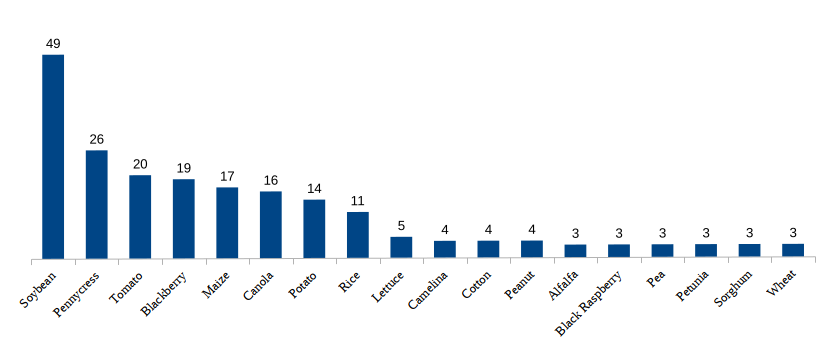
Number of applications by plant species (plants with at least 3 applications) as of November 3, 2026x
Herbicide tolerance and insecticide production are on the decline
Two traits alone account for 99% of the traits sought by companies in transgenic GMOs: herbicide tolerance and insecticide production. But when it comes to GMO / NGT, the landscape changes. In fact, by far the most common trait being developed is one aimed at modifying the very composition of the plants. Of the 230 applications filed, 82 claim such a genetic modification goal. This modified composition trait takes various forms, including changes in oil content in soybeans or canola, in the “quality” of fruit in tomatoes, bananas, or apples, and in biomass yield in poplars, among others.
Next are claims for modifications to plant architecture (23 applications). These may involve producing thornless blackberry plants, smaller tomato plants, or plants with fruits that detach more easily, among other examples. Other applications describe characteristics that have not been made public because they are “confidential” (20 applications) or involve herbicide tolerance (20 applications). The other traits found in the remaining 85 applications are highly varied, ranging from resistance to infectious agents to changes in yield, resistance to water- and heat-related stress, changes in flowering or flower colour, delayed browning, etc. The production by plants of insecticides targeting “pest” insects is the subject of two of the 230 applications filed, one for cotton and one for corn.
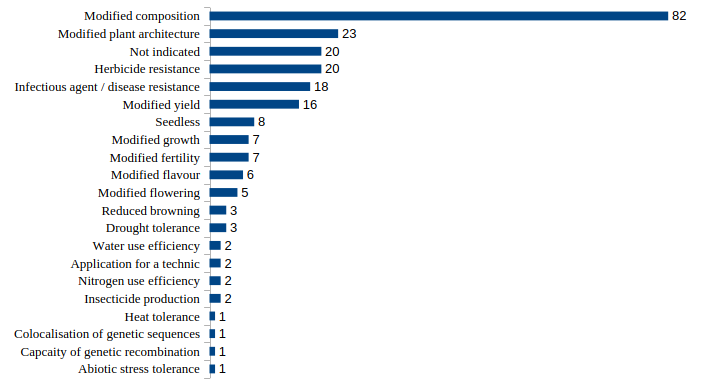
Modified traits in the 230 records as of November 3, 2026
The 230 applications filed in the United States ultimately represent a relatively small number of GMO / NGT plants. This number is all the more modest given that these applications in no way guarantee that the plants will actually be brought to market.
As can be seen by looking at the number of applications processed each year, deregulation in the United States which was implemented between 2020 and 2024 led to a sharp increase in applications during that period. However, since January 1, 2025, this deregulation is no longer in effect in the United States. Following a court ruling, the United States now regulates GMOs/NGTs in the same manner as it regulates transgenic GMOs, as reported by Inf’OGMxii. It should be noted that, for the time being, none of these plants produced using new techniques has been subject to a U.S. decision requiring mandatory labelling and traceability. This does not mean that this will not be the case in the future. In that scenario, while the European Union could deregulate a large portion of GMO / NGT by 2028, European producers of such GMOs would find themselves in a difficult situation, unable to export their products to the United States.
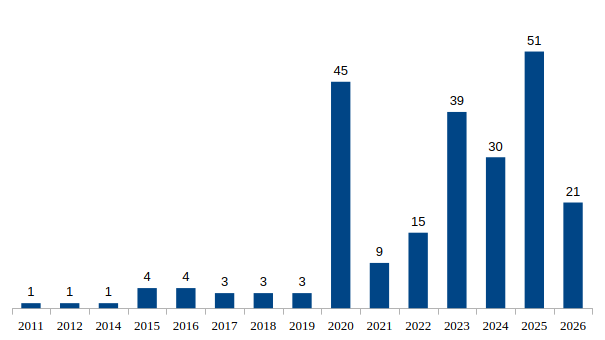
Number of applications filed annually since 2011 by companies, as of November 3, 2026
ihttps://infogm.org/en/gmo-ngt-a-memo-from-the-french-embassy-in-the-united-states-ignored-by-the-government/
iiThe companies having less than 4 applications are =
– 3 applications : Bayer Crop Science, ToolGen, Inc.
– 2 applications : BetterSeeds, Ltd, Boyce Thompson Institute, DuPont Pioneer, Evogene, Ltd., GeneNeer Ltd., IngateyGen LLC, Living Carbon PBC, Napigen Inc., Okanagan Specialty Fruits Inc., Pioneer Hi-Bred International, Inc., PlantArcBio Ltd., Syngenta Seeds, LLC, Tropic Biosciences UK LTD, Verinomics, Inc.
– 1 application : Agrinetica, Inc., Altria Client Services LLC, Arnold and Porter, LLP, Ball Horticultural Company, Dow AgroScience, Dummen NA, Inc, Epicrop Technologies, Inc., GDM Seeds, GFLAS Life Sciences, Inc, Gra&Green Inc., Intrexon Corporation, Meiogenix SAS, Nexgen Plants Pty Ltd, Origin Prime LLC, Plantik Biosciences, Redi Plants Corporation, Sanatech Seed Co., Ltd., Soilcea, The Traits Company, United Beet Seeds, Wild Bioscience Ltd
iiihttps://infogm.org/en/pairwise-shapes-the-food-of-the-future-with-ngt/
ivHolly Spangler, « Pennycress: The first cash cover crop », Informa, 15 June 2022
vhttps://infogm.org/en/patent-licences-access-to-innovation-subject-to-conditions/
vihttps://infogm.org/en/gmo-ngt-a-memo-from-the-french-embassy-in-the-united-states-ignored-by-the-government/
viiSyngenta United States, « Syngenta obtains non-exclusive IP license from Broad Institute for CRISPR-Cas9 genome-editing technology for agriculture applications », 2 November 2017.
viiiBASF, « BASF licenses CRISPR-Cas9 genome-editing technology from the Broad Institute », 22 March 2017.
ixUSDA, « Adoption of Genetically Engineered Crops in the United States – Recent Trends in GE Adoption », 12 December 2025.
xhttps://infogm.org/en/pairwise-shapes-the-food-of-the-future-with-ngt/
xiThe other plants being the subject of less than 3 applications are :
– 2 applications : Apple, Avocado, Mustard Greens, Poplar, Tobacco
– 1 application : Almond, Banana, Brassica, Lemon, Cucumber, Flax, Grape, Groundcherry, Pepper, Strawberry, Beet
xiihttps://infogm.org/en/the-united-states-do-not-exempt-gmos-ngts/
We need your help!
For over 25 years, Inf’OGM has been producing information, made freely available to everyone, on the artificialisation and appropriation of life (GMOs, NTGs, biotech, patents, etc.).
The monopolisation of a large share of public press subsidies by a few media groups reinforces the concentration of media ownership in the hands of a handful of businessmen. This concentration undermines the quality of information and democratic debate, which require a plurality of viewpoints.
In this context, alternative media outlets such as Inf’OGM, which receive no advertising revenue and provide information free of charge, need you – our readers – to continue to exist! Because, even when freely accessible, information comes at a cost.
Supporting Inf’OGM means working towards reliable, independent information on GMOs, biotechnology and seeds that is accessible to everyone.