
News
Syngenta drops its appeal against the Faucheurs Volontaires
By Christophe NOISETTE
Published on the 01/10/2026


On September 21, 2026, in Montpellier, Syngenta withdrew its appeal against the Faucheurs volontaires (volunteer crop destroyers) following the destruction of a sunflower plot in the Pyrénées-Orientales in 2016. In the initial proceedings, the Perpignan court had acquitted the activists, recognizing the defense of necessity. Consequently, Syngenta had appealed solely regarding the €760,000 in damages it was claiming.
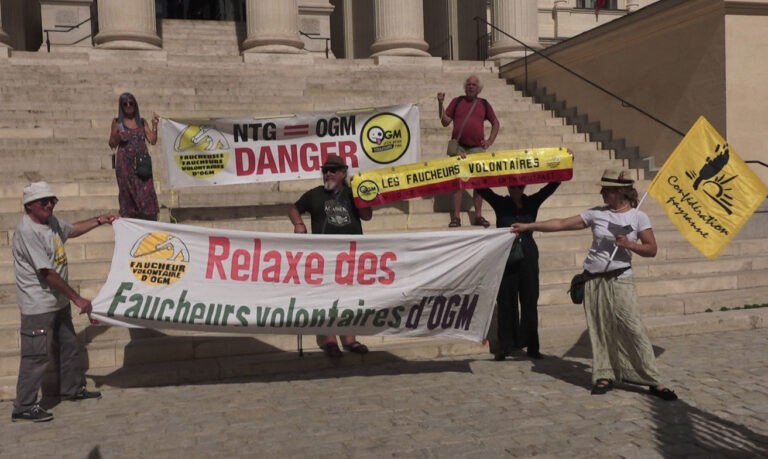
On Monday, September 21, 2026, at the Montpellier Court, the seat reserved for Syngenta’s lawyer was empty. And with good reason: the multinational—a subsidiary of the Chinese holding company Sinochem—had decided to withdraw its appeal against the civil-court acquittal won by the Faucheurs volontaires in the initial trial in Perpignan in December 2020i. No appeal had been filed regarding the criminal aspect of the case by either the prosecution or Syngenta. A recap of the facts follows.
Three hectares destroyed in 2016
In 2016, 150 Faucheurs volontaires destroyed a three-hectare plot of sunflowers in Elne (Pyrénées-Orientales). They believed the plot was planted with herbicide-tolerant sunflowers (VrTH). A report by Ansesii (the French Agency for Food, Environmental and Occupational Health & Safety) had indicated that the sunflowers were produced via so-called “in vitro” mutagenesis. Despite Syngenta’s subsequent denials, the plants therefore constituted GMOs under European Directive 2001/18.
During the initial trial, the judge officially affirmed that the VrTH sunflowers were GMOs—a claim denied by Syngenta, which had recently acquired Nidera, the company that owned the destroyed crops. In its ruling, the court found that “the civil party [i.e., Syngenta] is lying when it claims there were no GMOs in this field” and noted that “no authorization had been granted for this plot.” The field was therefore being cultivated illegally. The court held that the burden of proof lies with industrial operators to demonstrate that their crops are not GMOs. A similar judgment had been handed down by the Dijon Criminal Court on January 17, 2019, in the case involving the destruction of Dijon Céréales’ rapeseed cropiii.
Syngenta withdraws its appeal
Regarding the hearing scheduled for September 21, 2026, at the Montpellier Court of Appeal, the Faucheurs volontaires state in their press release: “This withdrawal is virtually unprecedented and stands out in the world of agrochemical multinationals, which typically engage in relentless litigation designed to wear down their opponents both morally and financially.iv“
It is worth recalling that the public prosecutor did not appeal the acquittal secured in the initial trial in Perpignan; consequently, the recognition of the “state of necessity” defense went unchallenged. Syngenta had embarked on a solo legal campaign aimed at weakening the Faucheurs volontaires movement by demanding around €760,000 in damages. The outcome of the trial was therefore highly uncertain.
The Faucheurs suggest several other possible reasons for this withdrawal. During the initial trial, Syngenta had partly justified its claim for damages by citing lost royalties on the destroyed seeds. However, “citing the protection of manufacturing processes, it had refused to disclose [the breeding method and variety name] of the destroyed plants. Yet, to substantiate its claims on appeal, would it have been forced to reveal confidential information regarding the techniques and varieties used—information that could prove detrimental to the company?” the Faucheurs ask.
The fact remains that in 2016, at the time of the crop destruction, cultivating sunflowers derived from recent genetic modification techniques without official authorization was illegal. Furthermore, Nidera should have publicly disclosed the location of the plots where these crops were grown.
A withdrawal linked to current protests
Could Syngenta’s withdrawal also be explained by a desire to “avoid bad publicity”? That is the question posed by the Faucheurs (crop-destroying activists). Indeed, the Perpignan Court had been receptive to arguments from the defense and its witnesses regarding the health and environmental risks associated with herbicides used on VrTH plants. It was for this reason—and due to the risks of GMO contamination—that the court recognized the “state of necessity” defense in 2020.
With an international protest against Syngenta scheduled for Saturday, October 3 (taking place in the Eure department in France)v, Syngenta’s withdrawal takes on a new light: an attempt not to add fuel to the fire. It is also worth noting that Syngenta had been claiming tens of thousands of euros in damages for “reputational harm.” Arguing this case at a time when Syngenta’s “black book” of controversies is only growing longer could have proven difficult.
In the same statement, the Faucheurs write: “We can understand Syngenta’s caution; the company has no desire for a trial to expose the dark side of its operations and its involvement in numerous well-documented scandals.”
Inf’OGM has previously documented various actions and statements by Syngenta—such as a remark made in 2022 by its boss, Eric Eyrwald, who claimed: “Africans are starving because we are eating more and more organic productsvi.” A few years earlier, in 2018, the company was found jointly liable for the death of a Landless Movement farmer in Brazilvii.
iChristophe Noisette, « OGM : relaxe pour les Faucheurs au nom de l’état de nécessité », Inf’OGM, 19 janvier 2021.
iiChristophe Noisette, « L’Anses tergiverse sur les variétés tolérantes aux herbicides », Inf’OGM, 5 mars 2020.
iiiChristophe Noisette, « OGM – Les Faucheurs volontaires relaxés définitivement à Dijon », Inf’OGM, 5 février 2019.
ivFaucheurs volontaires d’OGM, « Contre un faucheur volontaire d’OGM, la multinationale Syngenta jette l’éponge ! », 21 septembre 2026.
vStop pesticides, « Pesticides, Syngenta, ni ici ni ailleurs ! ».
viChristophe Noisette, « Pour Syngenta, la bio pourrait aggraver la crise alimentaire actuelle », Inf’OGM, 9 mai 2022.
viiChristophe Noisette, « Brésil – Syngenta condamnée suite à la mort d’un paysan », Inf’OGM, 22 janvier 2019.
We need your help!
For over 25 years, Inf’OGM has been producing information, made freely available to everyone, on the artificialisation and appropriation of life (GMOs, NTGs, biotech, patents, etc.).
The monopolisation of a large share of public press subsidies by a few media groups reinforces the concentration of media ownership in the hands of a handful of businessmen. This concentration undermines the quality of information and democratic debate, which require a plurality of viewpoints.
In this context, alternative media outlets such as Inf’OGM, which receive no advertising revenue and provide information free of charge, need you – our readers – to continue to exist! Because, even when freely accessible, information comes at a cost.
Supporting Inf’OGM means working towards reliable, independent information on GMOs, biotechnology and seeds that is accessible to everyone.