
News
New GMOs to produce medicines tested in Spain
By Christophe NOISETTE
Published on the 12/01/2026, modify the 09/03/2026


Near Valencia (Spain), in Polinyà del Xúquer, a trial of genetically modified tobacco to produce a molecule of therapeutic interest has been authorised. This tobacco has been modified using genetic modification techniques presented as new (NGT). The two partners in charge of the trial, the company MadeInPlant and the agricultural union AVA, declared the trial in December 2024, in accordance with Directive 2001/18 governing GMOs, even though they claim that this tobacco is not a GMO but an NTG plant.
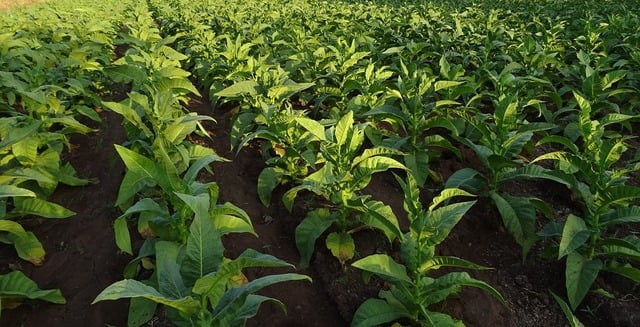
The Spanish company MadeInPlant and the agricultural union AVA have obtained authorisation to conduct field trials on genetically modified tobacco that they planted in 20251. In this trial, nicotine is supposed to have been largely replaced by another molecule, anatabine, an alkaloid with anti-inflammatory and neuroprotective properties. Anatabine occurs naturally in the leaves of plants in the Solanaceae family, such as tobacco. It helps the plant defend itself against insects. The increase in the amount of this molecule sought by technicians should serve as a medicine for Alzheimer’s disease, multiple sclerosis and intestinal inflammation. At least, that is what the company involved in this trial claims. However, the effectiveness of anatabine against Alzheimer’s disease has not yet been proven in humans. The available data is limited to preclinical studies2 on animal models showing a reduction in brain inflammation and amyloid markers.
A “NGT” plant with transgenic origins
Surprisingly, the public information document (Summary Notification Information Format, SNIF)3 for this trial is only available in Spanish on the website of the Spanish Ministry for Ecological Transition, but has not been posted on the European Commission’s website listing GMO field trials in Europe.
Technically, according to this SNIF, “the tobacco plants involved in this trial have mutations (deletions and insertions) in the endogenous MPO genes. The mutations were generated using the CRISPR/Cas9 system“. More specifically, “the modified plants have mutations in the MPO1 (N-methylputrescine oxidase 1) genes of tobacco, an enzyme that catalyses the second step in the biosynthesis pathway of alkaloids in tobacco. The mutations introduced consist of insertions or deletions in the gene sequence that result in the production of truncated proteins and potentially their loss of function. Under greenhouse conditions, these lines show reduced nicotine levels and increased anatabine levels“. It is specified that “these plants do not contain any exogenous DNA fragments“.
The trial is regulated under Part B of Directive 2001/18. However, the stipulation that no fragments of exogenous DNA are present in the final plant means that, if the deregulation bill currently under discussion is adopted, this trial would enable the company to apply for deregulated GMO status. However, this plant was obtained from transgenic tobacco. Indeed, it is also specified that the first stage of the production protocol for this genetically modified tobacco involves transgenes introduced using Agrobacterium (transgenes expressing the CRISPR/Cas complex and selection markers). It is then specified that one of the steps consists of selecting plants that no longer contain these transgenes. According to the dossier, the absence of these transgenes has been confirmed by sequencing (PCR).
What are AVA and MadeInPlant?
According to SNIF, the aim of this trial is to “determine the optimal growing conditions in the field for the modified strain for use as an anatabine “biofactory” plant“. The trial, planned for an area of 2,500 m², is being conducted jointly by the Valencian Farmers’ Association (AVA) and the Valencian company MadeInPlant.
The AVA is a member of the Spanish union ASAJA, itself a member of COPA-COGECA at European level. Its treasurer, Miguel Minguet, is currently vice-president of the European organisation in the field of ‘plant health’ (sic). ASAJA welcomed the agreement reached during the trilogue on Wednesday 3 December4 and stated: “It is essential that the agreement confirms that NTG 1 plants, because they are indistinguishable from conventionally bred plants, will be regulated in the same way as the latter“. The union provided one of its farms for the trial.
MadeInPlant is a Spanish biotechnology company, a spin-off of the Spanish National Research Council (CSIC) and the Polytechnic University of Valencia (UPV), specialising in the production of ‘biomolecules’ using plants as ‘biofactories’5. It uses genetically modified plants to produce antibodies, human growth factors, metabolites and enzymes for the pharmaceutical, cosmetics, agri-food and research sectors. This company is also active in the field of synthetic biology6.
MadeInPlant also works on other projects, sometimes through other companies, such as CTAEX. The two entities cooperate on initiatives such as the AGROFACTORY project, funded by the European Union (EAFRD), which aims to develop ‘biofactory’ crops based on Nicotiana tabacum tobacco to produce thaumatin. They also share partnerships with NOMAD Bioscience (or NAMBAWAN) for greenhouse and field trials on protein-producing plants (thaumatin, antibacterial/antiviral proteins), including regulatory and technical aspects7. CTAEX has also filed applications for similar GMO tobacco field trials in Spain8. Thaumatin is not a molecule of therapeutic interest. It was originally extracted from the fruit of the katemfe tree, native to tropical Africa, for its intense sweetening power (approximately 2,000 to 3,000 times greater than sucrose). This molecule is therefore mainly used as a low-calorie sweetener with no impact on blood sugar levels9. It is found in sugar-reduced products such as drinks, chewing gum, desserts and confectionery. It is authorised in the European Union as an additive under the name E957.
The AVA invents its own definition of GMO
Articles referring to this trial, such as those published in Agronews Comunitat Valenciana10, Bolsamania, Valencia News and Democrata.es, repeat the agricultural union’s statement almost word for word. In a press release11 published on 25 July 2025, it states that “the genomic techniques used in the study belong to the group of new gene editing techniques (NGT), which allow precise modifications to be made to the plant’s genome without incorporating DNA from other species. This clearly distinguishes them from genetically modified organisms, traditionally known as GMOs, and makes them a key tool for the development of safer and more widely accepted agricultural biotechnology“.
This statement is neither scientifically nor legally justified. To date, GMOs are defined by Directive 2001/18, which makes no reference to transgenesis or the addition of genes from other species. An GMO, let us reiterate, is “an organism, with the exception of human beings, whose genetic material has been modified in a way that does not occur naturally through multiplication and/or natural recombination“. The genetic modification made to this tobacco corresponds in every respect to this definition. Despite the distinction they wish to make between plants obtained by ‘new genomic techniques’ and GMOs, this tobacco is indeed a GMO. They themselves recognise this de facto: they have submitted an application for authorisation in accordance with current European GMO legislation, namely Directive 2001/18.
Tobacco to boost the local economy?
The company MadeInPlant emphasises on its website that this therapeutic tobacco project will also have a positive impact on the local economy: “The declining competitiveness of traditional herbaceous crops has jeopardized the viability of many agricultural enterprises, contributing to rural depopulation in various regions of Spain. A prime example is traditional tobacco cultivation, which not only faces profitability challenges common to other crops but also increasing stigmatization due to its conventional uses. This situation calls for viable and sustainable alternatives“.
This statement is partly misleading. In fact, the decline of tobacco cultivation in Spain is mainly due to the end of European subsidies12, the end of Tabacalera’s monopoly, which guaranteed attractive prices for producers13, and the decline in global demand, not to an intrinsic “decline in competitiveness” or decisive stigmatisation. It is unlikely that ‘therapeutic tobacco’ could actually revive such agricultural activity. In 2007, a French start-up, Librophyt, also conducted field trials of GMOs to produce therapeutic molecules14. This company ceased operations around 2010 due to a lack of commercial viability. In practical terms, extracting biomolecules from plants is not profitable on a large scale15. On average, less than 1% of the total weight of the plant is obtained, with fairly high purification costs. Has MadeInPlant found a solution to these technical and economic difficulties? Nothing in their communication allows us to say so.
Health as a pretext for deregulating GMOs/NGTs
This new trial highlights how health is being exploited to accelerate the deregulation of genetically modified plants using new techniques. However, the AVA agricultural union concludes its press release as follows: “This approach opens the door to applications in commercially important crops such as citrus fruits, rice and tomatoes, with the aim of improving nutritional properties, increasing resistance to pests and diseases, and reducing the use of plant protection products“. The promise of transgenic plants capable of producing any therapeutic molecule at low cost has not been fulfilled, despite numerous trials and public funding. Promoters of GMOs/NGTs reiterate this promise, claiming that the tools they have developed, notably Crispr, can solve the technical difficulties of transgenesis. So far, this has not yet been demonstrated factually.
- Chilebio Noticias, « España avanza a ensayos de campo con un tabaco editado sin nicotina y rico en un compuesto con propiedades medicinales », 10 August 2025. ↩︎
- Messinis, Dimitris E et al., « Systems biology reveals anatabine to be an NRF2 activator », Frontiers in pharmacology, vol. 13, 16 November 2022. ↩︎
- Miteco, Dossier B/ES/24/42, « RESUMEN DE LA NOTIFICACIÓN DE LA LIBERACIÓN DE PLANTAS SUPERIORES MODIFICADAS GENÉTICAMENTE (ANGIOSPERMAS Y GIMNOSPERMAS) », 17 December 2024. ↩︎
- Asaja, « Las nuevas técnicas genómicas avanzan: la UE alcanza un consenso histórico sobre soluciones para la agricultura europea », 4 December 2025. ↩︎
- Universitat Politècnica de València, « MadeInPlant | Plant biotechnology to produce valuable compounds in the sustainable field ».
MadeInPlant, « About us ». ↩︎ - In the study published in Plant Physiology on GoldenBraid, a synthetic biology system that allows pieces of DNA (genes, switches) to be assembled to create modified plants, one of the authors, Diego Orzaez, is a founding member of MadeInPlant.
Sarrion-Perdigones, Alejandro et al., « GoldenBraid 2.0: a comprehensive DNA assembly framework for plant synthetic biology », Plant physiology, vol. 162, 13 mai 2013. ↩︎ - Nomad Bioscience, « NOMAD Bioscience Enters Into Agreement with CTAEX, Spain, To Conduct Its First Field Trials With Plants Producing Non-Caloric Sweetener Thaumatin II in Extremadura, Spain », 10 November 2020. ↩︎
- European Commission, Food and Feed Information Portal Database, « Development of a genetically edited tobacco line with high anatabine content », 18 November 2024.
European Commission, Food and Feed Information Portal Database, « Development of a gene-edited tobacco line with high anatabine content », 16 January 2024. ↩︎ - Wikipedia contributors, “Thaumatin”, Wikipedia, The Free Encyclopedia, accessed January 6, 2026. ↩︎
- A relatively opaque website (the names of the editors or article writers are unknown). ↩︎
- AVA, « Un estudio pionero en la finca Sinyent produce tabaco sin nicotina y con compuestos farmacológicos », 25 July 2025. ↩︎
- European Union, « Document 52004DC0394 – Commission working document – Integrating environmental considerations into other policy areas- a stocktaking of the Cardiff process ». ↩︎
- Marc Ferrand, « La Production de tabac en Espagne », 1988. ↩︎
- Hervé Morin, « Un tabac OGM pour fabriquer des molécules thérapeutiques », Le Monde, 20 February 2007. ↩︎
- Ibid. ↩︎