
News
A biotech “Alliance”: when lobbying becomes institutionalised
By Denis MESHAKA
Published on the 30/09/2025, modify the 09/03/2026


At the end of July 2025, the EU Biotech and Life Sciences Alliance was quietly launched in the European Parliamenti. Supported by the lobby group Europabio, its aim is to bring together MEPs to “ensure that the [European] Union takes bold and coordinated action” to strengthen its biotechnology sector. While this initiative reflects a desire to maintain Europe’s competitiveness, it raises a major political question: where does democratic representation end and institutionalised lobbying begin?

In Brussels, lobbying is nothing unusual, with thousands of “interest groups” with different interests (NGOs, industries, trade unions, etc.) seeking to make their voices heard and influence European decisions. With the creation of the EU Biotech and Life Sciences Alliance, the biotech sector is seeking to strengthen its position in the European Parliament: in addition to the usual meetings in the offices and corridors of the European institutions, there is now a hybrid political structure, where MEPs appear alongside industrialists in a framework designed and run by the latterii. Elected to defend the public interest, they become de facto members of a private initiative whose agenda is to shape a regulatory environment that is more favourable to the biotechnology industry. Will European policy in this area be the result of a pluralistic democratic debate or a strategy of influence fuelled by lobbyists?
An initiative tailored for and by industry
To understand the scope of this Alliance, we need to look at who is pulling the strings. It describes itself as a “European parliamentary interest group founded to gather members of the European Parliament interested in biotechnology across sectors“. Behind this institutional facade – such parliamentary interest groups are commonplace – the organisation is anything but neutral, as it is supported and orchestrated by EuropaBio (European association for Bioindustries), the leading lobby group for European biotech giants. This support appears discreetly at the bottom of the page on the Alliance’s website: “Secretariat and funding – EuropaBio, the European association for bioindustries, supports the Group’s secretariat“. It is confirmed by the presence of Claire Skentelbery, Director General of EuropaBio, at the launch of the Alliance on 7 July 2025 in Strasbourgiii.
On its website, the EU Biotech and Life Sciences Alliance logically acts as a spokesperson for the industry. In a section entitled “The EU Biotech Mandate : A Path to global Leadership and Resilience“, its position is unequivocal. In particular, it emphasises the need to “maximise impact from a broad cluster of EC legislation and strategies, led by the Biotech Activ”. Since its inception, this legislative project has been actively supported by the European biotech industry, through its representative EuropaBiov vi.
The members of the Alliance
The twelve MEPs who are members of the EU Biotech and Life Sciences Alliance include representatives from various political groups – S&D (5), Renew (4), EPP (2) and Patriots (1). Of particular note is the presence of Stine Bosse (Renew), founder and co-chair of the Alliance alongside Eszter Lakos (EPP). Danish MEP Bosse, who is also vice-chair of the Committee on Public Health Committee and a member of the Committee on Environment, states on social mediavii that the Alliance “covers the diversity of political groups in Parliament, for a truly representative group working together to advance understanding and policymaking“.
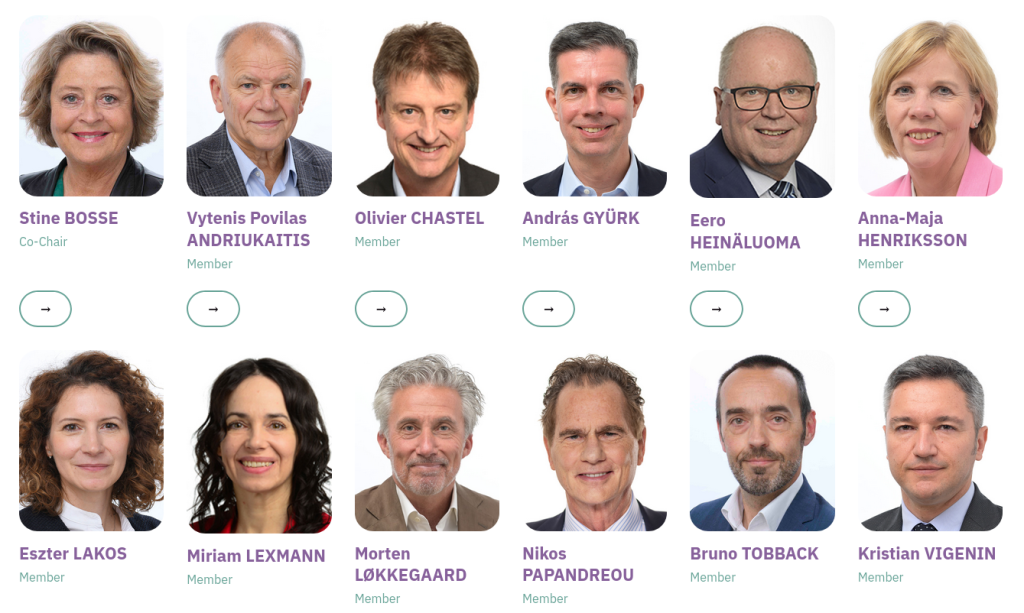
No explicit past or current links to the biotechnology or life sciences industry have been declared by these MEPs in their “Declaration of Private Interests“. Only Stine Bosse, who initiated the Alliance, declaresviii that she has worked for investment consulting firms and in the oil industry. However, the proximity of key parliamentary players to industry in the context of such an “alliance” cannot fail to influence their views, decisions and parliamentary activities. While it may be accepted that this is “part of the political game“, one may nevertheless question the real scope of this representativeness when EuropaBio’s lobbying agency, APCO, whose total lobbying costs in 2024 amount to nearly three million eurosix, is also involved in providing the secretariat for the Alliancex?
From lobbying to decisive influence
We contacted the EU Biotech and Life Sciences Alliance to understand how it works. They replied that it was “founded at the request of MEPs, and EuropaBio does not play a role in its delivery. MEPs are the drivers of topics and activities carried out by the Alliance. EuropaBio is funding the Secretariat of the Alliance, provided by APCO at present, as stated on the website. APCO is an independent service provider to the Alliance. APCO acts as the Secretariat of the Alliance and delivers activities as requested, approved and initiated by the MEPs“.
By funding the Alliance’s secretariat, which is run by a lobbying firm, EuropaBio is no longer content to influence elected representatives from the outside. It is establishing itself at the very heart of the parliamentary system. In parliamentary proceedings, a secretariat performs the important function of providing logistical support for, among other things, organising meetings, preparing minutes or briefing notes, communications (website, newsletter, events, etc.), administrative follow-up with MEPs and their assistants, and so on.
As the Alliance tells us, the APCO lobbyist can even, as secretary, more broadly “carry out activities requested, approved and initiated by MEPs“, with EuropaBio providing APCO with the financial resources to carry out these activities. Thus, although the Alliance’s MEPs are not themselves paid by EuropaBio, the interest group, which has no official institutional budget, relies on this private funding to exist. In concrete terms, thanks to this funding, Alliance MEPs have a space for meetings, events and exchanges… and consequently an agenda and priorities influenced by EuropaBio.
The challenge of biotechnology
This Alliance is not an isolated exception. Many sectors use comparable systems, such as the European Internet Forum for digital technologyxi. But this practice is particularly sensitive in the field of biotechnology, where European institutions’ decisions affect crucial societal issues. Examples include the protection of biodiversity (particularly pollinators), the right to organic and non-GMO food, food sovereignty, public health, the patent economy, the financialisation of life… and, of course, the subject of new genomic modification techniques (NGTs), at a time when the trilogue on the proposed Regulation is underwayxii.
It is also a highly concentrated sector controlled by the largest multinationals in the life sciences, agriculture and food industries – often the same companies – which hold a large share of the patents on marketed or developing products and related technologiesxiii. The influence of traditional biotech lobbying on legislators is already strongxiv, but it becomes even stronger when elected representatives engage in alliances and parliamentary interest groups whose agenda can be influenced by industrial lobbying structures. On the specific subject of NGTs, one consequence is an increased risk of deregulation, which favours agro-industrial multinationals, but also an understandable erosion of public confidence in institutions and their role in protecting public health and the environment.
Lifting the veil of secrecy on a common practice
Unlike the European Parliament’s “official intergroups“xv (informal forums for discussion between political groups, MEPs and civil society or businesses), which must comply with strict rules on transparency and fundingxvi, alliances or “parliamentary interest groups” seem to escape public scrutiny to a large extent. Reports are rare, funding is opaque, communication is possibly controlled by industry, and the people of the European Union have little or no information about them.
As several of these groups are structured around industry funding, this raises a global issue of transparency and conflicts of interest. How can MEPs remain impartial arbiters of regulation in a sector if they participate in an initiative set up by and for the defence of the interests of those they are supposed to regulate? This proximity fuels a well-known risk called “regulatory capture“, which means that the rules end up being written, directly or indirectly, by those who want to profit from them.
For years, NGOs such as Corporate Europe Observatoryxvii and Transparency Internationalxviii have been denouncing this parallel system, which allows lobbies to gain political legitimacy without submitting to the framework imposed on official parliamentary structures. But the problem remains: does Europe want to be a place where public policy is made transparently and in the public interest, or a place where industry itself organises parliamentary alliances that shape the law?
i EU Biotech and Life Sciences Alliance, “About Biotechnology and Life Sciences”.
ii EU Biotech and Life Sciences Alliance, “Biotech Takes the Spotlight: New EU Biotech and Life Sciences Alliance Launches in Strasbourg,“ 11 July 2025.
iii Ibid.
iv Denis Meshaka, “The European Commission postpones its ‘biotech law once again” Inf’OGM, 3 June 2025.
v Europabio, “EuropaBio’s Vision for a Bold EU Biotech Act”, 19 January 2025.
vi Europabio, “The EU Biotech Act.”
vii LinkedIn, “ ‘ EU Biotech and Life Sciences Alliance”.
viii European Parliament, Declaration of interests of Stine Bosse, 24 September 2024.
x EU Biotech and Life Sciences Alliance, “About Biotechnology and Life Sciences.”
LobbyFacts, “APCO Worldwide“.
xii Denis Meshaka, “The scientific lobby joins the trilogue on the deregulation of GMOs/NTGs”, Inf’OGM, 5 August 2025.
xiii Charlotte Krinke and Denis Meshaka, “Crispr/Cas9: access to a minefield?”, Inf’OGM, 21 June 2022.
xiv Claire Robinson and MPhil, “Behind the smokescreen, Vested interests of EU scientists lobbying for GMO deregulation,“ The Greens/EFA, September 2022.
xv European Parliament, “Intergroups in the European Parliament“.
xvi European Parliament, “Lobbying and transparency”.