
News
RNA interference: an expanding “biocontrol” product
By Christophe NOISETTE
Published on the 30/10/2026, modify the 03/11/2026


In August 2026, Mexico became the first country to authorize the commercial sale of a fungicide containing an interfering RNA (RNAi) as its active ingredient. This is not the first commercially approved product to utilize such molecules. The best-known example remains Calantha – developed by the same company, GreenLight Biosciences – which is designed to combat the Colorado potato beetle. This article provides a brief overview of the current status of RNAi-based pesticides.
Synthetic chemical pesticides are increasingly being criticized – not only for their adverse effects on health and the environment, but also for their growing ineffectiveness. Against this backdrop, biotechnology companies are exploring the mechanisms of living organisms, seeking to harness them through industrially manufactured products. One such technology, categorized under “biocontrol” products, is RNA interference (RNAi). This mechanism exists in nature, serving, among other things, as a defense system for living organisms. Small molecules, known as RNAii, have the ability to “silence” a vital genetic sequence in an aggressor.
Oifirax: An RNAi-based fungicide
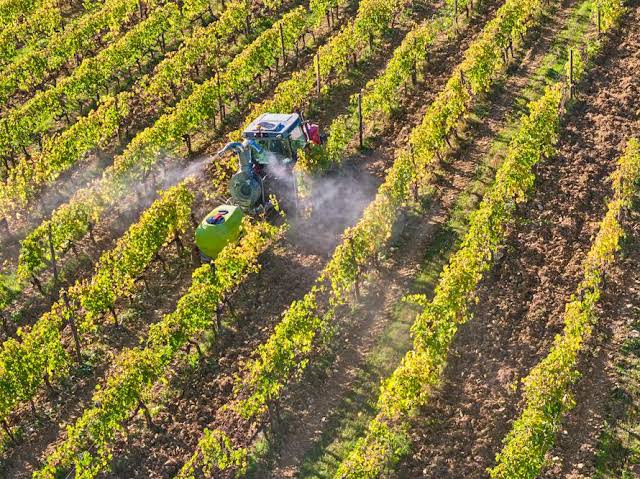
A genetic fungicide named Oifirax, developed by GreenLight Biosciences, was approved in Mexicoii last August for use against powdery mildew – a disease caused by the fungus Erysiphe necator. This fungicide contains an artificially produced RNAi molecule that “silences” the CYP51 genetic sequence within the target fungus. This sequence codes for an enzyme involved in the synthesis of ergosterol, an essential component of the fungal membrane – a thin envelope surrounding the cells. Altering these membranes disrupts the fungus’s development.
On October 28, 2025, GreenLight Biosciencesiii announced that it had submitted authorization applications for Oifirax – a product still under study – in the United Statesiv, the European Unionv (EU), and Brazil during the second quarter of 2025. The company plans to take similar steps in Argentina and Chile. It also states its intention to invest up to $100 million (approximately €89 million) in an industrial facility in the Mexico City metropolitan area, dedicated to the research, production, and export of RNA-based productsvi.
Inconclusive field evaluations and unknown risks
There is little public information available regarding the evaluations of this genetic fungicide, Oifirax. Among the information that is accessible, it is known that in 2025, Cornell AgriTech conducted field tests on grapevines using an RNA-based fungicide formulation from GreenLight Biosciences, identified as ES43-F-018vii. Cornell University described the results as “encouraging“. In practical terms, the trial targeting powdery mildew involved eight applications spaced ten days apart; however, the GreenLight Biosciences product was not tested in isolation – it was incorporated into programs that alternated between RNA, sulfur, and conventional fungicides. Under these conditions, how can its efficacy be properly assessed? Inf’OGM has found no documentary evidence of field trials in other countries (such as those in the EU, Mexico, or Brazil).
In terms of risk, the issue of specificity is worth highlighting. A fungicide is, by nature, more or less specific to the fungus it targets, though it may also affect other species. The genetic sequence it targets – CYP51 – is quite widespread among fungi; therefore, it is possible that the fungicide could also destroy “non-target” fungi.
Strong opposition
In the Mexican city of Oaxaca, the Espacio Estatal en Defensa del Maíz Nativo de Oaxaca – a coalition of 25 organizations, communities, and collectives – has voiced its opposition to this authorization. They are demanding that the product neither be manufactured nor used in Mexico until an independent environmental and health assessment has been conducted. Furthermore, these organizations challenge the use of the term “biofungicide“, which they consider misleading, as it implies the product is harmless or eco-friendly. This labeling contributes to confusion by applying the prefix “bio” to a wide range of products – most of which are not permitted in organic farmingviii. The organizations’ criticisms extend beyond RNA-based pesticides. In their statement, they also denounce the promotion of New Genomic Techniques (NGTs) applied to crops and insects – citing, for instance, a project involving genetically modified (GM) fliesix. They view this as part of a broader “techno-solutionist” agenda, pursued without genuine public debate or any regard for the precautionary principle.
GreenLight Biosciences brings more genetic pesticides to market
This Mexican regulatory approval marks a new milestone for GreenLight Biosciences, a company specializing in RNA-based pesticides, which it markets as an alternative to chemical pesticides. This fungicide is the third product from GreenLight Biosciences to be authorized for commercial sale. The other two are Calantha – an RNAi-based spray targeting the Colorado potato beetle – and Norroa, which targets Varroa destructor, a parasite that affects honey bees. Both of these products are currently authorized only in the United States.
What is the status of the Calantha application in Europe?
GreenLight Biosciences submitted an authorization application for Calantha in the EU in April 2025. The European Food Safety Authority (EFSA) has launched two public consultations.
The firstx, which took place from September 26 to October 17, 2025, focused on the application dossier submitted by the company and aimed to gather relevant studies or data prior to the formal assessment. Only one response was received during this consultation: a submission from the NGO Pollinis. Citing scientific studies, the organization argues that the current assessment process for this genetic pesticide is inadequate.
The secondxi phase, which will conclude on October 30, 2026, concerns the evaluation report drafted by the rapporteur Member State, Belgium, prior to its review by EFSA. In this report, Belgium classifies ledprona – the active substance in Calantha, used against the Colorado potato beetle – as a “low-risk substance“. Consequently, it deems it unnecessary to establish an acceptable daily intake (ADI) or exposure thresholds for those applying the product or for local residents. However, Belgium does raise two issues. First, it acknowledges uncertainties regarding non-target arthropods. A bioinformatic analysis identified six exact matches of 21 consecutive nucleotides between the ledprona sequence and sequences found in the seven-spot ladybird (Coccinella septempunctata). These matches could potentially allow ledprona to interfere with the expression of certain genetic sequences in the ladybird. Second, a 16-day trial showed a mortality rate of 63% to 70% among adult Diabrotica undecimpunctata (a type of leaf beetle) that had ingested the product. These findings therefore raise questions regarding the limits of the product’s specificity.
It should be noted that, from May 1 to August 28, 2026, Calantha was granted a temporary emergency authorization in Belgium. Such a derogation, provided for under Regulation 1107/2009 (Article 53), is permitted for the purpose of addressing a “danger that cannot be contained by any other reasonable means“. Yet, in September 2026, the organization Pollinisxii stated that this condition “appears far from being met in the case of Calantha“. According to documents and information obtained by Pollinis, not only was the threat posed by the Colorado potato beetle never classified as an emergency by industry stakeholders, but the product was, in fact, never marketed in the country throughout the entire duration of the derogation. And for good reason: the only two distributors of “Calantha” – outlets linked to Fine Agrochemicals B.V., a subsidiary of the De Sangosse Group – confirmed to Pollinis that they “chose not to offer the pesticide for sale during the entire period of the derogation“. The reason: there were too many uncertainties regarding its genetic mode of action, which is still novel and has never been evaluated.
It should also be noted that on June 13, 2025, the EFSA brought together GreenLight Biosciences, the European Commission, and representatives from member states for a workshop focused on RNA-based pesticidesxiii. According to the EFSA, the objective was to facilitate technical discussions with the industry and prepare for the evaluation of future regulatory dossiers based on this technology. This workshop is part of a broader series called “bioNAS“, which is dedicated to “innovative biopesticides“.
Other RNAi-based pesticides under development
On its website, GreenLight Biosciences showcases about a dozen other RNA-interference (RNAi) products, including insecticides targeting moths or thrips; fungicides against Fusarium (a widespread pathogenic fungus), late blight, or apple scab; and an herbicide targeting horseweed (Conyza canadensis).
In addition to spray-based applications, the company is also developing RNAi-based seed treatments. In January 2022, it announced a research partnership with Germains Seed Technology, combining Germains’ expertise in seed preparation and coating technologies with its own proficiency in double-stranded RNA (dsRNA). In a patent applicationxiv, GreenLight Biosciences describes applying double-stranded RNA (dsRNA) to seeds – via soaking or coating – to trigger RNA interference within the young plant. This RNA is designed to reduce the expression of specific plant genes that act as inhibitors of pathogen defense mechanisms, thereby strengthening the plant’s defenses. The document reports that a double-stranded RNA targeting a specific genetic sequence in soybeans, when applied as a seed treatment, protected the plants against the fungus Rhizoctonia solani. This patent application has a very broad scope: it describes numerous genetic targets and several methods of application – such as soaking, coating, or spraying – on seeds, seedlings, leaves, or roots. The same patent application also covers protection against fungi, bacteria, and viruses for a wide range of crops, including soybeans, lettuce, spinach, cereals, corn, cotton, and rice.
Other companies are positioning themselves in the field of RNAi sprays.
Another product utilizing RNAi has been authorized in Chinaxv; manufactured by Silicon Gene, it targets the tobacco mosaic virus.
While market authorizations remain very limited, industrial research in this area is abundant. Direct competitors to GreenLight Biosciences include AgroSpheres, RNAissance Ag, and Renaissance BioSciencexvi. In 2024, AgroSpheres entered into a multi-year commercial development agreement with FMC Corporation, a multinational company that produces and markets chemical pesticides.
The « Omnibus X » legislative package, which aims to facilitate the commercialization of biocontrol products – defined in very broad terms – proposes that for “low-risk” substances, the regulatory focus should be solely on the active ingredient rather than the product as a whole. As previously noted, this is just one of many regulatory simplifications included in the text. However, RNAi is never sprayed on its own; in its current form, it must be encapsulated within a nanoparticle to function.
i Annick Bossu, « L’ARN interférent : une face cachée du biocontrôle », Inf’OGM, le journal, n°177, October/December 2024.
ii Humberto Basilio, « In a global first, Mexico approves use of RNA-based fungicide », Science, 25 August 2026.
iii GreenLight Biosciences, « GreenLight Biosciences Submits Regulatory Dossier in US, EU and Brazil for Groundbreaking RNA-Based Solution to Control Grape Powdery Mildew », 28 October 2025.
iv Environmental Protection Agency, « GreenLight Biosciences, Inc Notice of Filing Pesticide Petition to establish an exemption from the requirement of a tolerance for new active ingredient Unecyna at 2.2% is a fungicide that specifically targets Powdery Mildew on grapes. The proposed formulation end-use product would be a soluble liquid containing Unecyna at 1% », 2 February 2026.
v EFSA/AESA, « Pesticide risk assessment and peer review of Unecyna in accordance with Article 12 of Regulation (EC) No 1107/2009 (application for approval) », last updated on 2 March 2026. On February 26, 2026, EFSA concluded that the dossier, submitted on September 29, 2025, was admissible for evaluation.
vi « GreenLight Biosciences producirá el primer biofungicida de RNA en México », Opportimes, 12 August 2026.
vii Cornell University, « Grape Pathology Updates, 2026 », 30 April 2026.
viii Christophe Noisette, « Organic farming and biocontrol: two concepts that do not overlap », Inf’OGM, 8 September 2026.
ix This is the NovoFly project, which aims to sterilize male New World screwworm flies (Cochliomyia hominivorax), a parasite that affects livestock.
x EFSA/AESA, Public Consultation PC-1629, « Application for the approval of the New Active Substance Ledprona », from 26 September 2025 to 17 October 2025.
xi EFSA/AESA, Public Consultation PC-2067, « Assessment Report on the active substance ledprona », from 31 August 2026 to 30 October 2026.
xii Pollinis, « Le Calantha, un pesticide génétique autorisé en urgence que personne n’a réclamé…sauf son fabricant », 9 September 2026.
xiii EFSA/AESA, « Ad hoc meeting 1st workshop on innovative biopesticides (bioNAS) – RNA-based technology for use in Plant Protection Products (PPP) », 13 June 2025.
xiv Published under number WO2024187037A1.
xv « A new milestone in Chinese biopesticide industry: First RNAi-based biopesticide granted registration », AgroPages, 14 April 2026.
xvi « RNA-Based Pesticides Move From Laboratory Science to Commercial Crop Protection », Global Agriculture, 1st September 2026.
We need your help!
For over 25 years, Inf’OGM has been producing information, made freely available to everyone, on the artificialisation and appropriation of life (GMOs, NTGs, biotech, patents, etc.).
The monopolisation of a large share of public press subsidies by a few media groups reinforces the concentration of media ownership in the hands of a handful of businessmen. This concentration undermines the quality of information and democratic debate, which require a plurality of viewpoints.
In this context, alternative media outlets such as Inf’OGM, which receive no advertising revenue and provide information free of charge, need you – our readers – to continue to exist! Because, even when freely accessible, information comes at a cost.
Supporting Inf’OGM means working towards reliable, independent information on GMOs, biotechnology and seeds that is accessible to everyone.