
Nanoparticles galore in pesticides
By Blandine FLIPO, journaliste à Sciences Critiques
Published on the 02/03/2026, modify the 09/03/2026


A report by ANSES, published last April, proposes to increase vigilance regarding the use of nanopesticides. These nanometric molecules are highly volatile, which considerably increases their potential for dissemination and contamination, as well as their potential toxic effects on the body. The problem is that not only is their sale unregulated in Europe, but the regulations do not provide for their detection.
Inf’OGM has co-published with Sciences Critiques an article by Blandine Flipo shedding light on the issue of nanopesticides, pesticide products containing nanoparticles used in agriculture. This article illustrates how the issues of information, monitoring and risk assessment are shared with the field of GMOs, at a time when many of them are facing potential deregulation.
On 1st April 2025, the French Agency for Food, Environmental and Occupational Health & Safety (ANSES) published a report entitled, which went surprisingly unnoticedi. This exploratory study, conducted with the Laboratoire national de métrologie et d’essais (National Metrology and Testing Laboratory, LNE Group), the French group responsible for carrying out measurements, set out to test for the presence of particles smaller than 100 nanometres in some of the most commonly used plant protection products.
The results are revealing: with the exception of one biocide, the researchers detected the presence of these nanoparticles in all of the products tested, both solid and liquid, in highly variable proportions.
“There are currently no regulations on nanopesticides“
Ludwig Blanc is a farmer in Chabrillan, in the Drôme region of France. He grows fresh basil and white garlic, which is sold in the local Super U supermarket. As a conventional farmer, he regularly handles plant protection products. Does he know that these products probably contain nanopesticides? “I’m not a chemist or an analyst“, he tells Sciences Critiques. “I don’t know exactly what’s in them, but I know it’s not mineral water! But whether they’re small, very small, or even tiny, I’m not surprised“.
Ludwig Blanc explains that he takes training courses with Certiphyto (individual certificate for plant protection products) representatives from the Drôme Chamber of Agriculture: “We are informed about everything related to equipment, masks, goggles and suitable gloves. We are extremely well trained“. However, he admits that he has not received any information about nanomaterials: “I am not qualified to say whether the masks and regulations are up to date, or whether they are sufficient to manage the risks of nanomaterials“.
And for good reason: to date, there are no regulations on nanopesticides, as Mathilde Detcheverry of the Association for Civic Monitoring and Information on Nanoscience and Nanotechnology Issues (AVICENN) explains: “While in Asia and the United States, some manufacturers disclose the use of nanos in pesticides, this is not the case in the European Union. This does not mean that they do not use them, simply that they apply a precautionary principle… at least in terms of marketing and communication! In fact, they are not legally obliged to indicate the presence of nanos on the packaging of their products, unlike cosmetics and food brands, which are required to do so. At European level, neither Regulation No. 1107/2009 on plant protection products nor Regulation No. 2019/1009 on fertilising products takes into account the size of the particles used in pesticides and fertilisers (whether for active substances or co-formulants)“.
In France, things are different: since 2013, manufacturers have been required to register any product containing 100 grams or more of nanoparticles in the R-Nano registerii, managed by ANSES. However, in 2016, researchers interested in this register managed by ANSES made a strange discovery. Eric Houdeau, a researcher at the French National Research Institute for Agriculture, Food and the Environment (INRAE) and former ANSES expert in the “Nano and Food” working group, explains: “Looking at the R-Nano register, we realised that the agricultural sector has the highest number of registrants“. However, none of these products are officially sold as nanopesticides. How is this possible?
Nanos everywhere
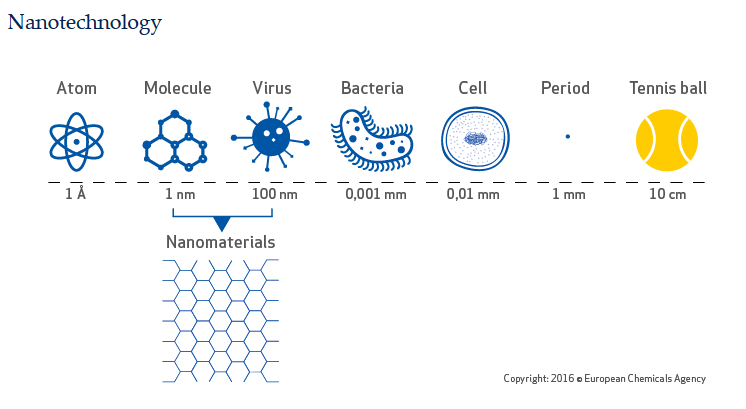
First, we need to know what we’re talking about! Bruno Lamas, a researcher at INRAE, explains: “Nanopesticides can contain particles ranging from 1 to 1,000 nanometres, whereas the official definition of nanoparticles is normally 1 to 100 nanometres“. There are nanoparticles of copper, silver and titanium dioxide, but also preparations in the form of micelles, a kind of nanometric capsule containing active substances (which can also be imagined in nanometric form), as well as hybrid forms (a combination of the two).
In short, there are many types of nanopesticides, which vary according to their composition. In addition, European regulations specify that nanoparticles must account for more than 50% of the total number of particles in a given substance for it to be considered a nanomaterial. This is not necessarily the case with conventional plant protection products…
Julien Durand-Réville is health manager at Phytéis (formerly the Union des industries des protections des plantes), a professional association of 18 companies that produce plant protection products for agricultural use. He confirms: “To our knowledge, there are currently no synthetic active substances with nano characteristics intentionally placed on the market in Europe for this purpose. However, there are certain co-formulants (powders, capsules, etc.) in which some of the distribution size contains nanoparticles“.
“When grinding techniques are used, we know that nanoparticles are inevitably produced“.
Eric Houdeau, Inrae
He explains this unintentional presence of nanomaterials by an industrial process: “When you grind powder or a mineral, there are large, medium, small and very small particles. And some of the smallest ones fall below the threshold for being considered nano. Thus, in a bag of powdered product, part of the weight is made up of these very small particles, and the product as a whole must therefore be declared in the R-Nano database. Even if, in terms of distribution, these small particles are tiny in relation to the total weight of the bag. Our products weigh artificially “dozens of kilograms” where, in other sectors of activity, intentional nanoparticles are sold directly to users in the production chain (i.e. a few grams)”. He adds that these particles are only found in “co-formulants“, not in active substances, and have not been intentionally added for any potential “nano-specific” properties.
However, according to European regulations, all chemicals must be assessed by the European Chemicals Agency (ECHA), which manages the REACH regulationiii. ANSES (or the European Food Safety Authority – EFSA – at European level) carries out a risk assessment when these chemicals are present in food or the environment. Eric Houdeau, an expert at ANSES, continues: “When grinding techniques are used, we know that nanoparticles are inevitably produced, which have the particularity of passing through biological barriers, with potential effects on health. Even if their volume share remains low in the final product, they are present in the billions. However,we do not know what specific impacts these nanoparticles have“. He regrets: “We are putting products on the market for which we are unable to assess the risk. Yet it is the very essence of REACH and the health authorities to carry out risk assessments!“.
Effects on the microbiota
Last October, four researchers from the INRAE Research Centre in food toxicology in Toulouse (including Bruno Lamas and Eric Houdeau) published a scientific review of studies on the impact of copper-based nanoparticles on the intestine in the journal The Science of the Total Environmentiv.
Researcher Bruno Lamas, co-author of the review, summarises: “What we found is that, at equal concentrations, copper nanoparticles are more cytotoxic than micrometric particles. In animals, their ingestion also causes more marked alterations in the microbiota and intestinal barrier. This intestinal microbiota, composed of bacteria and fungi, produces molecules that are beneficial to the host through the digestion of certain dietary fibres. However, in the presence of copper nanoparticles, the production of these molecules is significantly reduced. These observations suggest that copper nanoparticles have more harmful effects on the intestine“.
Why? It is not a question of the volume of material, but of the quantity of particles, explains Eric Houdeau: “Even if you apply less active ingredient with nanomaterials than with conventional pesticides on cultivated land, you still end up with many more ultra-fine products on the same surface area.” With just 100 grams, millions of nanoparticles are spread on agricultural land at once, “which accumulate in crops and end up being consumed by humans at the end of the food chain“.
“The amount of nanoparticles present in products must be reduced as much as possible“.
Anses
In light of the various existing studies, Anses concludes in its report: “Given the current state of knowledge on possible changes in particle shape, for example after dilution of the product and depending on the method of application used, there is considerable uncertainty about the levels of exposure of humans and environmental organisms“. It recommends that, in the absence of clear regulations and risk assessment methods, “nanoparticles in the product should be reduced as much as possible“.
Finally, with regard to particle size characterisation, it calls for “the methods recommended in the regulations in force on chemical substances (REACH regulation) to be incorporated into the testing requirements under the regulations on plant protection substances and products“.
Mathilde Detcheverry of AVICENN supports all of these measures. She confirms the urgent need to change the regulations so that a robust and systematic assessment of the risks associated with nanomaterials is finally made mandatory before they can be used in pesticides or fertilisers. She adds that “regular checks must be carried out by the authorities to ensure that non-compliant nanopesticides are not illegally sprayed on our fields“. Until that day comes, farmers like Ludwig Blanc and so many others will remain unaware that they are handling particles so tiny that they can pass through anywhere… with effects that we are only just beginning to measure.
i ANSES, « AVIS révisé de l’Agence nationale de sécurité sanitaire de l’alimentation, de l’environnement et du travail relatif à « Analyse des résultats d’une étude exploratoire visant à mesurer la présence de nanoparticules dans des produits phytopharmaceutiques et des produits biocides et à proposer, le cas échéant, des mesures de gestion afin de protéger les populations et l’environnement potentiellement exposés » », 2025.
ii Ministère de la Transition écologique and ANSES, « R-Nano.fr – Declaration of nanomaterials ».
iii ECHA, “Understanding REACH”.
iv Eva Casale, Lauris Evariste, Eric Houdeau, Bruno Lamas, “Copper nanoparticles in agriculture: from expected benefits of reduced copper use to toxicity on gut health”, Science of the Total Environment, volume 1004, 15 November 2025.
We need your help!
For over 25 years, Inf’OGM has been producing information, made freely available to everyone, on the artificialisation and appropriation of life (GMOs, NTGs, biotech, patents, etc.).
The monopolisation of a large share of public press subsidies by a few media groups reinforces the concentration of media ownership in the hands of a handful of businessmen. This concentration undermines the quality of information and democratic debate, which require a plurality of viewpoints.
In this context, alternative media outlets such as Inf’OGM, which receive no advertising revenue and provide information free of charge, need you – our readers – to continue to exist! Because, even when freely accessible, information comes at a cost.
Supporting Inf’OGM means working towards reliable, independent information on GMOs, biotechnology and seeds that is accessible to everyone.