
News
Limagrain has established a presence in the United Arab Emirates
By
Published on the 04/02/2026, modify the 09/03/2026


In June 2025, Limagrain, a French multinational seed company, signed a partnership agreement with Abu Dhabi Developmental Holding Company (ADQ), an Emirati sovereign wealth fund. In early October, this partnership resulted in the creation of a joint venture including a research unit focused on “genetic editing“.
On 25 June 2025, Limagrain announced in a press release that it had “entered into exclusive discussions to build a strategic and financial partnership with ADQ“i. Under this agreement signed with Vilmorin & Cie, a subsidiary of Limagrain, ADQ will acquire a 35% stake in Limagrain’s vegetable seed business. In early October, this agreement was formalised with the creation of a joint venture in line with the respective strategies of Limagrain and the United Arab Emirates (UAE). For the French seed producer, the aim is to accelerate “its development and, more specifically, to strengthen its leadership in the global vegetable seed market“. For ADQ, the challenge is to leverage “modern technologies” (robotics, digital, genetics) to increase local production and ensure its sovereignty in terms of food security.
Limagrain’s “Ambition 2030“
On 27 June, two days after its agreement with ADQ, Vilmorin & Cie announced the sale of AgReliant, “focused on the research, production, and sale of seeds, primarily corn and soybean” for the North American market, which it co-owned with KWSii. According to the company, “this transaction marks an important milestone for Vilmorin & Cie, enabling to further focus on its strategic priorities and to reinforce its other territories as it continues advancing on its Ambition 2030“. However, the proposed partnership with ADQ is also “fully in line with Vilmorin & Cie and its shareholder Limagrain’s strategic roadmap, “Ambition 2030”. It would further accelerate Vilmorin & Cie’s growth – particularly in its Vegetable Seeds business line – and support the Group in achieving its 2030 strategic objectives“iii.
So what are the ambitions of this strategy? With a view to achieving a turnover of €400 million, it is based in particular on the internationalisation of Limagrain, which states that it wants to help farmers “adapt to the effects of climate change (more frequent and intense periods of drought, irregular rainfall, increased pest pressure, etc.)” by providing “diversified genetic resources and appropriate technological tools to create new, more efficient seed varieties – and therefore plants”.
As we mentioned in a previous articleiv, Limagrain had already, in February 2023, publicly called on France to support the deregulation of GMOs obtained through new genetic modification techniques (NGT), considering them “essential to support the transition towards a resilient economy and a sustainable food system“. In March 2025, during an interview organised by the Afja (association of agricultural journalists)v, Sébastien Chauffaut, CEO of Limagrain, even stated: “We will market the first varieties derived from new genomic techniques in 2029“.
He also asserted that “a country’s ability to produce and promote its seeds is a diplomatic asset that allows it to negotiate from a position of strength“, thus making seeds “a diplomatic weapon in the service of competitiveness“. This vision echoes the UAE’s “National Food Security Strategy 2051“…
ADQ, a sovereign wealth fund serving a strategy
Created in 2018, ADQ is a major global investor, ranking among the top 10 sovereign wealth funds in terms of investment volume in 2023. As such, since 2020 it has been managing the operating surpluses of numerous national companies, which it can invest abroad in order to achieve its objectives: “investing in critical infrastructure, which underpins economic growth, and integrating into global supply chains to enhance self-sufficiency and resilience” in order to “improve the lives of people and communities“vi. While energy, health, transport and industry are key areas of investment for ADQ, agriculture and food supply are also highly strategic for the UAE. The country is 90% dependent on imports, mainly due to its desert climate. To date, ADQ’s major investment in this area has been the acquisition of 45% of the Louis-Dreyfus Group, a multinational agricultural commodities trading company based in Amsterdam (Netherlands), which is part of the “ABCD Group“vii.
With a view to breaking free from this heavy dependence on imports, in 2018 the UAE developed the “National Food Security Strategy 2051“viii. According to Grain, “its aim was to see the UAE in the top ten of the global food security index by 2021 (in reality, it was number 35) and number one by 2051. The plan not only involves more overseas farms but also a ramp up in domestic food production to cut the UAE’s reliance on food imports from the current 90% […] to 50%“ix. This strategy explicitly plans to rely on innovative technologies and international partnerships to achieve these objectives. To this end, the emirate has already entered into a partnership with Bayer in 2023. As reported by Revista Cultivarx, this partnership aims to conduct trials of vegetable seeds in order to adapt them to the growing conditions of the Emirati desert climate. It is therefore no surprise that the UAE is now entering into an agreement with Limagrain, a competitor of Bayer, which is likely hoping to benefit from the enormous investment capacity of Emirati sovereign wealth funds.
A partnership taking shape
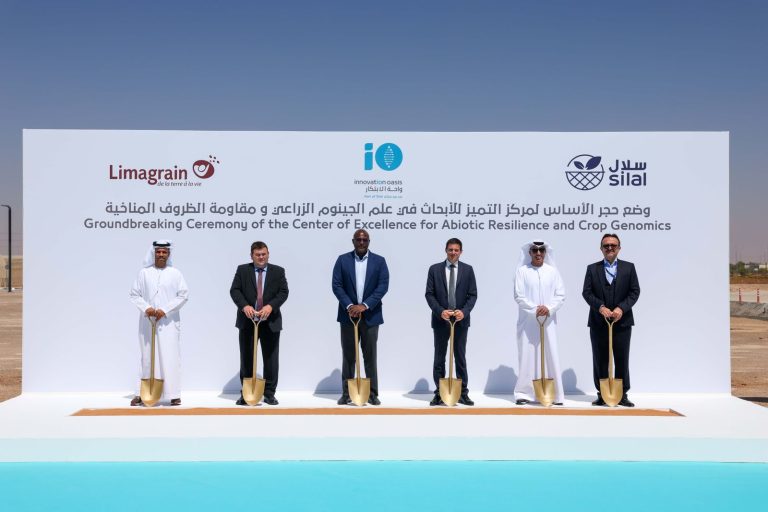
In early October 2025, this agreement took shape with the creation of a joint venture between Limagrain Vegetable Seeds and Silal, an Emirati agritech specialistxi. The result of this alliance is the Centre of Excellence for Abiotic Resilience and Crop Genomics (ARC-GEN) in the Al Ain region. The press release announcing this inauguration clearly states that this research centre aims to develop genetically modified vegetable plants that are able “to stand with extreme conditions such as heat, drought, and salinity“. To this end, scientists will draw on “advances in crop genomics, the study of plant DNA, to develop new vegetable varieties“. More specifically, “The GeneEditing Research Unit will apply advanced scientific techniques to refine plant genes and create stronger varieties with improved traits“.
Citing the promise of agriculture adapting to the challenges of climate change through the development of GMOs, Sébastien Vidal, President of Limagrain, welcomes this partnership between the UAE’s cutting-edge infrastructure and his company’s expertise in the field of seeds, believing that it will provide appropriate solutions “for the future of agriculture and food sovereignty, hand in hand, with respect for people, cultures, and shared values“.
This alliance between Limagrain and the UAE is in fact only a small part of the UAE’s overall strategy, which, by choosing agritech (vertical farming, hydroponics, controlled environment agriculture, robotics, etc.), aims to bring about a “disruption of food systems to be able to grow anything anywhere regardless of climate and environment“xii. Modifying living organisms to overcome soil and climate limitations, all in order to remain a “leader” in technological innovation and on international markets, is the reason given for the United Arab Emirates’ investments today. For its part, Limagrain makes no secret of its ambitions. Already present in 53 countries, the multinational company has positioned itself as a guarantor of food sovereignty, “disregarding all politics and bias“xiii. But the race for innovation and international partnerships could also be driven by a desire to gain market share at any cost, so as not to remain the fifth wheel in the global seed industry rankingsxiv…
i Limagrain, “Limagrain, via its subsidiary Vilmorin & Cie, has entered into exclusive discussions to build a strategic and financial partnership with ADQ on Vegetable Seeds“, 25 June 2025.
ADQ, “ADQ to acquire a strategic stake in Limagrain Vegetable Seeds and launch joint R&D partnership in UAE focused on the development of desert-adapted seeds”, 25 June 2025.
ii Vilmorin & Cie, “Vilmorin & Cie and KWS to sell North American Joint Venture AgReliant Genetics to GDM”, 27 June 2025.
iii Vilmorin & Cie, “Vilmorin & Cie has entered into exclusive discussions to build a strategic and financial partnership with ADQ on Vegetable Seeds”, 25 June 2025.
iv Denis Meshaka, « Limagrain, a “cooperative” that has always bet on GMOs », Inf’OGM, 12 May 2025.
v Mouhamed Ben Diene, « « Les semences … de véritables armes diplomatiques » », JA Mag, 19 March 2025.
vi ADQ, “01 ― What we stand for – Driving economic resilience“.
vii The “ABCD Group” refers to the four multinationals that share 70% of the global grain market (Archer Daniels Midland, Bunge, Cargill, Louis Dreyfus).
Laurie Debove, « Les ABCD, les 4 géants céréaliers, tirent des superprofits records de la crise alimentaire », La Relève et La Peste, 18 November 2022.
viii UAE, “National Food Security Strategy 2051”, updated on 30 December 2024.
ix Grain, “From land to logistics: UAE’s growing power in the global food system”, 3 July 2024.
x Rajaa Kantaoui, “Silal and Bayer announce partnership to drive innovation in agriculture”,Revista Cultivar, 5 December 2023.
xi Silal, “Silal partners with Limagrain Vegetable Seeds to launch Centre of Excellence for Abiotic Resilience and Crop Genomics”, 1st October 2025.
xii UAE Ministry of Climate Change and Environment, “A Guide to Food Security in the UAE“, 2023.
xiii Gaëlle Chazal, « Dans un monde qui se fracture, Limagrain “doit se rappeler que son métier est d’abord de nourrir les populations” », La Montagne, 21 June 2025.
xiv ETC Group & Grain, “Top 10 agribusiness giants: corporate concentration in food & farming in 2025”, 10 June 2025.
We need your help!
For over 25 years, Inf’OGM has been producing information, made freely available to everyone, on the artificialisation and appropriation of life (GMOs, NTGs, biotech, patents, etc.).
The monopolisation of a large share of public press subsidies by a few media groups reinforces the concentration of media ownership in the hands of a handful of businessmen. This concentration undermines the quality of information and democratic debate, which require a plurality of viewpoints.
In this context, alternative media outlets such as Inf’OGM, which receive no advertising revenue and provide information free of charge, need you – our readers – to continue to exist! Because, even when freely accessible, information comes at a cost.
Supporting Inf’OGM means working towards reliable, independent information on GMOs, biotechnology and seeds that is accessible to everyone.