
Biodiversity and stability of natural systems: what are the impacts of GMOs?
By Frédéric Jacquemart, Groupe International d’Études Transdisciplinaires (GIET)
Published on the 26/11/2025, modify the 09/03/2026


There is no shortage of observations of a living world in the process of destruction, with examples such as collapsing biodiversity and climate change. However, the solutions proposed and adopted by decision-makers in technophile countries are fueling this destruction, as in the case of GMOs. In the opinion piece published here by Inf’OGM, Frédéric Jacquemart calls for the implementation of a “global (systemic) assessment” that would “take into account the organization of the natural complex systems on which we depend in order to guide public decision-making”.
Western (globalized) civilization has developed and continues to develop increasingly diverse and powerful technologies. One of the observed results of this accelerated growth is the destruction of the living world… of which we are a part. The major challenges that arise from this (collapse of biodiversity, climate change, critical instability of societies) are a cause for concern among many scientists, policymakers, and the public. We would therefore expect questions to be asked about why and how such brilliant technoscience has led to the threat of mass species extinction and widespread violencei. However, quite the contrary, recognizing the problems and their extreme seriousness, solutions are being put in place to resolve them, constructed in the same terms as those that generated them. Something’s wrong? Let’s go harder and faster in the same direction. Obviously.
The field of GMOs is no exception to this brilliant strategy. In particular, think tanks have observed that genetically homogeneous crops inevitably lead to the emergence of pathogens that require even more pesticides, and are therefore implementing programs aimed at restoring cultivated biodiversity. How? By generating this biodiversity using tools known as “genome editing”, which in current practice means CRISPR/Cas. For example, there is a French program called Sélection Végétale Avancée (Advanced Plant Selection) with a budget of several million euros aimed at “ensuring the agroecological transition” by producing artificially diversified plants. As such a program was presented at one of the french ANSES’ committees, the following opinion was produced to fuel the debate. To give it credibility, it was submitted to a number of renowned scientists for co-signing. These signatures do not commit their authors to anything other than the scientific validity of the note and, in particular, not to the use made of it. Inf’OGM has decided to publish this opinion.
Note on biodiversity and the stability of natural systems
In the 1970s, following the work of Ilya Prigogine, among others, the theme of complex systems emerged, followed by adaptive systems. This raised questions about the stability, resilience, and adaptability of natural complex systems, which clearly maintain themselves despite their size and the disturbances they undergo.
At the time, there was much debate about whether the stability of systems depended on the diversity of their components, even though the term “biodiversity” was not introduced into ecology until the 1980s.
It is clear, for example, that the emergence of a pathogen in an ecosystem will cause less damage if it aims a diverse and redundant functional group than if it attacks a genetically homogeneous group, as is the case with current plantations in industrial agriculture and forestry.
However, with the pioneering work in this field by Gardner and Ashbyii, followed by Mayiii, it appears that, beyond a certain threshold, increasing the connectivity or variety of components reduces the stability of systems and ultimately even destroys them. The stability of ecosystems is therefore not directly linked to biodiversity understood as the diversity of species and genomes and, in the case of this work, non-historical.
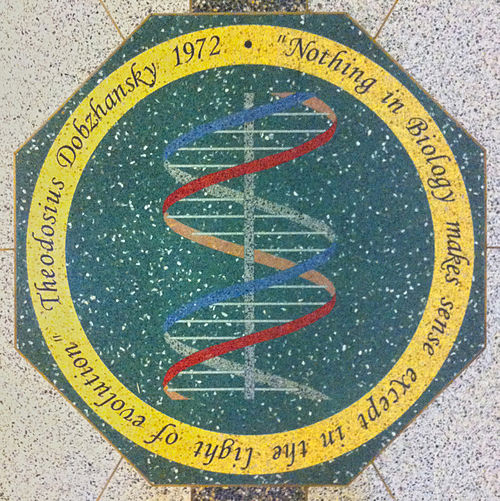
As Theodosius Dobzhansky wrote: “Nothing in biology makes sense except in the light of evolution”. The conclusions of Gadner, Ashby, May, and many others since then concerned a random rather than historical evolution of diversity and connectivity.
What makes the coherence of a natural complex system so immensely improbable is that any element that emerges during evolution is immediately confronted with the other elements of the system (general coevolution), in different ways depending on the scales and modules involved. In doing so, it produces at least local changes and persists if it proves to be compatible with the organization of the system, which is thus built step by step, historically. This historicity means that every change, every bifurcation occurring over time could have not happened or could have been different: events in a natural complex system are essentially contingent. On the other hand, although randomness is present at all stages and on all scales, these changes are not arbitrary, in the sense that randomness operates under restrictions and that any emergence is confronted with the totality of the system. This biodiversity (as observed) could have been different from what it is at a given moment, but it cannot be arbitrary, as in the case of the aforementioned models where, in fact, an increase in biodiversity via elements not derived from this autonomous evolutionary process alters or even destroys the stability of the systems.
In fact, tropical forest ecosystems, which have very high biodiversity, are stable and resilient, but so are temperate forest ecosystems with average biodiversity, and even very poor desert ecosystems are stable and resilient.
What makes a natural complex system stable and resilient is its organization, which, for ecosystems, translates into a certain level of biodiversity: this biodiversity has been historically shaped by the evolution of ecosystems. It is the biodiversity that we observe today and that must obviously be preserved in order to preserve their adaptability.
Due to the sheer number of possible connections, it is completely impossible for an external entity to intentionally generate a being that is consistent with a natural complex system. Introducing artificial beings into these systems would amount to randomly increasing diversity and therefore presents a high risk of destabilizing the system.
GMOs are precisely artificial living beings, random in relation to the organization of the ecosystems and societies into which they are introduced. Programs to introduce non-native plants (especially trees) that are supposedly drought-resistant are just as ecologically destructive, for the same reasons. In general, the transfer of living organisms from one geographical area to another cannot be done blindly, as is too often the case today, including for biological control purposes.
There is an urgent need to establish a global (systemic) assessment that takes into account the organization of the natural complex systems on which we depend in order to guide public decision-making.
Co-signatories (for the moment):
– Luc Abbadie, professor emeritus of ecology at Sorbonne University, former director of the Institute of Ecology and Environmental Sciences in Paris;
– Gilles Benest, doctor of ethology and ecology, honorary attaché at the National Museum of Natural History, honorary lecturer at Paris Diderot University;
– Bertheau Yves, Honorary Director of Research at INRA, National Museum of Natural History;
– Blandin Patrick, former professor of general ecology at the National Museum of Natural History, Honorary President of the French Committee of the IUCN;
– Blouin Manuel, professor of ecology at Agrosup Dijon;
– David Chavalarias, Director of the Paris-Ile de France Institute for Complex Systems;
– Myriam Ermonval, former Research Fellow in Virology at the Pasteur Institute;
– Pierre-Henri Gouyon, Professor Emeritus at the National Museum of Natural History and Agro Paris-Tech;
– Lecointre Guillaume, Director of the Systematics and Evolution Department at the National Museum of Natural History;
– Longo Giuseppe, Emeritus CNRS Research Director at the Cavaillès Interdisciplinary Center at the École Normale Supérieure (ENS) in Paris;
– Miquel Paul-Antoine, philosopher of biology, professor of contemporary philosophy at the University of Toulouse Jean Jaurès;
– Montévil Maël, research fellow at the CNRS, République des savoirs, USR 3608, École Normale Supérieure (ENS) Paris;
– Morand Serge, Director of Research at the CNRS (Institute of Evolutionary Sciences, Montpellier) and Associate Researcher at CIRAD (ASTRE);
– Petit Caroline, Centre Cavaillès, République des savoirs (UAR 3608) École Normale Supérieure;
– Sélosse Marc-André, Professor at the National Museum of Natural History;
– Soto Ana, Professor, Department of Immunology, Tufts University School of Medicine, Boston;
– Testart Jacques, Honorary Director of Research in Reproductive Biology at Inserm.
i This does not mean rejecting science or technology. These issues can be explored further if readers request it.
ii Gardner, M.R. and Ashby, W.R., “Connectance of large dynamic (cybernetic) systems: critical values for stability” Nature 238: 784, 1970.
iii May, R.M., “Will a large complex system be stable?”, Nature 238: 413-414, 1974.
We need your help!
For over 25 years, Inf’OGM has been producing information, made freely available to everyone, on the artificialisation and appropriation of life (GMOs, NTGs, biotech, patents, etc.).
The monopolisation of a large share of public press subsidies by a few media groups reinforces the concentration of media ownership in the hands of a handful of businessmen. This concentration undermines the quality of information and democratic debate, which require a plurality of viewpoints.
In this context, alternative media outlets such as Inf’OGM, which receive no advertising revenue and provide information free of charge, need you – our readers – to continue to exist! Because, even when freely accessible, information comes at a cost.
Supporting Inf’OGM means working towards reliable, independent information on GMOs, biotechnology and seeds that is accessible to everyone.