
News
Only three GMOs/NGTs are cultivated
By Eric MEUNIER
Published on the 04/08/2025, modify the 09/03/2026


At first glance, this finding may seem surprising. Only three GMOs obtained through new techniques of genetic modification are currently being cultivated and their harvest commercialized. The many promises of their benefits for health, the environment, and “competitiveness”, as well as the argument that they are already deregulated in many countries around the world, would suggest that these “miracle” products would have been more widely adopted. Clearly, this is not the case.
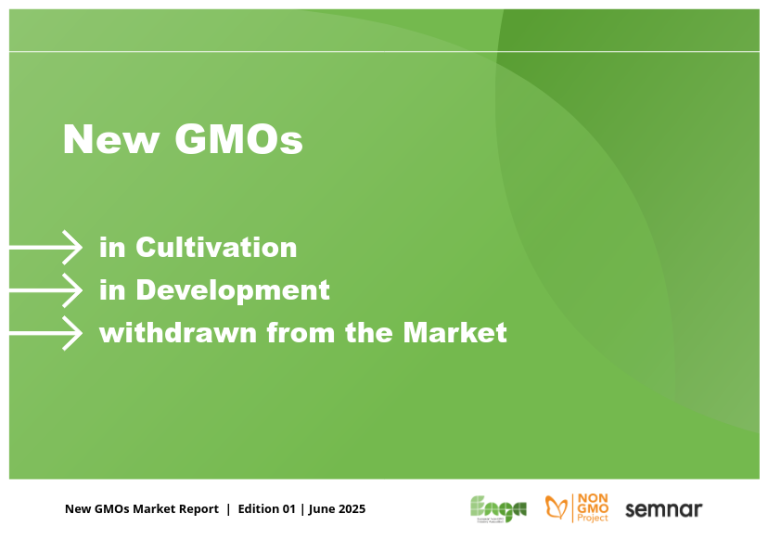
In early June, a report published by the German Association of Non-GMO Industries (ENGA), Non-GMO Projecti, and Eva Gelinskyii listed the plant GMOs obtained through new techniques of genetic modification (GMOs/NGTs) that are currently being cultivated and marketed. It also lists GMOs/NGTs that are not yet authorized for cultivation or are already authorized but whose harvest is not commercialized (under development), as well as those that have been withdrawn from the marketiii. For the authors, this report shows that “new GMOs are often a promise, but not a market reality”.
Three “new GMOs” grown commercially worldwide
Presented as a “concise overview of which New GMOs [operators in the GMO-free food chain] may need to deal with today and in the near future” the report lists three GMO plants, obtained through new techniques of genetic modification, that are grown and their harvests actually marketed.
Of these three GMOs/NGTs, two are corn varieties that have been made tolerant to herbicides (VrTH) and produce insecticides. Obtained through complex genetic modification protocolsiv using notably the CRISPR tool, these two varieties also contain transgenes. These are Corteva’s DP915635 and DP910521 corn varieties, both of which are authorized for import into the human and animal food chains in Europe.
The third GMO/NGT listed in the report is found in Japan. It is a tomato genetically modified by Sanatech using the CRISPR tool to produce a higher level of the amino acid γ-aminobutyric acid (known as GABA)v. However, this tomato is not authorized for import into the European Union, even though it appeared on supermarket shelves in Japan in 2024vi.
49 “new GMOs” in development
With regard to GMOs derived from new techniques of genetic modification and currently under development, the report provides a list of 49 GMOs/NGTs belonging to 20 different plant species (see Table 1), the vast majority of which were obtained using protocols involving the CRISPR tool.
According to the authors, these GMOs/NGTs are the work of a wider variety of companies (see Table 2) than those developing GMOs as we know them today, which are overwhelmingly the work of Corteva, Bayer, BASF, and Syngenta. While these multinationals are involved in the development of GMOs using new techniques of genetic modification, the report also identifies “many other companies and public institutions”. Another notable difference, according to the authors, is that these GMOs/NGTs are intended for human consumption, whereas until now, the vast majority of GMOs have been intended for use in “animal feed, processed food ingredients, fuel or clothing”. Above all, the authors emphasize that while the contribution of these GMOs/NGTs to the fight against climate change is a widely used argument for calling for their deregulation in Europe, only two of the 49 under development claim to have drought or salinity tolerance characteristics.
With regard to the United States, the authors of the report point out that this country accounts for 30 of the 49 GMOs/NGTs identified. Although several have already obtained commercial authorization, none of these 30 GMOs are currently being cultivated for commercial purposes. Many of these GMOs, moreover, “may never reach the market” the report states.
“New GMOs” already withdrawn from the market
As the authors of the report point out, it should be noted that “the first two New GMOs ever introduced to the market […] were economic flops”. These were a GMO rapeseed from Cibusvii and a GMO soybean from Calyxt. In addition to these commercial failures, the authors point out that Calyxt was acquired by Cibus, which is itself the subject of ongoing proceedings in the United States for “deceiving investors by ‘over-hyping’ its technology”.
The conclusion drawn by the authors of the report is quite simple and runs counter to the impressions suggested by the European Commission or multinationals in order to obtain the deregulation of GMOs/NGTs. For the authors, “new GMOs are often a promise, but not a market reality. Up to now, not a single plant contributes to sustainability. At the moment, the food sector is by no means faced with a flood of New GMOs, but only with individual plants“.
This report should provide interesting insight for European legislators pushing for the urgent deregulation of “new GMOs” on the grounds of their undeniable contribution to the fight against climate change, biodiversity loss, and even loss of competitiveness compared to countries that have supposedly adopted them.
| Plants | Number | |
| GMOs obtained by new genetic techniques and grown commercially | Maize | 2 |
| Tomato | 1 | |
| GMOs obtained by new genetic modification techniques under development (not cultivated or harvest not marketed) | Maize | 10 |
| Soya | 9 | |
| Rice | 6 | |
| Wheat | 3 | |
| Potato | 3 | |
| Camelina | 3 | |
| Sugar cane | 2 | |
| Horsetail | 2 | |
| Lettuce | 2 | |
| Sorghum | 1 | |
| Alfalfa | 1 | |
| Avocado | 1 | |
| Almond | 1 | |
| Banana | 1 | |
| Grape | 1 | |
| Strawberry | 1 | |
| Blackberry | 1 | |
| Watermelon | 1 | |
| GMOs obtained by new genetic modification techniques withdrawn | Canola | 1 |
| Soya | 1 |
| Companies | Number of dossiers | |
| GMOs obtained by new genetic techniques and grown commercially | Corteva | 2 |
| Sanatech | 1 | |
| GMOs obtained by new genetic modification techniques under development (not cultivated or harvest not marketed) | Corteva | 5 |
| Embrapa | 4 | |
| Inari | 3 | |
| Suzhou Qihe Biotechnology | 3 | |
| Green Venus | 3 | |
| Simplot | 3 | |
| Yield10 Bioscience | 3 | |
| GDM | 2 | |
| Cibus | 2 | |
| Bioheuris | 2 | |
| Pairwise | 2 | |
| Covercress | 2 | |
| Origin Agritech | 1 | |
| Weimi Biotechnology | 1 | |
| Amfora | 1 | |
| Shandong BellaGen Biotechnology | 1 | |
| KWS | 1 | |
| China Seed Group | 1 | |
| Insignium | 1 | |
| Biotechnology Company | 1 | |
| Indian Institute of Rice Research | 1 | |
| Indian Agricultural Research Institute | 1 | |
| Instituto Nacional de Tecnología Agropecuaria | 1 | |
| Calyxt | 1 | |
| Ohalo Genetics | 1 | |
| Tropic Bioscience | 1 | |
| Eto Life Sciences | 1 | |
| GMOs obtained by new genetic modification techniques withdrawn | Cibus | 1 |
| Calyxt | 1 |
i The Non-GMO Project was established in 2007 in the United States by two grocery stores wishing to organize themselves for a GMO-free supply chain and inform consumers through labeling.
ii Eva Gelinsky is as a freelance scientist. She is also co-coordinator of the Initiative for GMO-free Seeds and Plant Breeding (Germany, Austria, and Switzerland) and a member of the Federal Ethics Committee on Non-Human Biotechnology in Switzerland.
iii Hans Eisenbeis, Eva Gelinsky et Heike Moldenhauer, « New GMOs Market Report », Edition 01, June 2025.
iv For the GM maize DP915635, see :
Eric Meunier, « Transgenèse, Crispr/Cas9, ARNi… package total pour deux maïs OGM ! », Inf’OGM, 29 October 2024.
v Christophe Noisette, « Japon : des nouveaux OGM débarquent dans les assiettes », Inf’OGM, 22 November 2021.
vi Testbiotech, « CRISPR tomatoes now on the shelves », 5 February 2024.
vii Eric Meunier, « Colza Cibus : une mutation aux origines mystérieuses », Inf’OGM, 29 September 2020.
Eric Meunier, « Canola OGM : le gouvernement canadien au secours de Cibus », Inf’OGM, 10 November 2020.
We need your help!
For over 25 years, Inf’OGM has been producing information, made freely available to everyone, on the artificialisation and appropriation of life (GMOs, NTGs, biotech, patents, etc.).
The monopolisation of a large share of public press subsidies by a few media groups reinforces the concentration of media ownership in the hands of a handful of businessmen. This concentration undermines the quality of information and democratic debate, which require a plurality of viewpoints.
In this context, alternative media outlets such as Inf’OGM, which receive no advertising revenue and provide information free of charge, need you – our readers – to continue to exist! Because, even when freely accessible, information comes at a cost.
Supporting Inf’OGM means working towards reliable, independent information on GMOs, biotechnology and seeds that is accessible to everyone.